Our Top Picks
The best drone for most beginners in 2026 is a sub-249-gram GPS camera drone with return-to-home, obstacle sensing, replaceable propeller guards, and a spare battery; choose a smaller indoor-friendly model instead if you’ll mostly fly in a living room or backyard. The right pick depends less on headline camera resolution than on where you’ll fly, how much flight time you need, and what a damaged part will cost to replace.
Best beginner drones by flying situation
| Situation | Best fit | Why it suits a first-time pilot | Typical price range |
|---|---|---|---|
| Learning outside with a camera | DJI Mini 4K | GPS positioning, return-to-home, a stabilized 4K camera, and a sub-249 g takeoff weight | Usually $300–$450, depending on kit |
| More help avoiding obstacles | DJI Mini 4 Pro | Omnidirectional obstacle sensing adds protection in more directions than basic forward sensing | Usually $700–$1,100, depending on controller and kit |
| Practice indoors or in a small yard | Ryze Tello | Small, light, and less costly to repair than a camera-focused GPS drone | Usually $100–$200 |
| Learn manual flying and accept crashes | Beginner FPV kit, such as a BetaFPV Cetus series kit | Designed for close-range practice, often with a whoop-style drone and protective ducts | Usually $150–$400 |
Prices are broad U.S. market ranges, not current quotes; bundles, sales, and replacement parts change the total. Manufacturers’ advertised flight times are best-case figures. Wind, temperature, flight style, and reserve-battery settings usually reduce usable time.

Drone with 1080P Camera - Foldable Remote Control RC Quadcopter FPV Drone
Chosen because it specifies Foldable Remote Control RC Quadcopter FPV Drone.
View on Amazon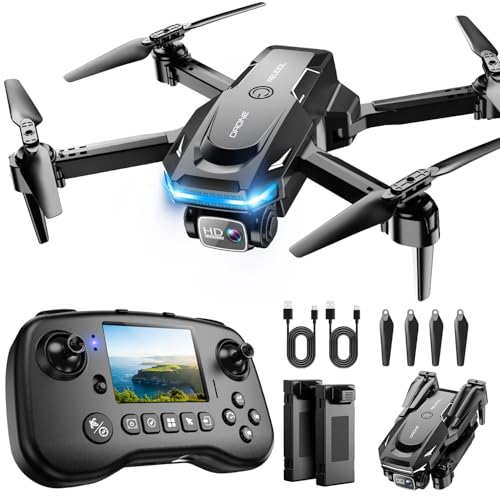
Drone with Camera, Screen on Controller Remote Control Quadcopter FPV Drone
Chosen because it specifies Screen on Controller Remote Control Quadcopter FPV Drone.
View on Amazon
1080P Drone with Camera for Kids & Adults Beginners, Foldable FPV Quadcopter with One Key Takeoff/Landing, Gesture Control, 360° Flips, 2 Batteries, Toy Gift for Teen Boys and Girls
Chosen because it specifies Foldable FPV Quadcopter with One Key Takeoff/Landing and Gesture Control.
View on Amazon
Drone with Camera & Screen on Controller, 1080P Foldable Drone for Adults Beginners, Control Quadcopter with Stable Altitude Hold, Gravity Control, Trajectory Flight, One Key Take Off, 2 Batteries, 3D Flips
Chosen because it specifies 1080P Foldable Drone for Adults Beginners and Control Quadcopter with Stable Altitude Hold.
View on AmazonWhat matters most before you buy
Flight time: plan around usable minutes
Camera drones commonly advertise roughly 30–45 minutes per battery under favorable conditions. For a new pilot, plan on about 20–30 practical minutes before landing with a sensible reserve. A spare battery can be more useful than a higher-resolution camera: it gives you another practice session without rushing to recharge. Tiny indoor drones often fly for only about 5–13 minutes, but their batteries are inexpensive and quick to swap.
Camera quality: stabilization beats resolution alone
A 4K label tells you the recording resolution, not whether footage will look smooth. For scenic photos and video, prioritize a mechanically stabilized gimbal, reliable GPS hover, and a camera angle you can adjust remotely. The DJI Mini 4K and Mini 4 Pro are camera-drone options with gimbal stabilization. A small toy drone may include a camera, but its footage and hovering ability are not a comparable substitute.
If you mainly want to learn steering, flying line of sight with a basic trainer can save money. Don’t pay for a camera you don’t expect to use.
Safety features: useful assistance, not collision-proofing
GPS hover and return-to-home help a beginner recover from a poor position or a weak connection, but return-to-home only works well when the home point and return altitude are set correctly. Obstacle sensing can reduce risk, yet it may miss thin branches, wires, reflective surfaces, or objects outside its detection directions. Propeller guards help with light bumps; they do not make a drone safe to fly near faces, pets, or fragile objects.
Read the specific model’s manual before flying. Check local rules as well: in the U.S., recreational pilots generally need to follow FAA requirements, including registration when applicable and TRUST completion. Rules vary by country and can change.
Control simplicity: GPS camera drone or manual trainer?
A GPS camera drone is usually easier to keep in place because it can hold position when you release the sticks. Beginners can practice gentle turns and short routes without constantly correcting drift. A small whoop-style FPV drone is more responsive and may require continuous input; that makes it rewarding practice, but a steeper first flight. Choose the control style that matches your goal rather than assuming every beginner needs the same kind of drone.
Repair costs: check the parts list first
On a camera drone, a cracked propeller is a relatively simple fix, while a damaged gimbal, camera, arm, or frame can mean a costly repair or service visit. Before buying, look up the manufacturer’s official replacement parts and repair options for that exact model. On small FPV trainers, propellers and frames are generally cheaper and easier to replace, but crashes are more frequent while learning. Budget for spare propellers and, if needed, a spare battery.
Head-to-head: DJI Mini 4K vs DJI Mini 4 Pro
Both are sub-249 g camera drones with stabilized 4K video and GPS-assisted flight. The Mini 4K is the simpler value choice for learning outdoors and capturing straightforward footage. The Mini 4 Pro costs more, but its omnidirectional obstacle sensing provides extra assistance when navigating around obstacles. That added sensing still does not replace a clear flying area, careful control, or a visual check of the drone’s path.
| Decision point | DJI Mini 4K | DJI Mini 4 Pro |
|---|---|---|
| Best for | Lower-cost outdoor camera flying | New pilots who want more obstacle-sensing assistance |
| Camera | 4K video with a 3-axis gimbal | 4K video with a 3-axis gimbal and more advanced shooting features |
| Obstacle sensing | Limited; do not expect all-direction collision avoidance | Omnidirectional sensing, subject to sensor limitations |
| Weight class | Under 249 g, depending on configuration and local rules | Under 249 g, depending on configuration and local rules |
| Cost trade-off | Lower initial cost; fewer advanced safety and camera features | Higher initial and potential repair costs |
For a first camera drone, the Mini 4K is the sensible pick if you can practice in an open area and want to keep the budget controlled. Choose the Mini 4 Pro if its added sensing and shooting features matter enough to justify the price. Neither is a good choice for indoor practice in a furnished room.
Where can a beginner safely practice?
Use the room dimensions below as practical planning guidance, not a guarantee of safety. A small indoor trainer can still strike a lamp, pet, or person, and a camera drone needs substantially more open space than its physical size suggests.
| Practice area | Suitable drone type | Practical space and clearance |
|---|---|---|
| Furnished 10 × 12 ft room | Small, ducted trainer only, and only when the room can be cleared | Keep at least 3–4 ft from people, pets, windows, lights, and furniture; avoid flying over anyone |
| Open garage or uncluttered large room | Small trainer | A clear area around 15 × 20 ft gives more room for basic hovering and turning |
| Open outdoor field | GPS camera drone or trainer | Start in a clear area at least 50 ft from bystanders and obstacles; follow local separation rules |
Remove breakables, switch on any propeller guards the manufacturer supports, and keep pets and children outside the practice area. Don’t fly a camera drone in a room merely because it has obstacle sensing: furniture, walls, and air currents make indoor control difficult, while its propellers can still cause injury or damage.
A simple first-flight plan
- Before takeoff: Read the manual, charge the battery, check propellers, set the return-to-home point and altitude, and confirm the area is permitted for flight.
- Start close: Take off in an open, wind-light area. Hover at a low, manageable height and practice small forward, backward, and sideways movements.
- Learn orientation: Practice turning the drone and bringing it back toward you. Controls can feel reversed when it faces you.
- Land early: Return with battery to spare rather than waiting for an urgent low-battery warning.
- Inspect afterward: Check propellers, arms, and guards for cracks or looseness before the next flight.
For most first-time pilots who want aerial photos, start with the DJI Mini 4K and one spare battery, then practice outdoors in a wide, open space. Pick the Mini 4 Pro if obstacle sensing is a priority and you’re comfortable with the extra cost. For indoor practice or a low-cost way to learn stick control, choose a small trainer instead—and leave camera-drone flying for outside.