Key takeaways
- Working height above all: The chuck should sit roughly at your sternum when the quill is retracted, so your forearm pulls the feed lever near horizontal. Adding a 1″ table raises your work surface, which means measuring your stance before you buy rather than after.
- Substrate stability: Dense MDF stays flat across seasons and won’t cup like solid stock; a rubber-wood or laminated bench top handles impact better. Either way, look for a sealed or melamine-faced surface — raw fiberboard drinks up humidity and swells around the T-track screws.
- Fence and T-track quality: Extruded aluminum fences resist the twist that steel-clad wood develops after repeated clamping. Check that T-tracks are inset flush and screwed into the substrate rather than glued, since that’s the first joint to fail.
- Replaceable zero-clearance insert: A sacrificial insert backs up the exit face of your cut, eliminating blowout and doubling as a wear part you can swap for pennies instead of resurfacing the whole table.
- Mounting and reach: Confirm the slot pattern matches your cast-iron table, and be honest about depth — a 24″ wide top only helps if you aren’t stretching past shoulder width to reach the flip stop.
What's inside
The stock cast-iron table that ships with most benchtop drill presses was designed around the machine, not around the person operating it. It’s small, slotted in awkward places, and offers nothing to register a workpiece against — so you end up pinching stock with one hand, feeding the quill with the other, and leaning in at a hunched angle to sight the bit. Do that for an afternoon of shelf-pin holes or dowel joinery and your lower back files a complaint long before your accuracy does. Tearout on the underside of every through-hole is the other tax you pay, because there’s nothing but air behind the exit point.
This guide looks at drill press tables from two angles I care about professionally: how the setup loads your body over a long session, and how the materials hold their geometry after a few hundred cycles of clamping, drilling, and re-squaring. I’ve grouped dedicated aftermarket tables alongside a few presses whose factory tables are genuinely worth building on, plus a height-adjustable bench that solves the ergonomic half of the problem at its root. Fit matters more than feature count here, so pay attention to swing, column clearance, and mounting slots before anything else.
As an Amazon Associate we earn from qualifying purchases.



🛒 Best Price Today on Amazon
Prime members get fast, free shipping on everything above, plus member-only deals. New members get a 30-day free trial — cancel anytime.
How to Choose a Drill Press Tables (2026)
- Working height above all: The chuck should sit roughly at your sternum when the quill is retracted, so your forearm pulls the feed lever near horizontal. Adding a 1″ table raises your work surface, which means measuring your stance before you buy rather than after.
- Substrate stability: Dense MDF stays flat across seasons and won’t cup like solid stock; a rubber-wood or laminated bench top handles impact better. Either way, look for a sealed or melamine-faced surface — raw fiberboard drinks up humidity and swells around the T-track screws.
- Fence and T-track quality: Extruded aluminum fences resist the twist that steel-clad wood develops after repeated clamping. Check that T-tracks are inset flush and screwed into the substrate rather than glued, since that’s the first joint to fail.
- Replaceable zero-clearance insert: A sacrificial insert backs up the exit face of your cut, eliminating blowout and doubling as a wear part you can swap for pennies instead of resurfacing the whole table.
- Mounting and reach: Confirm the slot pattern matches your cast-iron table, and be honest about depth — a 24″ wide top only helps if you aren’t stretching past shoulder width to reach the flip stop.
The Best Drill Press Tables (2026)s Reviewed
O’SKOOL DAB022 Drill Press Table
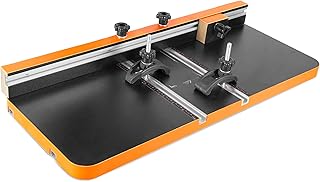
At 23-5/8″ x 15″ x 1″, this MDF top gives you real support for long stock without turning your press into a tripping hazard, and the aluminum fence with flip stop is the piece that saves your shoulders on repeat holes. The replaceable insert and dual T-tracks are the durability story: consumables wear out, the table doesn’t.
WEN DPA2513 24-by-12-Inch Table
A slimmer 12″ depth keeps the fence and stop block within easy arm’s reach, which is the right call for anyone with a compact bench or limited shoulder mobility. The adjustable fence holds position well under moderate clamping, though I’d treat it as a precision aid rather than a heavy production fixture.
JET JWDP-12 Benchtop Drill Press
JET’s variable-speed 1/2 HP head is the smoothest of the group, and the factory table is machined flat enough that an aftermarket top mounts without shimming. If you’re building a long-term station rather than patching one together, start here.
WORKPRO 48″ Adjustable Workbench
Five height settings and a 2,000 lb rubber-wood top mean you can dial the chuck to your own stature instead of adapting to a fixed bench, which is the single highest-leverage ergonomic fix available. Built-in outlets also kill the cord-across-the-work-surface habit that snags stock mid-cut.
VEVOR 12-Inch Benchtop Drill Press (6.2 Amp)
The 1 HP motor and 530–3140 RPM range cover wood and mild steel comfortably, and the 0–45° tilting worktable saves you from improvising angled jigs. Laser and LED lighting reduce the head-craning that quietly wrecks your neck over long sessions.
Frequently Asked Questions
Will an aftermarket table fit my press?
Most bolt to the existing cast-iron table through its slots, so measure slot spacing and overall table dimensions first. Presses with a 12″ swing or larger are the safest match for full-size tops.
Does adding a table reduce my drilling depth?
Yes — a 1″ top costs you 1″ of quill travel clearance. Factor that in if you regularly drill thick stock, and remember you can lower the table on the column to compensate.
MDF or plywood?
MDF wins on flatness and screw-holding for fence hardware; plywood wins on moisture resistance. For most shops, sealed MDF is the more predictable long-term surface.
How often should I replace the insert?
Swap it once the bore has opened up enough to stop supporting fibers — typically after a few dozen through-holes in the same spot. Keeping spares on hand is cheaper than resurfacing.
Final Thoughts
For most home shops, the O’SKOOL DAB022 delivers the best combination of flat substrate, real aluminum fence, and replaceable insert at a sensible footprint, while the WEN DPA2513 is the smarter pick if bench depth or reach is your constraint. Pair either with the WORKPRO adjustable workbench and you’ve addressed both halves of the problem: a table that stays true, at a height that keeps you working comfortably.