Key takeaways
- Clearance over the table: Aim for roughly 30 to 36 inches between the tabletop and the lowest point of the fixture, and never less than 7 feet from the floor at the blade edge. A fan hung too low creates a head-strike hazard on the chair side of the table; hung too high, the light pool spreads thin and washes out.
- Seated glare control: Check whether the LED panel is diffused, caged with an opal shade, or exposed. Exposed diodes at eye level cause squinting and genuine eye fatigue over a long meal. Dimmable drivers with a wide 3000K to 6500K range let you drop to warm, low output for dinner and push cool and bright for homework or board games.
- Motor type and expected service life: DC motors run cooler, draw less current, and avoid the start capacitor that is the usual first failure point on cheap AC fans. They also give you finer speed granularity, which matters when speed 1 needs to be genuinely gentle.
- Blade span versus room size: Match the sweep to the space, not the table. Rooms up to about 100 square feet suit 20 to 30 inch fans; 42 to 48 inches fits most standard dining rooms; 52 inches suits open-plan spaces above 225 square feet. Oversizing creates a draft that stirs steam off plates and chills whoever sits directly beneath.
- Serviceability and cleaning access: Kitchen-adjacent rooms coat blades in a fine grease film. Look for smooth, sealed blade surfaces and shades that come off without a screwdriver. Retractable and caged designs vary widely here, so confirm before you commit to something you cannot reach.
What's inside
A dining room is the one place in the house where people sit still, look up, and stay put for an hour or more. That changes the engineering problem entirely. In a bedroom a fan just has to move air quietly; over a table it has to move air without ruffling napkins, illuminate food without glaring into anyone’s seated sightline, and hang low enough to feel intentional but high enough that nobody clips a blade while standing to pass a dish. Most shoppers discover the mismatch only after installation, when the light hits their eyes at exactly the wrong angle or the fan on speed 3 turns a candle into a strobe.
This guide looks at dining fans the way a durability tester would: how the motor is likely to age, whether the blade assembly stays balanced after a few thousand hours, how the light performs from a seated eye level rather than from a ladder, and how easy the thing is to wipe down after a winter of cooking vapor. The picks below cover caged fandeliers, crystal statement pieces, low-profile farmhouse flush mounts, and retractable-blade models for rooms with tight ceilings.
As an Amazon Associate we earn from qualifying purchases.


🛒 Best Price Today on Amazon
Prime members get fast, free shipping on everything above, plus member-only deals. New members get a 30-day free trial — cancel anytime.
How to Choose a Dining Room Ceiling Fan With Light (2026)
- Clearance over the table: Aim for roughly 30 to 36 inches between the tabletop and the lowest point of the fixture, and never less than 7 feet from the floor at the blade edge. A fan hung too low creates a head-strike hazard on the chair side of the table; hung too high, the light pool spreads thin and washes out.
- Seated glare control: Check whether the LED panel is diffused, caged with an opal shade, or exposed. Exposed diodes at eye level cause squinting and genuine eye fatigue over a long meal. Dimmable drivers with a wide 3000K to 6500K range let you drop to warm, low output for dinner and push cool and bright for homework or board games.
- Motor type and expected service life: DC motors run cooler, draw less current, and avoid the start capacitor that is the usual first failure point on cheap AC fans. They also give you finer speed granularity, which matters when speed 1 needs to be genuinely gentle.
- Blade span versus room size: Match the sweep to the space, not the table. Rooms up to about 100 square feet suit 20 to 30 inch fans; 42 to 48 inches fits most standard dining rooms; 52 inches suits open-plan spaces above 225 square feet. Oversizing creates a draft that stirs steam off plates and chills whoever sits directly beneath.
- Serviceability and cleaning access: Kitchen-adjacent rooms coat blades in a fine grease film. Look for smooth, sealed blade surfaces and shades that come off without a screwdriver. Retractable and caged designs vary widely here, so confirm before you commit to something you cannot reach.
The Best Dining Room Ceiling Fan With Light (2026)s Reviewed
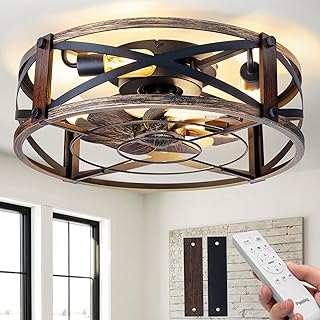
Passky 20″ Caged Low Profile Fandelier
The cage does real ergonomic work here: it shields the LED module so the light reaches the table without a hard hotspot in anyone’s line of sight, and the 20-inch sweep keeps airflow modest enough for a small breakfast nook. Reversible DC motor, six speeds, and timer settings make it a sensible pick for low ceilings where every inch of clearance counts.
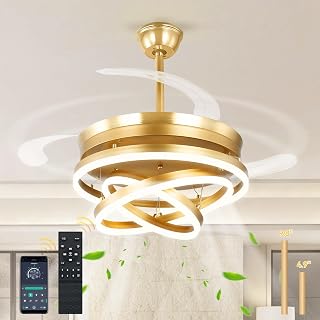
48″ Rose Gold Crystal Fandelier
This is the decorative option that still functions as a fan, with a 48-inch span suited to a standard dining room and dimming that lets the crystal read as warm sparkle rather than glare. Budget time for cleaning: faceted acrylic and glass elements hold dust and cooking residue more than a flat shade does.
52″ Flush Mount Farmhouse Fan with 3-Light
The strongest airflow performer of the group and the right choice for open-plan dining areas past 225 square feet. Flush mounting preserves headroom, and the three-light cluster spreads illumination across a long table more evenly than a single central panel, which is where many wide fans fall short.
30″ Retractable Brushed Nickel Fan Light
With blades retracted it reads as a flush ceiling light, which solves the awkward problem of a fan dominating a small formal dining room. The 3000K to 6500K tunable output and six speeds give it real range, though retraction mechanisms add moving parts, so treat quiet operation and smooth extension as your key inspection points on arrival.
addlon 24″ Low Profile Fandelier
App control plus a memory function means the fixture returns to your preferred warmth and speed without fiddling, a small ergonomic win you notice every evening. The wider airflow design compensates for the compact 24-inch span, making it a strong fit for tight or low-ceilinged dining spaces.
Frequently Asked Questions
How far above a dining table should a ceiling fan hang?
Keep the fixture bottom 30 to 36 inches above the tabletop, with at least 7 feet of floor clearance at the blade tips. Center it over the table rather than the room if the two do not align.
Will a ceiling fan blow out candles or disturb the table?
On low speeds, no. Six-speed DC models are the safer bet because speed 1 is genuinely gentle, whereas three-speed AC fans often start too strong for a dining setting.
What color temperature works best over a dining table?
3000K or warmer flatters food and skin tones and reduces visual fatigue during long meals. Tunable fixtures let you shift cooler for tasks without committing to one setting.
Are retractable-blade fans as durable as fixed-blade models?
Quality varies more, since the extension mechanism adds wear points. Check for smooth, even deployment during the first week and listen for ticking, which signals a blade that is not seating fully.
Final Thoughts
For most standard dining rooms, the 48″ Rose Gold Crystal Fandelier delivers presence and adequate sweep in one fixture, while the 52″ Flush Mount Farmhouse model is the better durability-per-dollar choice in larger open-plan spaces. If your ceiling is under 8 feet, the Passky 20″ Caged Fandelier handles glare and clearance more gracefully than anything else here.