Our Top Picks
For most home offices, a desk with two or three built-in drawers and a depth of about 24 inches is the safest all-round choice, while a compact writing desk with one shallow center drawer suits small rooms and light laptop work, and a pedestal or executive desk suits anyone who stores files and supplies. The right pick depends less on brand than on how much you need to store, how much floor space you have, and whether you want drawers that lock or glide on full-extension slides.
Desks with Drawers at a Glance
| Desk type | Best for | Typical stated features | Limits |
|---|---|---|---|
| Compact writing desk, one center drawer | Small bedrooms, laptop users, students | Width often listed between 40 and 48 inches; shallow pencil drawer | Little storage; drawer holds stationery, not files |
| Desk with side drawer stack (2 to 3 drawers) | General home office, mixed paper and gear | Makers commonly list 40 to 60 inch widths and 22 to 30 inch depths | Drawer side can eat knee room; some are fixed left or right |
| Pedestal desk with file drawer | Document-heavy work, tax and school records | File drawers sized for letter or legal folders when the maker says so | Heavy and bulky; assembly takes longer |
| Executive or L-shaped desk with drawers | Dual monitors, large workspaces | Wide return surface plus one or two drawer units | Needs a big room; shipped weight is high |
| Standing or height-adjustable desk with drawer | Anyone alternating sitting and standing | Electric frame; drawer often attached under the top or as a separate unit | Drawers add weight to the frame; check the lift rating |
| Secretary or hutch desk | Tight spaces, closed-door storage | Fold-down or enclosed work surface with drawers below | Smaller work area; less suited to two monitors |
Start with Size and Room Fit
Measure the wall where the desk will sit and leave room to pull the chair out and open the drawers fully. A drawer that cannot open all the way is a drawer you will stop using. As a general planning rule, allow roughly 36 inches of clear floor behind the chair for comfortable movement, and more if the door swings into the same area.

Lufeiya Computer Desk with File Drawers Cabinet, 47 Inch Reversible Home Office Desks with Filing Cabinet for Small Space, Gaming Study Writing Table PC Desks, Black
Chosen because it specifies Gaming Study Writing Table PC Desks and Black.
View on Amazon
Casaottima 48 Inches Computer Desk with 8 Fabric Drawers, Modern Office Desk with Large Storage for Home Office, Study, White
Chosen because it specifies Modern Office Desk with Large Storage for Home Office and Study.
View on Amazon
Somdot Computer Desk with Power Outlet and LED Lights, Desk with 6 Drawers | Desk with 6 Drawers, Kids Desk with Monitor Stand for Gaming Home Office Writing Study, Metal Frame, Easy to Assemble, White
Chosen because it specifies Desk with 6 Drawers and Desk with 6 Drawers.
View on Amazon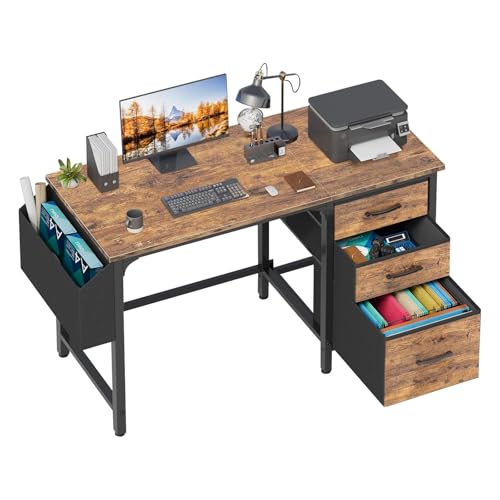
Lufeiya Computer Desk with File Drawers Cabinet, 47 Inch Reversible Home Office Desks with Fabric Filing Cabinet for Small Space, Study Writing Table PC Desks, Rustic Brown
Chosen because it specifies Study Writing Table PC Desks and Rustic Brown.
View on AmazonDesk depth matters for screens. A depth near 24 inches is usually enough for a laptop or a single monitor. If you want two monitors or a monitor plus a writing area, look for 28 to 30 inches or an L-shaped layout. Many makers list the exact interior drawer dimensions as well as the outer size; if you plan to store a laptop or letter-size folders, check that number rather than assuming.
Knee clearance is the detail most buyers overlook. With a drawer stack on one side, the open leg space may be only 20 to 24 inches wide. If you sit with legs crossed or use a footrest, a desk with a single center drawer, or one with a separate rolling cabinet you can move aside, will feel roomier.
Materials and Construction
Solid wood
Solid hardwood desks, often oak, walnut or rubberwood, are the most durable and can be refinished. They are also heavy and sit at the premium end. Look for makers that describe dovetail or similar joinery on drawers, as this is generally stronger than stapled corners.
Engineered wood (MDF, particleboard, plywood)
Most desks in the budget and mid-range tiers use engineered wood with a laminate or veneer surface. These are lighter and cheaper, and they hold up well to daily use if assembled carefully. Their weak points are moisture and repeated disassembly. Reviewers frequently note that cam-lock fittings loosen if a desk is moved several times, so plan to place it once and tighten fasteners after the first few weeks.
Metal and mixed-material frames
Steel legs with a wood-look top give a stable base at moderate cost. Check the leg finish and the levelers: adjustable feet help on uneven floors and stop rocking, which wears joints over time.
Drawer Quality Checklist
- Slides: Metal ball-bearing slides with full extension let you reach the back of the drawer. Basic roller or wood-on-wood glides are fine for light items but can stick over time.
- Stops and soft-close: Drawer stops prevent a loaded drawer from falling out. Soft-close is a convenience, not a necessity.
- Bottom panel: A thin hardboard bottom can sag under heavy files. Makers sometimes state a per-drawer weight capacity; use it as a guide.
- Locks: If you keep financial or personal documents, a lock helps deter casual access, but desk locks are not a substitute for a safe or lockable cabinet for valuables.
- Organizers: A shallow top drawer with a removable tray keeps cables, pens and chargers sorted.
Budget Tiers and Trade-offs
| Tier | What you usually get | Trade-off |
|---|---|---|
| Budget | Laminate or particleboard top, light frame, basic glides, simple assembly | Lower weight capacity; drawers may rattle; avoid frequent moves |
| Mid-range | Thicker top, metal slides, better finishes, wider range of sizes | Still mostly engineered wood; assembly time rises |
| Premium | Solid wood or high-grade veneer, dovetail drawers, full-extension slides, refinishable surface | Heavy, harder to move, longer delivery and assembly |
Pick X If…
| Pick this | If you… |
|---|---|
| Compact writing desk with a center drawer | Have a small room, work on a laptop, and keep few supplies |
| Desk with a two or three drawer stack | Need everyday storage for chargers, notebooks and some paper |
| Pedestal or file-drawer desk | Keep hanging folders and printed records close at hand |
| L-shaped or executive desk | Use multiple monitors and have a large room |
| Height-adjustable desk with drawer | Alternate sitting and standing and want some storage |
| Solid wood desk | Plan to keep the desk for many years and can accept the weight and cost |
Assembly, Safety and Care
Follow the maker’s manual for assembly order, and use two people when the desk top or drawer unit is heavy. Do not load drawers beyond the stated capacity; overloaded top drawers on tall units can make a desk less stable. If a desk includes a tall hutch or shelf unit and you have children or pets, use the supplied wall anchors where the maker provides them.
For electrical items, route cables through grommets instead of pinching them in drawer slides. Do not run power strips inside a closed drawer where heat can build up, and keep any strip within the limits printed on its label. If you are unsure about adding outlets or built-in power, ask a licensed electrician.
To clean laminate, wipe with a slightly damp soft cloth and dry immediately. For wood, use a product the maker approves, avoid standing water, and use coasters and a desk pad to protect the finish. Wax or lubricate metal slides lightly only if the maker suggests it.
Alternatives to a Desk with Built-in Drawers
- Desk plus rolling cabinet: A plain desk and a separate mobile drawer unit give flexibility. You can move the cabinet to either side or tuck it under the desk, and it can be reused if you change desks later.
- Console table or vanity used as a desk: Shallow, stylish, and often has a drawer. Check depth and chair clearance, since many are meant for display rather than daily computer use.
- Floating wall desk with a drawer: Saves floor space in a bedroom or hallway nook. It must be mounted into studs or with anchors rated for the load, and a licensed installer is wise if you are unsure.
What Reviewers and Makers Tend to Agree On
Across furniture outlets and maker listings, a few themes recur. Drawers are the first thing to fail on cheaper desks, usually at the slides or the thin back panel. Wobble is usually fixed by tightening hardware and using levelers rather than by buying a different desk. And the stated dimensions on the product page are the most reliable guide to fit, so compare them with your own measurements before ordering. Treat marketing phrases such as “heavy duty” cautiously unless the maker gives a weight rating.
Frequently Asked Questions
How many drawers do I need in a home office desk?
Two or three is enough for most people. One shallow drawer holds small tools and cables, and a deeper one holds notebooks or folders. Only add a dedicated file drawer if you keep a meaningful amount of paper.
What desk depth is best if I use a monitor?
About 24 inches suits a laptop or one monitor for most people. If you sit close to a large screen or use two, a depth of 28 to 30 inches gives more comfortable viewing distance. Always compare the maker’s listed depth with your space.
Are engineered wood desks a bad choice?
No. They are common and affordable, and they perform well when assembled correctly and kept dry. Their limits are lower weight capacity and less tolerance for moving and re-assembly, so they suit a desk that stays in one place.
Do desk drawers with locks keep documents secure?
They deter casual access, but they are not designed to resist determined entry. For passports, financial records or valuables, use a purpose-built lockable cabinet or safe and follow its instructions.
Can I put a power strip in a desk drawer?
It is best not to. Closed drawers trap heat, and cables can be crushed by the slides. Mount the strip on the desk leg or underside as the strip’s instructions allow, and consult an electrician if you need more outlets.
How do I stop a desk from wobbling?
Check that all bolts and cam locks are fully tightened, adjust the levelers if the desk has them, and make sure the floor is even. If wobble persists, a corner brace or a rug pad under the feet can help, provided the maker allows modification.
More from Amazon
Programs that pair well with the guide above. Offers and eligibility are set by Amazon and may change.
Collect the home and kitchen items you want in one registry that guests can shop from.
Create a wedding registrySet up recurring deliveries of everyday items on eligible products. Terms and savings are set by Amazon.
Explore Subscribe & SaveFree shipping on eligible items, Prime Video and more. Eligible new members can start with a free trial.
Start a Prime free trialAudiobooks and podcasts to listen to on the go. Eligible new members can start with a free trial.
Try Audible freeAs an Amazon Associate we earn from qualifying purchases.