Our Top Picks
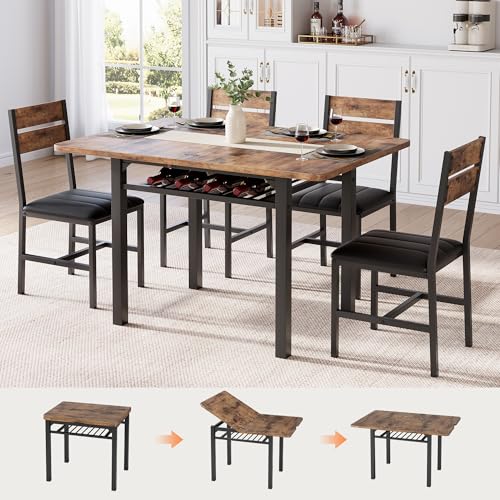 MapleGrace Extendable Dining Table Set for 4 with47.2"L x 31.5"W x 30"H47.2 x 31.5 x 30 inches81 poundsCheck on Amazon
For most apartments and breakfast nooks, a round or drop-leaf table with two to four chairs or a bench is the safest fit, while a counter-height set with stools suits very tight kitchens and a bench-style set suits narrow rooms where seating needs to tuck fully away. The right choice depends less on style than on three measurements: the floor area available, the clear walking path around the table, and how often more than two people eat at once.
Dining Table Sets for Small Spaces at a Glance
| Set type | Best for | Typical seating | Main limit |
|---|---|---|---|
| Round pedestal table with chairs | Tight squares, corners, studio apartments | 2 to 4 | Hard to extend; pedestal base can limit knee room |
| Drop-leaf or gateleg set | Rooms used for several purposes | 2 to 6 when opened | Leaf hinges and supports need regular checking |
| Extendable rectangular set | Households that host occasionally | 4 to 6 when extended | Needs clear floor space on both ends when open |
| Table with built-in bench | Narrow rooms and wall-side placement | 3 to 4 | Less comfortable for long meals; harder to move in and out |
| Counter-height (pub) set | Kitchens with an open edge or small island | 2 to 4 | Stools are taller; not ideal for young children or limited mobility |
| Wall-mounted or fold-down table | Micro-apartments | 1 to 4 | Needs solid wall mounting; limited surface when folded |
Measure Before You Browse
Furniture guides from home retailers and interior outlets commonly suggest leaving roughly 36 inches between the table edge and the nearest wall or furniture so a person can pull out a chair and still pass behind it. In a very tight space, 30 inches may be workable if the path is not a main walkway. Measure the room, mark the table footprint with painter tape on the floor, and sit in an imagined chair position to see whether the layout feels workable.

Azomabox Dining Table Set for 4, 3-Piece Kitchen Table with 2 Benches, Grey | Modern Dining Table Set for Space-Saving, Apartment, Breakfast Nook, Samll Space, Kitchen, Easy Assembly
Chosen because it specifies 3-Piece Kitchen Table with 2 Benches and Grey.
View on Amazon
FAVSH Dining Table Set for 4, Kitchen Table with 2 Benchs, Grey | Modern Functional 3 Piece Space-Saving Dining Room Table Set for Apartment, Breakfast Nook, Small Space
Chosen because it specifies Kitchen Table with 2 Benchs and Grey.
View on AmazonMapleGrace Extendable Dining Table Set for 4 with Built-in Shelf Rack Brown | Kitchen Table Set with 4 PU Leather Upholstered, Wood Dining Room Chairs for Dining & Small Spaces
Chosen because it specifies Kitchen Table Set with 4 PU Leather Upholstered and Wood Dining Room Chairs for Dining & Small Spaces.
View on Amazon
5 PCS Farmhouse Dining Table Set for 4,60" Large Folding Dining Table Set w/ 4 Leather Chairs, Drop Leaf Foldable Kitchen Table for Small Spaces,Barn Door Design,6 Wheels,2-Layer Storage Shelf,Brown
Chosen because it specifies 60" Large Folding Dining Table Set w/ 4 Leather Chairs and Drop Leaf Foldable Kitchen Table for Small Spaces.
View on AmazonAlso measure doorways, stairwells and elevators. Many small-space sets ship flat and need assembly, but some pre-assembled tables will not pass through narrow entries. Check the stated assembled dimensions and the packaged dimensions on the maker’s product page.
Table Shapes and What They Do in Small Rooms
Round and oval tables
A round table has no corners to bump into and lets people seat closer together. Makers of pedestal tables typically list diameters in the range of 30 to 42 inches for two to four seats. A single central pedestal leaves legs out of the way, but a wide pedestal base can interfere with chair placement. Reviewers often point out that a round table’s seating count is not flexible: squeezing in an extra person is harder than on a rectangle.
Square and small rectangular tables
Square tables around 30 to 36 inches per side suit two to four people and push easily into a corner. Narrow rectangular tables, sometimes listed at about 24 to 30 inches deep, fit along a wall or behind a sofa, but diners may find the surface too shallow for shared dishes.
Drop-leaf and extendable tables
Drop-leaf designs fold two sides down to leave a narrow strip and open up when guests arrive. Extendable tables with a butterfly leaf or sliding top offer a larger surface without permanent floor use. Look for a locking mechanism on the leaf and test the movement each time you extend it; a leaf that wobbles or sags is often a sign of weak hardware. If you rarely host, a smaller fixed table with a few folding chairs in a closet can be simpler and sturdier.
Chairs, Stools and Benches
Chairs account for as much visual bulk as the table. Armless chairs with slim legs slide fully under the tabletop and take less floor area than chairs with arms. Backless stools tuck even further, though they are less comfortable for long meals and offer no support for children or older adults. Benches save room on a wall side but make it harder for the person in the middle to leave without others moving.
Chair seat height is typically around 17 to 19 inches for standard tables, and standard table height is around 28 to 30 inches. Counter-height tables are around 34 to 36 inches with stools roughly 24 to 26 inches. Check that the apron (the frame below the tabletop) leaves enough clearance for thighs; makers may list apron height or knee clearance.
Materials and Construction
- Solid wood: durable and repairable, but heavier and usually in the mid-range or premium tier. Wood can show seasonal movement.
- Engineered wood (MDF or particleboard with veneer or laminate): common at the budget tier and lighter to move; edges and corners can chip, and standing water can cause swelling. Wipe spills quickly.
- Metal frames: thin steel legs save space visually and are common in industrial-style sets; check the weight capacity the maker states.
- Glass tops: make a room feel more open, but fingerprints show and edges need care around children. Look for tempered glass and rubber feet or pads.
- Marble or stone-look surfaces: check whether the surface is real stone or a printed laminate, and follow the maker’s cleaning instructions because some stones stain easily.
Budget Tiers
| Tier | What you usually get | Trade-offs |
|---|---|---|
| Budget | Engineered wood, flat-pack assembly, metal legs, basic upholstered or plastic chairs | Lower weight capacity, finish wears faster, hardware can loosen and need re-tightening |
| Mid-range | Mix of solid wood frames and veneer tops, better chair padding, drop-leaf or extension hardware | Heavier; more finishes to choose from; assembly may still be required |
| Premium | Solid hardwood, stone or specialist finishes, tested joinery, matching benches or storage | Larger investment; may be larger than a true small-space footprint |
Well-Known Sources to Look At
Several established furniture makers publish small-space dining lines. Ashley Furniture and Winsome Wood list compact bistro and drop-leaf sets, IKEA lists small tables such as extendable and gateleg designs, and Coaster, Linon and Safavieh list pub and bistro sets across many price points. Treat these as starting points: model lineups change often, so read each maker’s current product page for stated dimensions, materials and weight limits before deciding. Independent outlets such as Wirecutter, Real Simple and Apartment Therapy periodically publish small-space dining roundups that are useful for comparing real-life reports on stability and finish quality.
Safety and Care Notes
- Anchor wall-mounted or fold-down tables only to studs or with anchors rated for the load, as directed by the manual.
- Tighten leg bolts after the first few weeks of use, then again occasionally. Flat-pack hardware commonly loosens.
- Use felt pads under chair legs on hard floors to prevent scratches.
- Wipe spills promptly, especially on engineered wood and stone-look tops. Use coasters and trivets for hot items.
- With glass tops, avoid placing very hot pans directly and check the maker’s stated weight limit.
- For households with toddlers, rounded corners and a stable pedestal base are worth prioritizing.
Pick X If… Decision Table
| Pick this | If |
|---|---|
| Round pedestal set | Your space is roughly square and you usually seat two to four people |
| Drop-leaf set | The dining area doubles as a workspace or walkway and you host only occasionally |
| Extendable rectangular set | You host regularly and have clear space on both ends when open |
| Bench set | The table sits against a wall and you need to seat children or extra guests |
| Counter-height set | You want a breakfast bar feel and dining overlaps with a kitchen counter |
| Wall-mounted or fold-down table | Floor space is extremely limited and the wall can handle the load |
Alternatives to a Full Dining Set
- Bar cart or console that converts to a table: a narrow console that extends can act as a dining table for four.
- Breakfast bar or counter extension: a wall-attached counter with two stools keeps the floor open.
- Bistro table plus folding chairs: a compact table with chairs stored away between meals, a common choice for very small flats.
Frequently Asked Questions
How big should a dining table be for two people?
Makers commonly list tables of about 24 to 30 inches across for two seats, though a 30 to 36 inch table is more comfortable for sharing plates. Aim for at least 24 inches of table width per person for comfortable elbow room. If the space is tight, a round table of about 30 inches is a common choice.
Are round tables better than square for small rooms?
Round tables remove corners and let diners sit slightly closer together, which suits tight squares and corners. Square or rectangular tables fit better against walls. The best choice depends on the room’s shape and how much walking space you need around it.
Can a dining table double as a desk?
Yes, many people use drop-leaf or small rectangular tables for both. Choose a stable base and a surface at standard table height, and consider a separate supportive chair if you will sit for long periods. If you have back or neck pain from prolonged sitting, consider speaking with a healthcare professional about ergonomics.
How much space do I need behind a chair?
Interior-design guidance generally suggests around 36 inches from table edge to wall for easy movement, and about 30 inches as a tight minimum. Measure with the chair pulled out and a person seated, not only with it tucked in.
Is a bench or chairs better for a small space?
A bench tucks fully under the table and seats extra people in a pinch, but it offers less back support and makes it harder for those in the middle to get out. Chairs are more comfortable and individually movable. Many households combine a bench on the wall side with chairs on the open side.
How do I keep a small dining set from feeling cramped?
Light colors, glass or open-leg designs and slim chairs reduce visual weight. Keep the surface clear of clutter, and use a wall mirror or light fixture to open up the area. Choosing a table with a lower profile or a pedestal base can also help.
More from Amazon
Programs that pair well with the guide above. Offers and eligibility are set by Amazon and may change.
Collect the home and kitchen items you want in one registry that guests can shop from.
Create a wedding registrySet up recurring deliveries of everyday items on eligible products. Terms and savings are set by Amazon.
Explore Subscribe & SaveFree shipping on eligible items, Prime Video and more. Eligible new members can start with a free trial.
Start a Prime free trialAudiobooks and podcasts to listen to on the go. Eligible new members can start with a free trial.
Try Audible freeAs an Amazon Associate we earn from qualifying purchases.