Our Top Picks
For most hot tub owners, stabilized granular chlorine (dichlor) is the simplest daily sanitizer, non-chlorine shock is useful for routine oxidizing without a strong smell, and bromine suits people who prefer a more stable option in hotter water or who find chlorine odor irritating. Always follow the spa maker’s manual and the product label, because the wrong product can damage the shell, cover and equipment.
At a glance: sanitizer options for hot tubs
| Option | Form | Best for | Limits |
|---|---|---|---|
| Dichlor granules (Leslie’s, Clorox Pool&Spa, Spa Essentials and similar) | Fast-dissolving stabilized chlorine granules | Routine sanitizing and quick top-ups | Adds stabilizer over time; may need more partial water changes |
| Chlorine tablets sized for spas | Small slow-release tablets through a floater or feeder | Steady dosing for regular users | Check the label; large pool trichlor tablets are not for spas unless the label allows |
| Liquid or unstabilized chlorine (sodium hypochlorite) | Liquid | Users avoiding stabilizer buildup | Needs careful measuring; storage and handling care |
| Bromine tablets or granules | Tablets in a floater or feeder | Stable sanitizing in hot water | Different chemistry; can be harder on some covers per reports |
| Non-chlorine shock (potassium monopersulfate) | Granules | Weekly oxidizing without a strong smell | Does not sanitize on its own, per product labels |
| Salt system or mineral cartridge | Equipment | Reducing the amount of added chemical | Equipment cost; still needs testing and sanitizer |
Why the product form matters
Hot tub water is warm, small in volume and used heavily, which means sanitizer demand changes quickly. Chlorine in warm water breaks down faster than in a cool pool, and body oils, cosmetics and lotions use up sanitizer. A product that dissolves well and is easy to dose in small amounts is the practical priority. That is why dichlor granules are so common: they dissolve quickly and are sold in small containers.

Leisure Time E5, Spa 56 Chlorinating Granules for Spas and Hot Tubs, 5 lbs | Maintains Clean, Clear, Sanitized Water; Specifically Formulated for Spa and Hot Tubs
Chosen because it specifies Spa 56 Chlorinating Granules for Spas and Hot Tubs and 5 lbs.
View on Amazon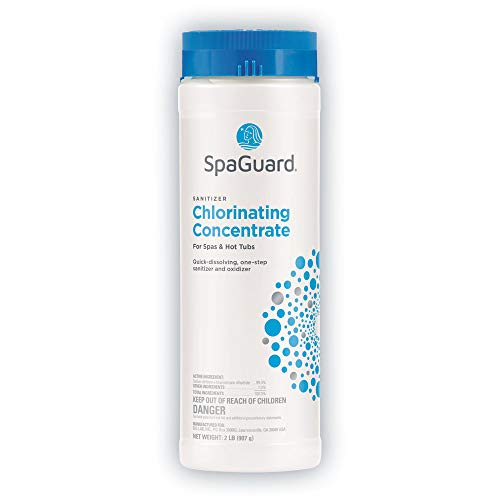
SpaGuard Spa Chlorinating Concentrate, 2 lb, Single Pack | Advanced Spa Water Treatment for Hot Tubs, Quick Dissolving Oxidizer
Chosen because it specifies 2 lb and Single Pack.
View on Amazon
SpaGuard Spa Chlorinating Concentrate, 5 lb, Single Pack | Advanced Spa Water Treatment for Hot Tubs, Quick Dissolving Oxidizer
Chosen because it specifies 5 lb and Single Pack.
View on Amazon
SpaGuard Spa Chlorinating Concentrate, 14 oz, Single Pack | Advanced Spa Water Treatment for Hot Tubs, Quick Dissolving Oxidizer
Chosen because it specifies 14 oz and Single Pack.
View on AmazonDichlor granules
Dichlor is chlorine with built-in stabilizer. Brands including Leslie’s, Clorox Pool&Spa and Spa Essentials sell products in this category for spas. The label typically states a dose per specified water volume. Adding too much at once can make the water cloudy and irritating. Dichlor adds cyanuric acid as it works, and when levels climb, the sanitizer becomes less effective, so many owners partially drain and refill on the schedule the maker suggests.
Tablets and floaters
Slow-release tablets can keep levels steadier between uses. Only use a tablet product labeled for spas and hot tubs. Large, slow-dissolving pool tablets can release too much sanitizer in a small body of water and damage the shell or equipment. Never drop tablets directly onto the shell, and follow the feeder instructions.
Bromine
Bromine is described by makers and spa retailers as more stable at higher temperatures and as having less of a chlorine-type smell. It is used in tablets through a floater or feeder, often with a separate oxidizer. Switching between chlorine and bromine needs a careful water change per the manufacturer, because the two should not be mixed in the same water. Read your spa manual first.
Non-chlorine shock
Non-chlorine shock is used to oxidize waste and restore clarity. Product labels note it does not by itself act as a sanitizer, so it complements chlorine or bromine rather than replaces it. It is popular for use right after soaking because users can often get back in sooner than after a chlorine shock, according to the maker instructions. Follow the label on wait times.
Test strips and balance matter as much as the brand
- Test sanitizer, pH and total alkalinity regularly. Strips or a liquid kit both work if used correctly.
- Balanced pH helps sanitizer work and protects equipment. The ranges are listed in the spa manual or on test kits.
- Rinse the filter regularly and replace it as the maker advises.
- Shower before use to reduce the sanitizer demand from lotions and oils.
Safety rules for spa chemicals
- Never mix chemicals with each other. Chlorine and acids or other sanitizers can release dangerous gas.
- Add product to water, not water to product, and follow the label order.
- Wear gloves and eye protection. Keep containers sealed, dry and out of reach of children and pets.
- Do not use the spa until levels return to the range the label gives.
- Skin or eye irritation can result from unbalanced water. If symptoms persist, ask a doctor.
- Store chlorine away from acids, fuels and heat.
Budget tiers
| Tier | What you get | Fits |
|---|---|---|
| Budget | Dichlor granules, test strips | Basic routine care |
| Mid-range | Spa tablets with a floater, non-chlorine shock, a liquid test kit | Regular users wanting steadier water |
| Premium | Mineral cartridge or salt system plus sanitizer and a complete kit | Frequent users who want to reduce handling |
Pick X if…
| If you… | Pick |
|---|---|
| Want the simplest routine | Dichlor granules |
| Soak daily and want steadier levels | Spa-labeled tablets in a floater |
| Dislike chlorine smell | Bromine, per the spa manual |
| Want to soak soon after shocking | Non-chlorine shock plus a sanitizer |
| Have water that builds up stabilizer | Liquid unstabilized chlorine, with partial drains |
| Want fewer chemicals added | Salt or mineral system plus reduced sanitizer |
Compatibility notes
- Check the spa manual for approved sanitizers. Some warranties list which products are allowed.
- Do not use pool products labeled only for pools unless the label permits spa use.
- Floating feeders should be set according to the product instructions to avoid over-dosing.
- Covers and cushions can be affected by strong sanitizer fumes, so keep the lid open for a short time after shocking.
Alternatives
- Ozone or UV add-ons: reduce how much sanitizer is needed but are not a stand-alone solution.
- Spa-care service: a local dealer can test and advise.
- Frequent partial water changes: help control stabilizer and dissolved solids.
A basic weekly routine
- Test the water for sanitizer, pH and alkalinity before adding anything.
- Adjust alkalinity and pH first with the products named in your spa manual. Sanitizer works better when the water is balanced.
- Add the correct amount of sanitizer with the pumps running, as the label directs, and keep the cover open until fumes clear.
- Apply a shock treatment weekly or after heavy use, following the product label.
- Rinse the filter cartridge with a hose, and soak it in a filter-cleaning solution on the maker’s schedule.
- Drain and refill the spa according to the manual.
Common problems and what they usually mean
Cloudy water
Cloudiness often points to a dirty filter, low sanitizer or high dissolved solids. Test the water, clean the filter and consider a partial water change. Add a clarifier only if the label permits for spas.
Foam on the surface
Foam can come from soap residue, lotions or detergent left in swimwear. Showering before use and rinsing swimsuits without detergent help. A spa-specific defoamer is an option but not a cure for the cause.
Skin or eye irritation
Irritation is often associated with poorly balanced water or used-up chlorine compounds. Exit the spa, rinse with fresh water and test the water. If irritation continues or breathing is affected, seek medical advice.
Green or slimy water
This suggests sanitizer has been low for some time. Follow the maker’s cleaning and refill guidance rather than adding large amounts of chemicals. A partial or full drain and a plumbing cleaner designed for spas may be needed.
Storage and handling
- Keep containers in a cool, dry, ventilated place away from direct sun.
- Use a clean, dry scoop for each product. Moisture or cross-contamination can cause reactions.
- Close lids tightly after use, because granules absorb moisture and clump.
- Keep chlorine separate from acids, brominating tablets and oils.
- Dispose of empty containers as the label says and never reuse them for anything else.
Frequently Asked Questions
What type of chlorine is best for a hot tub?
Many owners use dichlor granules because they dissolve quickly and are sold for spas. Liquid chlorine and spa-labeled tablets are other options. Choose a product labeled for spas and follow the maker’s dosing directions.
Can I use pool chlorine tablets in a hot tub?
Only if the label states they are suitable for spas. Large pool tablets dissolve slowly and can release too much sanitizer into a small volume of water. When unsure, use a spa-specific product.
Is bromine better than chlorine for hot tubs?
Bromine is described as more stable in hot water and with less odor, but it uses different chemistry. Both can work when used correctly. Do not mix them without a water change as advised in the spa manual.
How often should I add sanitizer?
Follow the label and test the water before and after use. Frequent use needs more attention than occasional use. A steady routine is better than large occasional doses.
Why does my hot tub water smell strongly of chlorine?
A strong smell often means the water has used-up chlorine compounds and needs oxidizing or balancing, not more chlorine. Test the water and follow the label for shocking. If problems persist, a spa dealer can advise.
Are hot tub chemicals safe to handle?
They are safe when handled per the label with gloves, ventilation and secure storage. Never mix products, and keep them away from children. If skin or eyes are irritated, rinse with water and seek medical advice if symptoms continue.
More from Amazon
Programs that pair well with the guide above. Offers and eligibility are set by Amazon and may change.
Collect the home and kitchen items you want in one registry that guests can shop from.
Create a wedding registrySet up recurring deliveries of everyday items on eligible products. Terms and savings are set by Amazon.
Explore Subscribe & SaveFree shipping on eligible items, Prime Video and more. Eligible new members can start with a free trial.
Start a Prime free trialAudiobooks and podcasts to listen to on the go. Eligible new members can start with a free trial.
Try Audible freeAs an Amazon Associate we earn from qualifying purchases.