Key takeaways
- Balance over raw weight: A 15 lb saw with its mass centered near your grip feels lighter than an 11 lb saw that hangs forward. Hold the tool at the angle you’ll actually cut at and note whether your wrist stays straight or drops.
- Vibration path: Overmolded grips, isolated motor mounts, and a rigid frame keep buzz out of your hands. Chattering blades signal poor guide bearing support, which fatigues both you and the blade weld.
- Reachable tension and guide adjustment: Beginners change blades often. Lever tensioning and thumbscrew guide adjustment mean you’ll actually maintain the saw instead of tolerating drift.
- Variable speed with real range: Roughly 130–470 FPM covers softwood through mild steel and conduit. Slow speeds cut heat, and heat is what work-hardens material and kills blades early.
- Housing and duty cycle honesty: Cast or alloy bases, sealed bearings, and metal gearcases outlast glass-filled nylon under repeated load. Match the tool’s stated duty cycle to how long you plan to run it.
What's inside
Most first band saws get bought for the wrong reason: a spec sheet number. Buyers fixate on cutting capacity or amp draw, then discover three weekends later that the tool fights them. The handle forces the wrist into ulnar deviation, the trigger sits too far forward for a gloved finger, vibration travels straight up the forearm, and the blade wanders because the guide bearings were adjusted once at the factory and never again. Fatigue, not skill, is what ruins a beginner’s cuts. A saw that feels neutral in the hand after twenty minutes will teach you more than a powerful one that leaves your grip shaking.
This guide looks at beginner band saws through two lenses I trust more than marketing copy: how the tool loads your body, and how it holds tolerance over time. That means grip geometry and balance point, vibration damping, switch placement, blade tensioning mechanisms you can actually reach, and the housing and bearing quality that determine whether the saw still cuts square in year three. Below are six portable and benchtop options worth a beginner’s money, followed by a buying framework, reviews, and answers to the questions that come up most.
As an Amazon Associate we earn from qualifying purchases.


🛒 Best Price Today on Amazon
Prime members get fast, free shipping on everything above, plus member-only deals. New members get a 30-day free trial — cancel anytime.
How to Choose a Band Saw For Beginners (2026)
- Balance over raw weight: A 15 lb saw with its mass centered near your grip feels lighter than an 11 lb saw that hangs forward. Hold the tool at the angle you’ll actually cut at and note whether your wrist stays straight or drops.
- Vibration path: Overmolded grips, isolated motor mounts, and a rigid frame keep buzz out of your hands. Chattering blades signal poor guide bearing support, which fatigues both you and the blade weld.
- Reachable tension and guide adjustment: Beginners change blades often. Lever tensioning and thumbscrew guide adjustment mean you’ll actually maintain the saw instead of tolerating drift.
- Variable speed with real range: Roughly 130–470 FPM covers softwood through mild steel and conduit. Slow speeds cut heat, and heat is what work-hardens material and kills blades early.
- Housing and duty cycle honesty: Cast or alloy bases, sealed bearings, and metal gearcases outlast glass-filled nylon under repeated load. Match the tool’s stated duty cycle to how long you plan to run it.
The Best Band Saw For Beginners (2026)s Reviewed
DEWALT DCS374B 20V MAX Band Saw
The 5-inch capacity and integrated hang hooks make this the most job-friendly cordless option here, and the front grip lets you drive the cut with your shoulder rather than your wrist. It’s a bare tool, so budget for a battery, but the gearcase and bearing support are built for repeated deep cuts.
VEVOR Portable Band Saw with Removable Base
The removable alloy steel base is the real ergonomic story: clamp it down and you have a benchtop saw, lift it off and you have a handheld. Variable speed from roughly 138 to 472 FPM plus a 0–45° bevel gives beginners room to learn material behavior without swapping tools.
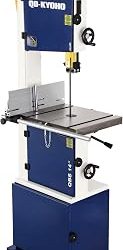
WEN BA3962 10-Inch Band Saw with Stand
For a stationary first saw, the included stand puts the table near elbow height, which keeps your shoulders down and your sightline over the blade. Two speeds and a 3.5-amp motor handle furniture-scale hardwood resawing and curve work comfortably.
DOVAMAN Portable Band Saw with Base
A well-shaped rear handle and forward grip keep the wrist neutral through longer cuts, and the bundled pair of blades means you can compare tooth counts early instead of guessing. The base and 0–45° angle adjustment make repeat cuts consistent.
DEWALT DCS378B 20V MAX XR Brushless Bandsaw
The brushless motor runs cooler and lighter, and the 3-3/8-inch capacity trims enough bulk that one-handed positioning stops being a strain. Choose this over the DCS374B if most of your work is tubing, strut, and stock under three inches.
Frequently Asked Questions
Is a portable or benchtop band saw better for a beginner?
Portable saws teach control and go where the work is. Benchtop and stand-mounted saws are steadier and better for curved woodwork, since both hands guide the material instead of the tool.
How much does blade choice matter?
More than the motor. Aim for at least three teeth in the material at all times; too few teeth strip, too many clog and overheat.
Why does my blade wander off the line?
Usually guide bearing clearance or insufficient tension, not operator error. Check both before forcing the cut.
Do I need to wear gloves?
Yes for handling hot, sharp stock; keep them snug so nothing catches near the blade path.
Final Thoughts
For an all-round first saw, the DEWALT DCS374B offers the best balance-to-capacity ratio and the durability to grow with you. The VEVOR portable with removable base is the smartest value if you want handheld and benchtop use in one tool, and the WEN BA3962 remains the easiest entry point for furniture-focused woodworking.