Key takeaways
- Port size: Match the separator to your hose, regulator, and tool fittings. A 1/4-inch unit suits many light-duty tools, while 1/2- and 3/4-inch ports reduce restriction in higher-flow systems.
- Filtration stages: Particulate, coalescing, and desiccant stages address different contaminants. More stages can improve air quality, but they also add replacement parts and pressure drop.
- Pressure and airflow: Check the published PSI range and CFM rating against your compressor. A separator that cannot keep up may starve a spray gun or plasma cutter even when the compressor itself is adequate.
- Drain design: Automatic drains reduce daily maintenance, particularly on frequently used equipment. Confirm that the drain can be positioned safely and that its fittings are accessible for cleaning or replacement.
- Construction: Metal bowls, protected gauges, robust mounting points, and clearly marked regulators generally withstand workshop abuse better than lightweight components. Always use a separator within its rated pressure and temperature limits.
What's inside
Compressed air often carries more moisture than workshop tools can tolerate. As warm air leaves the compressor and cools inside a hose, tank, or filter body, water condenses—bringing rust, paint defects, clogged plasma-cutting consumables, and premature wear to pneumatic tools. The right separator removes that moisture before it reaches the point of use.
This guide focuses on practical durability: connection size, filtration stages, drainage, pressure handling, airflow, and how easily a unit can be serviced. The best choice depends on whether you are protecting a spray gun, running a plasma cutter, or outfitting a demanding home workshop.
As an Amazon Associate we earn from qualifying purchases.




🛒 Best Price Today on Amazon
Prime members get fast, free shipping on everything above, plus member-only deals. New members get a 30-day free trial — cancel anytime.
How to Choose a/an Air Compressor Water Separator (2026)
- Port size: Match the separator to your hose, regulator, and tool fittings. A 1/4-inch unit suits many light-duty tools, while 1/2- and 3/4-inch ports reduce restriction in higher-flow systems.
- Filtration stages: Particulate, coalescing, and desiccant stages address different contaminants. More stages can improve air quality, but they also add replacement parts and pressure drop.
- Pressure and airflow: Check the published PSI range and CFM rating against your compressor. A separator that cannot keep up may starve a spray gun or plasma cutter even when the compressor itself is adequate.
- Drain design: Automatic drains reduce daily maintenance, particularly on frequently used equipment. Confirm that the drain can be positioned safely and that its fittings are accessible for cleaning or replacement.
- Construction: Metal bowls, protected gauges, robust mounting points, and clearly marked regulators generally withstand workshop abuse better than lightweight components. Always use a separator within its rated pressure and temperature limits.
The Best Air Compressor Water Separators (2026) Reviewed
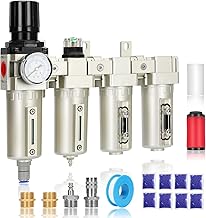
3/4-Inch NPT Four-Stage Air Drying System
This high-flow separator is aimed at demanding applications such as sandblasting and spray painting, where a narrow passage can become a real performance bottleneck. Its four-stage layout combines filtration, regulation, and drying, while the auto drain helps limit standing water; its larger connections make the most sense on a substantial compressor and permanent shop setup.
1/2-Inch NPT Three-Stage Industrial Dryer
With particulate filtration, coalescing filtration, and a desiccant dryer, this unit offers a well-rounded defense against particles, oil mist, and residual moisture. The metal bowl and broad 0–240 PSI regulator range suggest a durable choice for users who want a serviceable installation rather than a small inline trap.
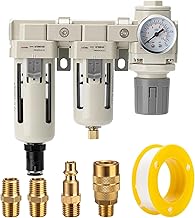
3/8-Inch NPT Double Air Filter Dryer
This compact system balances useful filtration with a more approachable 3/8-inch connection size. Its combination of double filters, pressure regulation, and automatic or semi-automatic draining suits general garage work, although buyers should compare the drain arrangement and replacement-filter availability with their expected maintenance routine.
LE LEMATEC AI303 Inline Moisture Trap
The AI303 is the practical pick for point-of-use protection where space is limited, such as directly before a paint gun or plasma cutter. Its 1/4-inch NPT format is easy to integrate into lighter pneumatic equipment, but the smaller passage is better suited to modest airflow than continuous, high-volume industrial work.
1/2-Inch NPT Four-Stage, 141-CFM Dryer
This four-stage model stands out for buyers who need substantial airflow without moving to 3/4-inch plumbing. The stated 141 CFM capacity and 0–240 PSI range make it appealing for spray finishing and plasma-cutting setups, while the auto drain reduces the chance that collected water will be forgotten between sessions.
Frequently Asked Questions
Does a water separator remove all moisture from compressed air?
No. A separator removes liquid water and, depending on its filter stages, oil mist and particles. It cannot fully eliminate water vapor; for especially dry air, add a properly maintained desiccant or refrigerated dryer and install the separator after the compressor tank where the air has cooled.
Where should an air compressor water separator be installed?
For general protection, place it downstream of the tank and as close to the tool as practical. A short length of pipe between the tank and separator allows heat to dissipate, improving condensation removal. Sensitive spray equipment may benefit from an additional small filter at the gun.
Is a larger NPT size always better?
Not necessarily. Larger ports can support higher airflow with less restriction, but they do not improve filtration by themselves. Choose the size that matches your system and tool demand; adapters can work, though unnecessary reductions may create a flow bottleneck.
How often should the separator be drained?
Automatic drains still need inspection, while manual units should be emptied whenever water accumulates and always after demanding sessions. Check bowls, seals, and filter elements regularly. A sudden increase in water or pressure drop can indicate a saturated element, excessive compressor condensation, or a drain problem.
Final Thoughts
For high-flow shop systems, the 3/4-inch four-stage separator is a strong durability-minded choice, while the 1/2-inch three-stage model offers an excellent balance of filtration and serviceability. For a compact point-of-use installation, the LE LEMATEC AI303 is the more convenient option; match any selection to your compressor’s airflow, connection size, and actual moisture load.