Our Top Picks
Pros & cons
- 360-degree swivel with adjustable height suits varied counters
- SGS-certified gas lift supports up to 300 pounds
- Faux leather cushions wipe clean easily
- Faux leather surface can feel warmer in humid rooms
- Pair-only set limits seating to two at a time
 COLAMY Adjustable Upholstered Bar Stools Set of 3Set of 320.87 x 17.72 x 42.91 inches34.52 PoundsCheck on Amazon
The best adjustable bar stools are the ones whose lowest and highest seat settings match your counter or bar while leaving enough knee room, a usable footrest, and at least 24 inches of personal space per seat.
For most kitchens, a gas-lift stool with a 22–30-inch seat-height range is the most versatile choice. It usually fits standard counter-height surfaces, adjusts for different users, and offers smoother positioning than a basic fixed-leg stool. For a raised bar, look for a 28–36-inch range instead. Before choosing a style, measure the underside of your counter—not just the top—and compare it with the stool’s actual seat-height range.

Nalupatio Modern Bar Stools Set of 2, Adjustable Faux Leather Upholstered Swivel Bar Stools, Counter Height Bar Chairs with Back for Kitchen Island, Black
Chosen because it specifies Adjustable Faux Leather Upholstered Swivel Bar Stools and Counter Height Bar Chairs with Back for Kitchen Island.
View on Amazon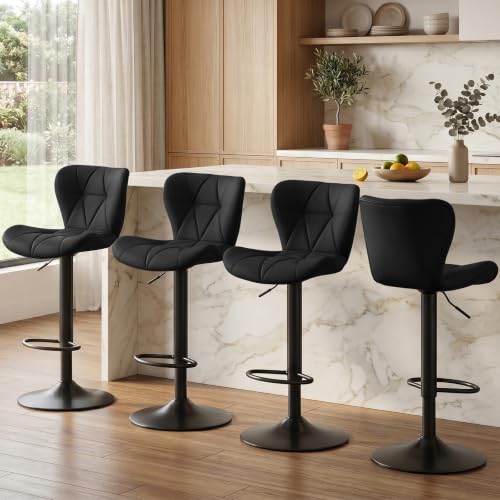
HAPPYMONT Bar Stools Set of 4, PU Leather Adjustable Height Swivel Barstool
Chosen because it specifies PU Leather Adjustable Height Swivel Barstool.
View on AmazonCOLAMY Adjustable Upholstered Bar Stools Set of 3,360° Swivel Counter Height Chairs with Soft Cushioned Seat & Stable Metal Base for Kitchen Island,250 LBS Capacity,Easy Assembly,Beige
Chosen because it specifies 250 LBS Capacity and Easy Assembly.
View on Amazon
VECELO Bar Stools Set of 2, Adjustable Counter Height Barstools with Back and Arm, Swivel Bar Chair Stools for Kitchen Counter Island Cafe Dining Room, Industrial Style, Brown
Chosen because it specifies Adjustable Counter Height Barstools with Back and Arm and Industrial Style.
View on AmazonChoose the right height before choosing the style
Seat height is measured from the floor to the top of the seat cushion. Counter and bar labels are not always consistent, so use the measurements below as a starting point.
| Surface type | Typical surface height | Recommended seat height | Useful adjustable range |
|---|---|---|---|
| Dining-height table | 28–30 inches | 17–19 inches | 16–21 inches |
| Counter-height island | 34–36 inches | 24–26 inches | 22–30 inches |
| Bar-height counter | 40–42 inches | 28–30 inches | 28–36 inches |
Allow about 9–12 inches between the top of the seat and the underside of the counter. That clearance gives your thighs room without forcing your knees upward. A thick cushion can reduce usable space, so measure from the floor to the compressed sitting surface when possible, not only to the frame.
Best adjustable bar stools by shopping situation
Best for a small apartment: slim, backless or low-back stools
Choose a stool with a footprint no wider than about 17–18 inches if your kitchen aisle is tight. Backless designs can slide completely under an overhang, preserving walking space, while a low-back model provides more support without visually closing in the room. A pair of 15–17-inch-wide stools generally works beneath a 48-inch island, provided the counter has enough uninterrupted legroom.
For a 10-by-12-foot kitchen or dining area, avoid oversized bucket seats unless the stools will remain pulled out most of the time. Swivel seats are convenient, but their bases often occupy more floor area than four narrow legs.
Best for children, pets, and frequent spills: wipeable upholstery and stable bases
Performance vinyl, polyurethane upholstery, and tightly woven synthetic fabric are usually easier to maintain than open-weave linen or velvet. Look for sealed seams, a cushion attached securely to the frame, and a base that does not have sharp protrusions where a pet collar or child’s clothing could catch.
A five-point or broad circular base is generally more resistant to tipping than a narrow pedestal. Check the manufacturer’s weight rating and use it as a ceiling rather than a target; a stool rated for 250 pounds should not routinely carry loads close to that limit. Keep the adjustment handle inaccessible to small children when possible, because repeated leaning on a gas-lift lever can change the height unexpectedly.
Best for renters: tool-light assembly and a compact moving footprint
A pedestal stool with a separate seat, column, and base can be easier to carry through a narrow doorway than a fully welded frame. However, its parts must be tightened correctly. Choose a design assembled with common hex keys and inspect every fastener after the first week, when joints may settle.
Measure the package as well as the finished stool. A box that is 20 inches wide may pass through a doorway but still be difficult to turn in a hallway. For apartments, two lighter stools are often easier to move than one heavy solid-wood model; check the listed shipping weight rather than assuming a metal base is light.
Best for back comfort: a padded back, footrest, and controlled swivel
For meals or work sessions lasting more than 20–30 minutes, choose a backrest that supports the lower-to-mid back and a footrest positioned so your feet are not dangling. A height-adjustable stool is not automatically ergonomic: if the column rises but the footrest stays too low, shorter users may still lose leg support.
Use the footrest as a practical test. With the seat at the correct height, your feet should rest on it without pressing hard into the backs of your thighs. A contoured seat with medium-firm foam is usually more supportive than a very soft cushion that bottoms out. If you have persistent back pain, an adjustable office-style stool with a shaped back and a stable five-wheel base may be more suitable than a decorative kitchen pedestal stool.
Materials: what you gain and give up
| Material or construction | Advantages | Trade-offs | Best fit |
|---|---|---|---|
| Solid hardwood frame | Repairable, substantial, warm appearance | Heavier; can cost more; may develop joints that need tightening | Traditional kitchens and long-term use |
| Engineered wood seat or shell | Consistent shape, often lighter and less expensive | Edges and screw holes can be damaged by overtightening or moisture | Budget-conscious interiors |
| Steel or aluminum frame | Strong, slim, and easy to clean | May feel cold; thin tubing can flex; finishes can scratch | Modern spaces and frequent cleaning |
| Vinyl or polyurethane upholstery | Quick to wipe and resistant to ordinary food spills | Can crack or peel with heat, sunlight, and harsh cleaners | Families and busy kitchens |
| Woven polyester or performance fabric | Warmer feel, broad color selection, less slippery | Requires prompt stain treatment and can hold odors | Comfort-focused rooms |
Foam quality matters more than a thick-looking cushion. A cushion around 2–3 inches thick with medium-firm foam is a practical everyday specification. Very soft foam may feel comfortable initially but compress unevenly, especially at the front edge. If the product listing does not state foam type or density, judge comfort by the return policy and by the seat’s support structure rather than assuming thickness equals durability.
Head-to-head: pedestal stools versus four-leg stools
Pedestal stools usually win on adjustability and swivel movement. A gas-lift column can cover several inches of height, and the circular base is easy to sweep around. They are a good choice when several people of different heights share one counter. Their weaknesses are greater sensitivity to loose hardware, possible rocking on uneven floors, and a base that can interfere with a footrest or robot vacuum.
Four-leg adjustable stools generally offer a more familiar chair-like feel and may be steadier for people who dislike swiveling. They can also look better in farmhouse, traditional, or industrial rooms. Their adjustment systems are often more limited—such as selectable bolt holes or telescoping legs—and the legs may occupy more floor space. Choose them when stability and appearance matter more than quick height changes.
For either design, inspect the welds or joinery, the underside of the seat, the adjustment lock, and the connection between the footrest and frame. The footrest is often the first part to loosen because users repeatedly place their full leg weight on it.
Allow enough room around each stool
- Plan on at least 24 inches of counter width per person for occasional use.
- Use 26–30 inches per person for more comfortable meals or larger seats.
- Leave about 9–12 inches between the back of a stool and a wall or cabinet when people are seated.
- Allow approximately 36 inches behind the stool if people need to walk through regularly.
- For a counter with a deep overhang, confirm that knees will not hit cabinet doors, drawers, or support brackets.
As an example, a 72-inch island can usually accommodate three 18-inch-wide stools with generous spacing, or four narrower stools for occasional seating. Four broad 21-inch bucket stools may fit mathematically but feel crowded and make it harder to enter or leave.
Assembly and durability checks before buying
Expect basic assembly to take roughly 15–45 minutes per stool, depending on whether the seat, back, base, and footrest arrive separately. Tighten bolts gradually in a crisscross pattern rather than fully tightening one side first. Do not use a power drill unless the instructions permit it; overtightening can strip engineered-wood inserts or distort metal brackets.
After assembly, place the stool on a hard, level surface and check for rocking. Sit with the stool at its lowest and highest settings, test the swivel for rubbing, and confirm that the footrest remains secure. Recheck fasteners after several days of use. Keep the gas-lift cylinder clean and never lubricate it with an unapproved product, since oil can attract grit or affect the mechanism.
For a durable purchase, prioritize a clearly stated weight capacity, replaceable glides or feet, a protected finish, and a return period long enough to evaluate the height and comfort in your own kitchen. General-market pricing is commonly about $80–$180 per stool for basic adjustable models, $180–$350 for better upholstery and construction, and $300–$600 or more for premium materials and refined mechanisms.
Final buying decision
Choose 22–30-inch adjustable stools for a standard kitchen counter, 28–36-inch models for a true bar, and a lower range only for dining-height surfaces. Then narrow the choice by situation: slim wipeable stools for small or family-heavy spaces, a padded back and well-positioned footrest for longer sitting, and a stable non-swiveling frame if movement or balance is a concern. The most attractive stool is still the wrong choice if its lowest setting leaves your knees cramped, its highest setting cannot reach the counter comfortably, or its base prevents people from moving around the room.