Key takeaways
- Seat height: Aim for 17–19 inches from the floor. That range keeps your hip slightly above your knee, which lets you reach your foot without collapsing your lower back. Benches in the 16-inch range, like the 16.5-inch XKZG, sit closer to a footstool and suit taller users or quick perches better than long lacing sessions.
- Load path: Follow the weight from seat to floor. Benches with vertical dividers running full depth under the seat carry load in compression, which is strong. Benches where the seat spans a wide open cavity rely entirely on panel stiffness, so wider models need a center support.
- Cushion density: Thickness is marketing; density is durability. Higher-density foam resists compression set, the permanent flattening that turns a padded seat into a hard board. A firmer cushion that barely dents under a thumb press will outlast a plush one.
- Material and joinery: Solid hardwood and bamboo tolerate repeated flexing and can be re-tightened. Engineered panels are dimensionally stable and cost less, but their fastener holes wear, so favor designs with cross-braces or back panels that triangulate the frame.
- Depth and tier spacing: Around 11–12 inches deep suits a tight hallway and adult sneakers laid flat; 13–14 inches gives better thigh support when seated and swallows boots. Check vertical clearance between tiers against your bulkiest pair before assuming it fits.
What's inside
Most shoe benches fail in the same place: the seat. Shelves rarely collapse, but the surface people actually sit on takes a repeated shock load — someone dropping their body weight onto it twice a day, often off-center near one end — and that’s where thin panels flex, cam-lock fasteners loosen, and foam cushions compress into a permanent dish. Buyers tend to shop by width and door count, then discover eighteen months later that the bench creaks, the seat sags toward the middle, or the height was never right for lacing a boot in the first place.
This guide looks at shoe benches through two lenses: ergonomics, meaning seat height, depth, and cushion behavior under real sitting posture, and durability, meaning how the load travels from the seat into the frame and down to the floor. Each pick below was assessed on those terms rather than on styling alone, with notes on where a given construction method helps and where it sets a ceiling on service life.
As an Amazon Associate we earn from qualifying purchases.



How to Choose a Shoe Storage Bench (2026)
- Seat height: Aim for 17–19 inches from the floor. That range keeps your hip slightly above your knee, which lets you reach your foot without collapsing your lower back. Benches in the 16-inch range, like the 16.5-inch XKZG, sit closer to a footstool and suit taller users or quick perches better than long lacing sessions.
- Load path: Follow the weight from seat to floor. Benches with vertical dividers running full depth under the seat carry load in compression, which is strong. Benches where the seat spans a wide open cavity rely entirely on panel stiffness, so wider models need a center support.
- Cushion density: Thickness is marketing; density is durability. Higher-density foam resists compression set, the permanent flattening that turns a padded seat into a hard board. A firmer cushion that barely dents under a thumb press will outlast a plush one.
- Material and joinery: Solid hardwood and bamboo tolerate repeated flexing and can be re-tightened. Engineered panels are dimensionally stable and cost less, but their fastener holes wear, so favor designs with cross-braces or back panels that triangulate the frame.
- Depth and tier spacing: Around 11–12 inches deep suits a tight hallway and adult sneakers laid flat; 13–14 inches gives better thigh support when seated and swallows boots. Check vertical clearance between tiers against your bulkiest pair before assuming it fits.
The Best Shoe Storage Benches (2026) Reviewed
Homleke 4-Door Shoe Bench
At 18.5 inches tall and 13.8 inches deep, this is one of the better-proportioned entryway benches for actually sitting down: the extra depth supports the back of the thigh instead of leaving you perched on an edge. Four doors and an adjustable shelf hide clutter, and the divider layout behind them doubles as structural support beneath the thickened seat cushion.
VASAGLE CUSTOS Shoe Bench
The 11.8-inch depth is the headline here — it tucks into narrow corridors where a standard bench would block traffic — and 18.9 inches of seat height stays in the ergonomic sweet spot. Fifteen compartments mean plenty of internal partitions transferring load, though the shallow footprint makes it a better perch than a lounging seat.
Solid Wood Flip-Top Bench, Walnut
A 550-pound rating and solid wood construction put this in a different durability class: joints can be re-tightened rather than stripping, and the flip-top gives full access to the cavity without door hinges to wear out. At 31.5 inches wide with side hooks, it’s the pick for entryways that need strength and hardware in a compact span.
HOMSHO Farmhouse 4-Door Bench
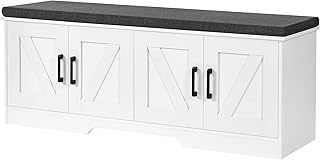
The 47.2-inch width covers a full family’s footwear, and adjustable shelves let you set tier height around boots rather than working around a fixed spacing. Wide benches live or die on center support, and the four-door layout keeps interior dividers under the seat where they belong.
Pipishell Bamboo Shoe Rack Bench
Bamboo’s high strength-to-weight ratio and moisture tolerance make it the smart choice for a mudroom or balcony, and the 300-pound rating is honest for an open three-tier frame. There’s no cushion, so it’s firm underneath, but open shelving means airflow around damp shoes and nothing to compress or discolor over time.
Frequently Asked Questions
What seat height is best for putting on shoes?
Roughly 17–19 inches for most adults, matching standard chair height. Lower benches force deeper hip and spine flexion, which is fine occasionally but tiring if you’re wrestling with laces or tall boots daily.
How much weight should a shoe bench support?
Look for at least 250–300 pounds for single-occupant use. Ratings above 500 pounds, like the solid wood walnut model, signal margin for two people sitting or someone dropping onto the seat rather than easing down.
Do closed-door benches trap odor?
They can, since enclosed cabinets limit airflow around damp shoes. Choose models with vented or slatted panels, leave doors ajar to dry footwear, or go with an open bamboo rack if ventilation matters more than concealment.
Is solid wood worth the premium over engineered panels?
For the seat, generally yes — solid wood and bamboo handle cyclic loading and can be re-fastened, while engineered panel holes gradually loosen. For interior shelves that only hold shoes, engineered panels are perfectly adequate and keep costs down.
Final Thoughts
If longevity is the priority, the solid wood flip-top walnut bench earns it with a 550-pound rating and joinery you can service. For larger households, the HOMSHO 47.2-inch farmhouse bench balances capacity with adjustable tiers, while the Pipishell bamboo rack is the sensible pick for damp entryways where airflow beats enclosed storage.