Key takeaways
- Reach geometry: Measure from your pillow to the intended surface before buying. Your forearm sweeps an arc, not a straight line, so the fingerprint pad and keypad should face up and slightly toward the bed rather than out toward the wall. Top-mounted sensors almost always beat front-mounted ones for bedside use.
- Steel gauge and weld quality: Look for 14- to 16-gauge bodies with continuous seam welds and a recessed door edge that leaves no pry gap. Spot welds and folded-tab corners flex under leverage, and that flex is what a pry bar exploits.
- Cycle-rated moving parts: Auto-sliding doors, gas struts, and drawer glides are the first components to fail. Check for ball-bearing glides or steel rails rather than plastic bushings, and confirm the door still self-aligns after repeated fast opens.
- Access redundancy: Insist on at least three independent methods — biometric, PIN, and a mechanical override key stored elsewhere in the house. Batteries die at inconvenient times, and a low-battery warning you sleep through is not a plan.
- Interior fit and finish durability: Closed-cell foam holds its shape far longer than open-cell egg-crate, which compresses and sheds. Powder coat resists the humidity and skin oils of nightly contact better than painted finishes, especially around the keypad bezel.
What's inside
Most nightstand safe comparisons stall out on lock specs and steel thickness, which tells you almost nothing about the two things that actually determine whether a safe works at 3 a.m.: how your body interacts with it half-awake in the dark, and whether the moving parts survive a few thousand open-close cycles without drifting out of alignment. A safe that demands you sit up, twist, and hunt for a sensor with the wrong hand is a safe you will eventually stop locking. A hinge that develops slop in year two turns a crisp latch into a rattling one.
This guide evaluates bedside handgun safes the way a furniture and hardware specialist would: reach geometry from a pillow, sensor placement relative to your arm’s natural arc, gauge and weld integrity, cycle life on hinges and sliding mechanisms, foam density, and how each unit ages against humidity, dust, and battery corrosion. Below are six options spanning compact biometric boxes, auto-sliding designs, travel-rated cases, and full concealment furniture, with notes on who each one genuinely fits.
As an Amazon Associate we earn from qualifying purchases.


🛒 Best Price Today on Amazon
Prime members get fast, free shipping on everything above, plus member-only deals. New members get a 30-day free trial — cancel anytime.
How to Choose a Handgun Safe For Nightstand (2026)
- Reach geometry: Measure from your pillow to the intended surface before buying. Your forearm sweeps an arc, not a straight line, so the fingerprint pad and keypad should face up and slightly toward the bed rather than out toward the wall. Top-mounted sensors almost always beat front-mounted ones for bedside use.
- Steel gauge and weld quality: Look for 14- to 16-gauge bodies with continuous seam welds and a recessed door edge that leaves no pry gap. Spot welds and folded-tab corners flex under leverage, and that flex is what a pry bar exploits.
- Cycle-rated moving parts: Auto-sliding doors, gas struts, and drawer glides are the first components to fail. Check for ball-bearing glides or steel rails rather than plastic bushings, and confirm the door still self-aligns after repeated fast opens.
- Access redundancy: Insist on at least three independent methods — biometric, PIN, and a mechanical override key stored elsewhere in the house. Batteries die at inconvenient times, and a low-battery warning you sleep through is not a plan.
- Interior fit and finish durability: Closed-cell foam holds its shape far longer than open-cell egg-crate, which compresses and sheds. Powder coat resists the humidity and skin oils of nightly contact better than painted finishes, especially around the keypad bezel.
The Best Handgun Safe For Nightstand (2026)s Reviewed
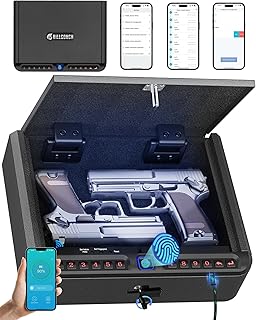
BILLCONCH Smart Pistol Safe with Fingerprint and App
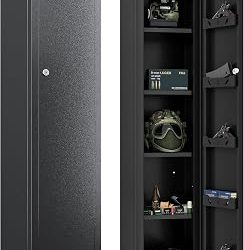
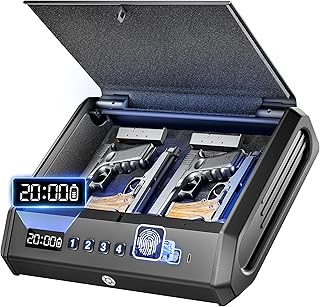
Four access paths — fingerprint, app, 0–9 keypad, and key — give this one the deepest redundancy in the group, and the top-facing sensor sits exactly where a hand coming off a pillow lands. The interior LED is genuinely useful for orientation, and the steel body holds its door alignment well through heavy daily use.
Slider Hidden Handgun Safe with Auto Sliding Door
The auto-sliding door removes the lift-and-clear motion that a drop-down or top-hinged lid requires, which matters enormously in tight nightstand-to-headboard clearances. Verify the rail track stays clean, since debris in a sliding mechanism causes more real-world failures than lock electronics do.
Biometric Gun Safe with Wireless Charging and Clock
By absorbing the roles of charging pad, clock, and safe, this unit reduces nightstand clutter and consolidates your reach targets into one footprint. Adjustable brightness and a backlit keypad make it the most livable option for light sleepers who don’t want a glowing box in the room.
VAULTEK LifePod 20 Biometric Weatherproof Case
This is the most durable shell here, with a weather-sealed body and included security cable that lets it move from nightstand to vehicle to luggage. It trades the instant deployment of a sprung door for portability, so it suits travelers more than someone optimizing purely for bedside speed.
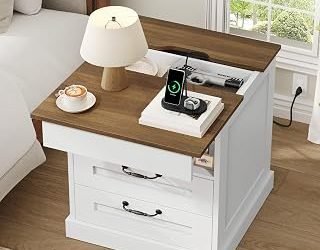
Nightstand with RFID Lock Cabinet and Charging Station
Concealment furniture is the right answer when you want zero visual signal that a firearm is in the room, and this piece integrates outlets, LED lighting, and an RFID compartment into a legitimate bedside table. Judge it on drawer glide load rating and carcass rigidity, not just the lock.
Frequently Asked Questions
Are biometric scanners reliable enough for emergency access?
Modern capacitive sensors read reliably when you enroll the same finger four or five times at slightly different angles and pressures. Dry, cold, or lotioned fingers are the usual culprits behind rejections, which is why keypad and key backups remain non-negotiable.
Should I bolt the safe down?
Yes. Nearly all of these ship with pre-drilled mounting holes, and anchoring into a nightstand base or bed frame stringer defeats the most common theft method, which is simply carrying the whole box away.
How often should I replace the batteries?
Set a fixed schedule — twice a year, aligned with daylight saving changes — regardless of remaining charge. Units running on AA cells, like the large 100-fingerprint models, also benefit from a quick terminal inspection for corrosion at each swap.
Sliding door or drop-down door?
Sliding designs win in cramped spaces and where vertical clearance is limited. Drop-down and spring-assisted lids present the firearm at a better grip angle but need unobstructed room in front of the safe.
Final Thoughts
For most bedsides, the BILLCONCH smart safe offers the best balance of access redundancy and hardware durability, while the Slider auto-sliding safe is the smarter pick when clearance is tight. If concealment matters more than raw speed, the RFID lock nightstand solves the problem at the furniture level instead of adding another box to the room.