Key takeaways
- Fit: Measure drawer width, depth, and height with the drawer closed and fully extended. A precise fit prevents trays from shifting and wasting usable space.
- Access: Choose layouts that let you identify and lift a tool without moving several others first. Angled holders and labeled compartments reduce wrist twisting and visual searching.
- Stability: Non-slip feet, interlocking bins, magnetic bases, and close-fitting dividers help keep contents in place when a chest or toolbox is opened quickly.
- Durability: Look for thick plastic, reinforced edges, smooth drawer action, and hardware that can tolerate repeated loading. Brittle trays are a false economy in active workshops.
- Organization type: Small parts need contained drawers, while wrenches, pliers, and mixed hand tools benefit from dedicated racks or modular trays. Match the organizer to the tools you actually use.
What's inside
A tool box becomes inefficient long before it becomes full. Loose sockets disappear beneath pliers, dividers slide during transport, and small fasteners migrate into one another’s compartments. The result is wasted time, awkward reaching, and unnecessary wear on both tools and the storage system.
This guide evaluates tool box organizers from an ergonomics-and-durability standpoint. The emphasis is on access, stability, material quality, drawer compatibility, and how well each design supports repeatable organization in a home workshop, garage, or furniture-making space.
As an Amazon Associate we earn from qualifying purchases.




How to Choose a Tool Box Organizer (2026)
- Fit: Measure drawer width, depth, and height with the drawer closed and fully extended. A precise fit prevents trays from shifting and wasting usable space.
- Access: Choose layouts that let you identify and lift a tool without moving several others first. Angled holders and labeled compartments reduce wrist twisting and visual searching.
- Stability: Non-slip feet, interlocking bins, magnetic bases, and close-fitting dividers help keep contents in place when a chest or toolbox is opened quickly.
- Durability: Look for thick plastic, reinforced edges, smooth drawer action, and hardware that can tolerate repeated loading. Brittle trays are a false economy in active workshops.
- Organization type: Small parts need contained drawers, while wrenches, pliers, and mixed hand tools benefit from dedicated racks or modular trays. Match the organizer to the tools you actually use.
The Best Tool Box Organizers (2026) Reviewed
IRIS USA 44-Drawer Small Parts Storage Cabinet
The IRIS USA 44-Drawer Small Parts Storage Cabinet is a strong choice for screws, nuts, electronic components, craft supplies, and other small items that are difficult to manage in a standard tool chest. Its many shallow drawers make contents visible and easy to sort, while the wall-mountable and stackable design supports flexible installation in a garage or workshop. This is best used as a stationary organizer rather than a portable toolbox insert, since its value comes from dedicated compartment access.
75-Drawer Parts Storage Cabinet
The 75 Drawer Parts Storage Cabinet is built for users who maintain a broad inventory of fasteners and workshop hardware. Its high compartment count allows more specific labeling, which can reduce overfilled bins and speed up replenishment during repairs or furniture projects. Before mounting or stacking it, check the cabinet’s footprint and loading balance; a densely filled unit should sit securely rather than being placed where its upper section can tip forward.
60-Piece Magnetic Modular Wrench Organizer
The 60 pcs Magnetic Modular Wrench Organizer is designed for tool drawers where loose wrenches tend to overlap and become difficult to identify. Metric and SAE labels support faster selection, while magnetic retention helps keep modules aligned as the drawer opens and closes. It is particularly useful for a mechanic’s layout, although users should confirm that the individual slots accommodate their wrench thickness and that the drawer has enough clearance above the organizer.
WORKPRO 2-Pack Plier Organizer Rack
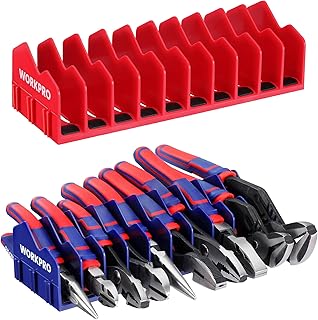
The WORKPRO 2-Pack Plier Organizer Rack provides a dedicated vertical home for pliers, cutters, and similarly shaped tools. Its 20-slot capacity and non-slip rubber base can improve retrieval by separating handles instead of allowing them to form a tangled pile. The high-strength plastic is practical for routine workshop use, and the extendable format offers layout flexibility, but measure your drawer first because vertical clearance matters as much as width.
A-LuGei 69-Piece Tool Box Organizer Tray Divider Set
The A-LuGei 69-Piece Tool Box Organizer Tray Divider Set offers five tray sizes for arranging mixed hand tools, accessories, and workshop odds and ends. The broad assortment makes it easier to build a drawer-specific layout without committing to a permanently molded insert, while the extra-thick plastic should withstand normal repositioning and loading. It is a good fit for users who frequently change their tool selection, though unused pieces may need a separate storage location.
Frequently Asked Questions
What is the best organizer for screws and small hardware?
A drawer cabinet such as the IRIS USA 44-Drawer model or the 75 Drawer Parts Storage Cabinet is generally more effective than open trays. Individual compartments keep fasteners separated, make labels practical, and reduce the chance of small parts spilling across a work surface.
Are magnetic wrench organizers safe for tool drawers?
Yes, provided the organizer fits securely and the drawer has adequate vertical clearance. Magnets help prevent modules from sliding, but they do not replace a properly sized layout; an overloaded drawer can still shift or become difficult to open.
Should pliers stand upright or lie flat?
Upright storage is usually better for frequently used pliers because the handles remain separated and visible. A rack also reduces the grasping force needed to remove one tool from a crowded drawer, which is helpful during repetitive work.
Are modular divider trays better than fixed inserts?
Modular trays are more adaptable and work well when the tool collection changes over time. Fixed inserts can be faster to organize when their molded slots match your tools precisely, but they offer less flexibility for unusually shaped or oversized equipment.
Final Thoughts
For a permanent small-parts station, the IRIS USA 44-Drawer Small Parts Storage Cabinet is a practical starting point; the 60-Piece Magnetic Modular Wrench Organizer is the stronger specialist choice for wrench drawers; and the WORKPRO Plier Organizer Rack is a sensible upgrade for anyone tired of digging through a mixed hand-tool compartment.