Key takeaways
- Access: Choose drawers, removable trays, or open compartments based on how often you need each tool; visibility matters more than maximum capacity.
- Load handling: Check wheel size, handle design, case stiffness, and weight distribution if the organizer will travel across thresholds, driveways, or unfinished floors.
- Compartment control: Adjustable dividers are useful for changing tool collections, while molded compartments provide better resistance to shifting during transport.
- Protection: Water- and debris-resistant construction is valuable in garages and vehicles, but do not confuse basic resistance with complete waterproofing.
- Ergonomics: Look for comfortable lifting points, a handle that telescopes smoothly, and layouts that reduce repeated bending, reaching, and rummaging.
What's inside
A toolbox can be full of compartments and still waste time. Shallow trays let fasteners migrate, loose tools collide in transit, and poorly balanced cases become awkward to lift or roll. The right organizer system should control movement, make frequently used tools easy to reach, and tolerate the dust, impacts, and temperature swings common in garages and workshops.
This guide evaluates six practical storage approaches through an ergonomics-and-durability lens: portability, access, modularity, divider quality, weather resistance, and long-term handling comfort. Whether you need a rolling tower for renovation work or a compact organizer for screws and fittings, these picks help match the system to the way you actually work.
As an Amazon Associate we earn from qualifying purchases.




How to Choose a Tool Box Organizer System (2026)
- Access: Choose drawers, removable trays, or open compartments based on how often you need each tool; visibility matters more than maximum capacity.
- Load handling: Check wheel size, handle design, case stiffness, and weight distribution if the organizer will travel across thresholds, driveways, or unfinished floors.
- Compartment control: Adjustable dividers are useful for changing tool collections, while molded compartments provide better resistance to shifting during transport.
- Protection: Water- and debris-resistant construction is valuable in garages and vehicles, but do not confuse basic resistance with complete waterproofing.
- Ergonomics: Look for comfortable lifting points, a handle that telescopes smoothly, and layouts that reduce repeated bending, reaching, and rummaging.
The Best Tool Box Organizer Systems (2026)s Reviewed
Keter Stack N Rolling Tool Box Modular Storage System
The Keter Stack N Rolling system is a strong choice for users who want one mobile base with room to expand. Its three-piece layout, all-terrain wheels, telescoping handle, and weather-resistant construction support job-site movement while keeping the load organized. The modular format is especially useful when separating hand tools, accessories, and small hardware reduces repeated searching.
FLEX STACK PACK 3-Drawer Tool Box
The FLEX STACK PACK FS1105 takes a more drawer-centered approach, making it a good fit for technicians who prefer direct access over lifting off stacked cases. Three drawers can reduce bending and unnecessary unpacking, although users should distribute heavier tools carefully so the unit remains stable and comfortable to move.
A-LuGei 69-Piece Tool Box Organizer Tray Divider Set
This larger A-LuGei set is designed to retrofit drawers, rolling chests, workbenches, and desk storage rather than replace the toolbox itself. Its assortment of five tray sizes gives you flexibility when organizing mixed tools and parts; the main benefit is a cleaner visual layout that makes unused drawer space easier to reclaim.
A-LuGei 80-Piece Tool Box Organizer
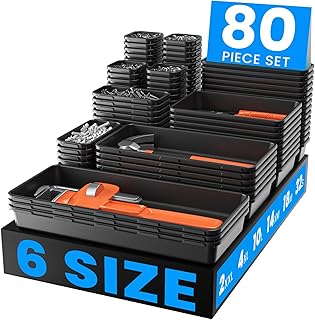
With six sizes and 80 pieces, this A-LuGei organizer is the better option for a broad, frequently changing collection that includes hand tools and small parts. It can accommodate many layouts, but a successful setup depends on measuring drawer depth and planning zones before filling every available space.
DEWALT TSTAK Extra Large Tool Box
The DEWALT TSTAK DWST17806 suits users who want a spacious, stack-compatible case with a removable tray for quick access. Its water- and debris-resistant design is practical for transport and workshop storage, while the extra-large format favors bulkier tools that do not fit comfortably in compact organizers. It is less specialized for tiny components than a divider tray set.
Frequently Asked Questions
What is the best type of toolbox organizer for a home workshop?
A modular rolling system works well when tools must move between rooms or out to a vehicle. For a stationary bench, drawer trays and adjustable dividers usually provide faster visual access and make it easier to maintain a consistent layout.
Are toolbox organizers worth using inside a rolling tool chest?
Yes. Internal trays prevent tools from sliding into disordered piles and make the available drawer height more usable. They also reduce the time spent digging through a drawer, which is often more valuable than adding another large storage compartment.
How should heavy tools be arranged?
Keep dense items low and close to the wheels or central support area, with lighter tools above them. This lowers the center of gravity, limits drawer strain, and makes a rolling case less likely to tip when crossing uneven surfaces.
Can these systems be used outdoors?
Some cases offer resistance to water and debris, making them suitable for short-term outdoor or vehicle use. Even weather-resistant storage should be kept off standing water and closed securely; prolonged exposure can still damage tools, hardware, and drawer mechanisms.
Final Thoughts
The Keter Stack N Rolling system is the strongest all-around pick for mobile, modular storage, while the FLEX STACK PACK is compelling for users who value drawer access. For reorganizing an existing chest, the A-LuGei 69-piece or 80-piece divider sets provide the most layout flexibility, and the DEWALT TSTAK is a durable choice when a roomy portable case is the priority.