Our Short List of 3

- Best for: Hosts storing service for twelve to sixteen in one permanent dining-room chest.
- Material: Wood
- Dimensions: 15.35″L x 11.33″W x 6.89″H
- Layers: 3, with 3 compartments listed
- Lining: Felt lined
- Best for: One formal set stored in a shallow sideboard or buffet drawer.
- Material: Wood, varnished finish
- Colour: Light Walnut
- Dimensions: 11″D x 15″W x 3″H
- Weight: 2 pounds
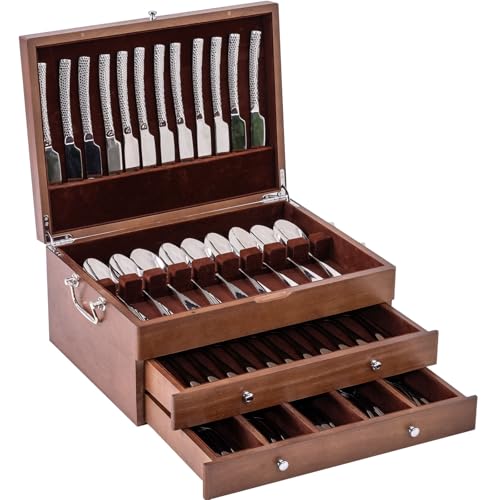
- Best for: Large or combined sets that need the widest three-layer layout in one case.
- Dimensions: 16.3 x 11.6 x 6.88 inches
- Weight: 11.36 pounds
- Design: Three-layer chest with lid and handle
- Use: Silverware storage
All 5 Picks at a Glance
| Product | Specs | Action |
|---|---|---|
| GENRICE Wooden Silverware Chest, Three-Layer |
| Check price on Amazon |
| WGLILO Wooden Silverware Storage Box, Walnut |
| Check price on Amazon |
| ACBORN Silverware Storage Box, Three-Layer |
| Check price on Amazon |
 Household Essentials Windowed Flatware Storage Chest |
| Check price on Amazon |
 Lafulling Flatware Storage Box, 2-Pack |
| Check price on Amazon |
Our Top Picks
- GENRICE Wooden Silverware Chest without Silverware Three-layer15.35 x 11.33 x 6.89 inches15.35 x 11.33 x 6.89 inches8.7 poundsCheck on Amazon
- ACBORN Silverware Storage Box with Lid Three-layer16.3 x 11.6 x 6.88 inches11.4 poundsCheck on Amazon
- Household Essentials Windowed Flatware Storage Chest18.9" W x 10.63" L x 3.15" H11 x 19 x 4 inches1.4 poundsCheck on Amazon
A full flatware service is awkward to store well. Loose in a kitchen drawer, knives nick fork tines, spoons nest and scratch, and sterling or silver plate sits exposed to the humid air that speeds up tarnish. A dedicated chest solves the layout problem with slots and dividers, but the real decision is which trade-off you want: maximum capacity in a tall layered case, a slim box that disappears into a sideboard drawer, or a light soft-sided chest that stores on a closet shelf between holidays.
This guide is for hosts who keep service for twelve or more, families storing an inherited set they only use a few times a year, and anyone whose good flatware currently shares a drawer with everyday cutlery. The five picks below were chosen from their Amazon listings for construction, dimensions, lining and stated capacity, so you can match a chest to your set and your storage space rather than guessing from a photo.
Quick Picks
As an Amazon Associate we earn from qualifying purchases
| Product | Best for | Key spec from title |
|---|---|---|
| GENRICE Wooden Silverware Chest, Three-Layer | Large formal services | Three wood layers with felt lining |
| WGLILO Wooden Silverware Storage Box, Walnut | Shallow drawers and sideboards | Slim wood chest, 3 inches tall |
| ACBORN Silverware Storage Box, Three-Layer | Maximum room in one case | Three layers, 16.3 inches wide |
| Household Essentials Windowed Flatware Storage Chest | Occasional-use sets on a shelf | Windowed lid, stackable fabric chest |
| Lafulling Flatware Storage Box, 2-Pack | Splitting two smaller sets | Zippered hard-shell case, 2-pack |
How to Choose
Count Sets, Serving Pieces and Slots
Start with what you actually own. A chest rated for twelve place settings usually means twelve each of knives, forks and spoons, but the pinch point is the serving pieces: ladles, pie servers and salad sets are longer and thicker than place pieces and need the wide slots or the top tray. Check the listing’s compartment layout against your longest piece before ordering. If your service has grown past one set, a layered chest that stacks trays vertically almost always beats a single wide layer, because it grows upward instead of taking more shelf width.
Match the Lining to Your Metal
Lining matters most for sterling silver and silver plate, which tarnish when sulphur in the air reaches the surface. A felt-lined or cloth-lined interior cushions pieces so they do not rub, and a closed lid limits air exchange; some linings are treated to absorb tarnish-causing gases, which is the feature worth paying for if the set is real silver. Stainless steel is far more forgiving and mainly needs separation to prevent scratching. Whatever the metal, pieces should go in clean and completely dry, because a sealed chest traps whatever moisture you close inside it.
Measure the Space Before the Chest
Chests fail on fit more often than on quality. Measure the height of the drawer or cabinet shelf first: slim chests around three inches tall slide into sideboard drawers that a six- or seven-inch layered case will never fit. Then check the footprint against shelf depth, remembering that a chest stored on its side still needs clearance for the lid or handle. Finally, think about loaded weight. A large wooden chest full of flatware is a two-hand lift, so if the storage spot is a high closet shelf, a lighter fabric or hard-shell case may be the safer everyday choice.
Choose Rigid or Soft-Sided Construction
A rigid wooden chest behaves like a small piece of furniture: it protects against knocks, stacks predictably, and keeps its shape for decades, which suits a set that lives permanently in a dining room. Soft-sided fabric chests and hard-shell zippered cases give up some crush protection in exchange for low weight, fold-flat storage when empty, and easy carrying to a rental, a holiday home or a buffet in another room. Neither is better in the abstract. Pick rigid construction for protection and permanence, and a case for portability and occasional use.
The 5 Best Options
GENRICE Wooden Silverware Chest, Three-Layer
- Best for: Hosts storing service for twelve to sixteen in one permanent dining-room chest.
- Material: Wood
- Dimensions: 15.35″L x 11.33″W x 6.89″H
- Layers: 3, with 3 compartments listed
- Lining: Felt lined
Hosts storing service for twelve to sixteen in one permanent dining-room chest.
The lift-off lid is not hinged, so you need a clear surface to set it on while you work through the layers.
This is the pick for a full formal service that has outgrown a single-layer box. Three stacked wood layers give knives, forks, spoons and serving pieces their own levels instead of one crowded tray, and the listing states capacity for twelve, sixteen or more sets, so a growing collection has headroom. Felt lining cushions the pieces, the lift-off lid opens the whole top layer at once, and a handle makes the chest movable between sideboard and table. At just under seven inches tall it needs a cabinet or shelf rather than a shallow drawer, so it suits dining-room storage best.
Watch out for: The lift-off lid is not hinged, so you need a clear surface to set it on while you work through the layers.
WGLILO Wooden Silverware Storage Box, Walnut
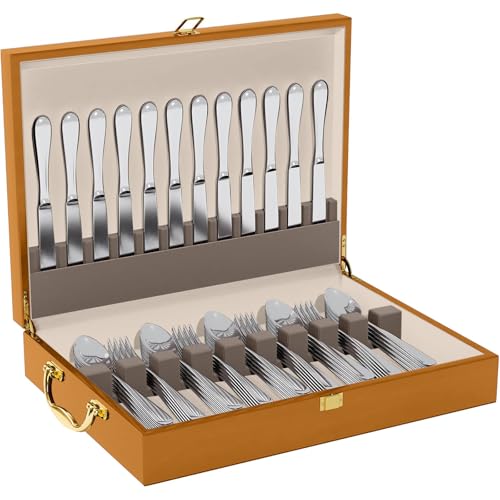
- Best for: One formal set stored in a shallow sideboard or buffet drawer.
- Material: Wood, varnished finish
- Colour: Light Walnut
- Dimensions: 11″D x 15″W x 3″H
- Weight: 2 pounds
One formal set stored in a shallow sideboard or buffet drawer.
The three-inch height leaves little clearance, so serving pieces with thick handles may stop the lid closing flat; test your longest piece first.
Where the layered chests grow upward, this WGLILO box stays low: at three inches tall it slides into the shallow drawer of a sideboard or buffet where taller cases cannot go. The wooden body has a varnished finish in a light walnut colour, a felt-lined interior and a carry handle, and the listing rates it for twelve sets of forks, knives and spoons. It is the natural home for a single good set that you want separated and padded but still within reach of the dining table, rather than boxed away in a closet.
Watch out for: The three-inch height leaves little clearance, so serving pieces with thick handles may stop the lid closing flat; test your longest piece first.
ACBORN Silverware Storage Box, Three-Layer
- Best for: Large or combined sets that need the widest three-layer layout in one case.
- Dimensions: 16.3 x 11.6 x 6.88 inches
- Weight: 11.36 pounds
- Design: Three-layer chest with lid and handle
- Use: Silverware storage
Large or combined sets that need the widest three-layer layout in one case.
It is heavy even when empty, so plan a low, sturdy shelf; the listing does not detail the interior lining, so check the product photos if tarnish protection is your priority.
The ACBORN is the biggest footprint in this group, a three-layer case measuring 16.3 inches wide that trades portability for sheer room. Three levels let you separate everyday place pieces from serving tools and rarely used extras, and the lid and handle keep the case closed and carryable despite its size. At over eleven pounds before any flatware goes in, it is a substantial piece of storage furniture rather than a light box, which suits a large household set that stays in one place: a pantry shelf, a buffet cabinet or the bottom of a china cupboard.
Watch out for: It is heavy even when empty, so plan a low, sturdy shelf; the listing does not detail the interior lining, so check the product photos if tarnish protection is your priority.
Household Essentials Windowed Flatware Storage Chest
- Best for: Holiday and occasional-use sets stored on a closet or pantry shelf.
- Material: Fabric
- Colour: Grey
- Compartments: 5, plus a serving utensil pouch
- Lid: Removable, windowed, lift-off opening
Holiday and occasional-use sets stored on a closet or pantry shelf.
Fabric sides flex, so do not stack heavy items on top of it, and the windowed lid is a viewing panel rather than an airtight seal.
This fabric chest from Household Essentials is built for the set that comes out a few times a year. Five compartments organise place pieces and serving utensils, a pouch holds serving utensils, and the removable lid has a window so you can confirm what is inside without opening it on a dusty closet shelf. The chest is stackable when full and folds when empty, and at 1.4 pounds it is easy to carry down from a high shelf. It gives up the crush protection of wood, so it belongs in calm storage, not under a pile of other boxes.
Watch out for: Fabric sides flex, so do not stack heavy items on top of it, and the windowed lid is a viewing panel rather than an airtight seal.
Lafulling Flatware Storage Box, 2-Pack
- Best for: Splitting two smaller sets between locations, or separating formal and everyday flatware.
- Material: Polyester, hard shell
- Closure: Zipper lid with clear window
- Compartments: 5, with adjustable dividers
- Pack: 2 cases
Splitting two smaller sets between locations, or separating formal and everyday flatware.
The case core is board rather than solid wood, so keep it in dry storage and avoid stacking heavy boxes on top of it.
Sold as a pair, these zippered hard-shell cases suit households splitting storage: one case for the formal set, one for everyday overflow, or one kept at home and one at a holiday place. Each case has five compartments with adjustable dividers, so the layout adapts to long knives or short teaspoons instead of forcing a fixed grid. A clear window in the lid identifies the contents, the zipper keeps dust out, and the cases collapse when empty. The polyester shell is rigid enough to hold its shape on a shelf, though it is not furniture-grade protection.
Watch out for: The case core is board rather than solid wood, so keep it in dry storage and avoid stacking heavy boxes on top of it.
Which One Fits Your Situation
You Host Big Dinners With Service for Sixteen
Choose a layered wooden chest and give serving pieces their own level. The GENRICE three-layer chest is stated to hold sixteen or more sets, and the ACBORN offers the widest three-layer layout if your pieces run long. Both keep a full service in one lift, so setting a large table means carrying one chest, not opening several boxes.
Your Good Set Lives in a Sideboard Drawer
Measure the drawer height, then look at the WGLILO. At three inches tall with a felt lining and a varnished wood body, it fits the shallow drawers that rule out layered chests, and it keeps a twelve-piece service padded and separated where you actually use it, a few steps from the table.
The Set Comes Out Only for Holidays
Light, shelf-friendly storage wins here. The Household Essentials chest folds when empty, stacks when full and shows its contents through the windowed lid, while the Lafulling two-pack lets you split a big collection across two smaller cases that are easier to lift down from a high shelf.
You Are Storing an Inherited Sterling Set
Prioritise lining and a closed lid. The felt-lined GENRICE and WGLILO chests cushion pieces so they cannot rub, and their wooden bodies keep dust and light out between uses. Load the set clean and fully dry, keep serving pieces in the widest slots, and store the chest somewhere with steady, dry air.
Common Mistakes
- Buying by place-setting count alone, then finding the serving pieces are too long or too thick for any slot in the chest.
- Storing sterling or silver plate in an unlined box, where pieces rub against bare wood or each other and tarnish faster.
- Skipping the tape measure: a layered chest that is too tall for the drawer or shelf it was bought for ends up stored somewhere inconvenient.
- Putting flatware away slightly damp, which seals moisture inside the chest and leaves water spots or corrosion on blades.
- Choosing a soft-sided case for a heavy full service, then stacking other storage on top of it and crushing the contents.
Frequently Asked Questions
How many pieces of flatware fit in a chest?
It depends on the layout more than the box size. Single-layer chests commonly hold one service for twelve, roughly sixty place pieces plus a few serving tools. Layered chests stack two or three trays and can hold service for sixteen or more. Count your serving pieces separately, because they consume the widest slots first.
Does a felt lining really slow down tarnish?
Felt helps in two ways: it pads pieces so they do not scratch each other, and together with a closed lid it limits the air reaching the silver. Some linings are treated to absorb tarnish-causing gases and work better still. No lining makes a chest airtight, so clean, dry storage conditions still matter.
Can a flatware chest go inside a kitchen drawer?
Yes, if the height works. Slim chests around three inches tall are made for drawers and sideboards, while layered chests near seven inches tall usually are not. Measure the drawer’s interior height with the chest lid included, and leave a little clearance so the lid does not scrape every time the drawer moves.
How should flatware be prepared before long-term storage?
Wash and dry every piece completely, since trapped moisture is the main cause of spots inside a closed chest. Polish sterling only if you prefer it bright; handling with clean, dry hands or cotton gloves keeps skin oils off the surface. Then lay pieces in their slots without forcing them, and close the lid fully.
More from Amazon
Programs that pair well with the guide above. Offers and eligibility are set by Amazon and may change.
Collect the home and kitchen items you want in one registry that guests can shop from.
Create a wedding registrySet up recurring deliveries of everyday items on eligible products. Terms and savings are set by Amazon.
Explore Subscribe & SaveFree shipping on eligible items, Prime Video and more. Eligible new members can start with a free trial.
Start a Prime free trialAudiobooks and podcasts to listen to on the go. Eligible new members can start with a free trial.
Try Audible freeAs an Amazon Associate we earn from qualifying purchases.