Our Top Picks
The best whole house air purifier is usually a high-grade filter or air cleaner installed in your existing HVAC system if you have ducted forced air, and a set of room purifiers if you do not. Ducted homes with a compatible blower suit an in-duct media cleaner from makers such as Aprilaire or Honeywell Home, while apartments, ductless homes and renters are better served by a few well-sized portable units from brands such as Coway, Blueair, Levoit or Winix. This guide explains the trade-offs by budget tier, with no prices quoted.
What “whole house” really means
There is no single standard for the term. Makers use it for two different product types: units that attach to the home’s ductwork and treat air as it circulates through the HVAC system, and larger portable units that claim to cover a big open floor plan. Neither works unless air actually moves through the space. In-duct cleaners only filter when the system blower runs, so a system that cycles on and off will clean less than one set to run the fan more often. Portable units only treat the room they are in, and closed doors limit their reach.

MOOKA Air Purifier for Home Large Room up to 2200 Ft², H13 True HEPA, PR1 | Pet Mode Air purifier with 26db Quiet HEPA Sleep Mode, AQI Display, Air Cleaner for Pets Hair Dander, Smoke, Odors, Pollen
Chosen because it specifies H13 True HEPA and PR1.
View on Amazon
LEVOIT Smart Air Purifier for Home Large Room up to 1875 Ft² Vital 200S-P | For Quiet Bedroom at 27dB, AHAM VERIFIDE, Air Quality Monitor, HEPA Sleep Mode for Allergies, Pet Hair and dander, White
Chosen because it specifies For Quiet Bedroom at 27dB and AHAM VERIFIDE.
View on Amazon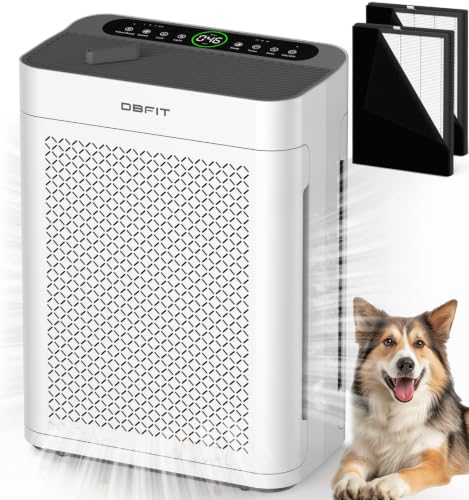
Air Purifiers for Home Large Room up to 3000sq.ft, DBFIT HEPA Double-Sided Air Purifier with Washable Filter, PM 2.5 Display Air Quality Sensor, Air Cleaner for Bedroom, Dorm Room, Pets, Office, AP300
Chosen because it specifies DBFIT HEPA Double-Sided Air Purifier with Washable Filter and PM 2.5 Display Air Quality Sensor.
View on Amazon
WINIX 5510 Air Purifier (New Generation of 5500-2 with App Support) for Home Large Room Up to 1881 Ft² in 1 Hr, True HEPA, High Deodorization Carbon Filter and Auto Mode, Captures Pet Allergies, Smoke
Chosen because it specifies True HEPA and High Deodorization Carbon Filter and Auto Mode.
View on AmazonAt a glance: main routes to whole-home air cleaning
| Approach | Best for | Key stated features | Limits |
|---|---|---|---|
| In-duct media air cleaner (Aprilaire 2210 / 2410 class) | Ducted forced-air homes, owners who prefer set-and-forget | Makers list deep pleated media in a cabinet, with replacement every several months to a year; MERV 11 to 16 grades are common in this category | Needs installation space and an HVAC technician; high-grade media can restrict airflow on some systems |
| Honeywell Home media filter cabinets | Homes with existing filter slots that can take a thicker filter | Maker lists a multi-inch media filter with high-efficiency grades | Fit and blower compatibility need to be confirmed; professional installation commonly advised |
| High-MERV drop-in filters | Renters and those with standard filter slots | Pleated filters in standard sizes with MERV ratings from the maker | Highest grades can strain older blowers; check the furnace manual |
| Multiple portable HEPA units (Coway, Blueair, Levoit, Winix classes) | Apartments, homes without ducts, targeted rooms | Makers list True HEPA or HEPA-type filters with stated room coverage and fan speeds | Multiple filters to replace; noise and placement across several rooms |
| Large-room portable units (Blueair 311 class, Honeywell HPA300 class) | Open-plan living areas | Higher airflow with coverage claims for big rooms | Still limited to a connected space |
In-duct systems: what to check first
Ask an HVAC technician before buying. The things that matter are blower capacity, the size and location of your filter slot, and the static pressure of your ductwork. Thick media cabinets typically hold a deep filter and lower airflow resistance than a thin filter of the same grade, which is why makers promote them for systems that cannot handle a thin high-MERV filter. Many makers state compatibility ranges in tons or CFM, so keep your system’s specification handy.
MERV is a rating of filter efficiency. Higher numbers capture smaller particles, but the rating does not equal HEPA performance. A MERV 13 or higher is often described by independent outlets as a sensible target for homes if the system tolerates it. Follow the furnace or air handler manual, and do not remove the filter or modify the system without a professional.
Portable route: how many units do you need?
For a typical home, many reviewers suggest placing a unit in the rooms where you spend the most time, usually the bedroom and main living area, then adding more if needed. Check each maker’s coverage claim, and remember it normally assumes a closed room. Open plan areas with a large stated coverage may need a high-capacity unit.
- Bedroom: a quiet mid-size tower such as a Coway Airmega 200M class or Levoit Core 600S class unit.
- Living room: a Blueair Blue Pure 311 class or Honeywell HPA300 class unit, sized to the floor area.
- Home office: a compact unit such as the Levoit Core 300 class.
Ongoing costs and maintenance
In-duct media filters are replaced about once or twice a year per most makers, which is simpler than managing several portable filters. Portable systems have a higher count of filters and a higher electricity load across multiple fans. Budget tiers fit as follows: budget systems rely on high-MERV drop-in filters and one or two compact purifiers, mid-range options include a media cabinet or several quality portables, and premium setups combine an in-duct system with portable units in key rooms.
Whatever you choose, keep a reminder to change filters. A loaded filter reduces airflow and cleaning performance and can stress the blower.
UV lights and other add-ons
Some in-duct products add UV lamps or electronic cells. Makers describe these as supplemental, and independent outlets often caution that evidence of benefit varies and that some electronic or ozone-producing devices need care. If you consider one, look for regulatory certification for ozone emissions, follow the installation instructions exactly, and use a licensed technician for anything wired into the HVAC system. Do not rely on any device as a medical solution; people with asthma or allergies should discuss their situation with a doctor.
Pick X if…
| Pick this | If you |
|---|---|
| Aprilaire or Honeywell Home media cabinet | Own a ducted home, want whole-home coverage and are willing to pay for installation |
| High-MERV drop-in filter | Rent or want the lowest-effort upgrade, and your system tolerates it |
| Several mid-size portables | Live in an apartment or home without ducts |
| Large-room unit like Blueair 311 or Honeywell HPA300 | Have an open plan living area |
| Combination of in-duct plus portable | Want premium-tier coverage with a quiet bedroom unit |
Alternatives
- Ventilation upgrades: bathroom and kitchen exhaust fans used correctly reduce moisture and cooking particles at the source.
- Energy recovery ventilators: for tight, newer homes, a pro can discuss ventilation with filtered fresh air.
- Source control: regular vacuuming, doormats and washable bedding reduce load on any system.
Frequently Asked Questions
Are whole house air purifiers worth it?
It depends on your home. Ducted homes that run the fan often can benefit from an in-duct media cleaner, but the improvement depends on filter grade and run time. If you mostly want clean air in one or two rooms, portable units can be more cost-effective.
Will a high-MERV filter damage my furnace?
It can if the filter restricts airflow beyond what the blower is designed for. Check the furnace or air handler manual and ask a technician, particularly in older systems.
Is a MERV 13 filter the same as HEPA?
No. HEPA is a defined standard that captures at least 99.97 percent of 0.3 micron particles, while MERV 13 is a lower efficiency grade. It is still a useful upgrade for many homes.
Do I need to run the HVAC fan constantly?
For an in-duct cleaner to work, air has to move through it. Many homeowners set the fan to circulate, but this raises energy use and should follow the system’s instructions.
How often do whole-home filters need replacing?
Media cabinet filters are usually changed every six to twelve months according to makers, while thin drop-in filters are more often replaced every one to three months. Check your model’s schedule.
Can I install an in-duct air cleaner myself?
Some drop-in options are simple, but cabinets and electrical add-ons usually call for a licensed HVAC technician or electrician. Poor installation can cause leaks, airflow problems or safety issues.
More from Amazon
Programs that pair well with the guide above. Offers and eligibility are set by Amazon and may change.
Collect the home and kitchen items you want in one registry that guests can shop from.
Create a wedding registrySet up recurring deliveries of everyday items on eligible products. Terms and savings are set by Amazon.
Explore Subscribe & SaveFree shipping on eligible items, Prime Video and more. Eligible new members can start with a free trial.
Start a Prime free trialAudiobooks and podcasts to listen to on the go. Eligible new members can start with a free trial.
Try Audible freeAs an Amazon Associate we earn from qualifying purchases.