Key takeaways
What's inside
Setting up a high-performance home office is no longer just about finding a flat surface and an adjustable chair. It is an investment in your daily physical well-being, productivity, and home aesthetics. When choosing the foundation of your active workspace, the head-to-head matchup of a bamboo standing desk vs solid wood standing desk is one of the most critical decisions you will make.
At first glance, both materials offer a warm, organic alternative to cold industrial plastics and cheap particleboard. However, beneath the surface lies a deep contrast in structural engineering, weight distribution, tactile feedback, and long-term durability. Standing desks undergo constant mechanical movement, height adjustments, and shifting loads. Therefore, the material you choose affects not just how your office looks, but how much your monitors wobble at a 45-inch height, how easily the surface scratches under daily use, and how the desk responds to seasonal humidity changes.
As an Amazon Associate we earn from qualifying purchases at no extra cost to you. Product prices and availability are accurate as of the date shown and are subject to change.


Quick Verdict
Choose a bamboo standing desk if you want a lightweight, highly scratch-resistant, and eco-friendly workspace with a clean, contemporary aesthetic at an accessible price point. Choose a solid wood standing desk if you view your desk as a lifetime investment, prefer the unique, rich grain patterns of authentic timber, require superior dampening against monitor wobble, and want the ability to sand down and refinish your desktop decades down the road.
Side by Side
To help you visualize the core differences, this comparison table breaks down how these two desktop materials perform across key operational and aesthetic categories:
| Category | Bamboo Standing Desk | Solid Wood Standing Desk |
|---|---|---|
| Material Composition | Laminated, compressed grass fibers arranged in vertical or horizontal strips. | 100% natural timber cut from hardwood or softwood trees (e.g., walnut, oak, rubberwood). |
| Tactile Feel & Look | Uniform, light-toned, modern linear patterns with visible growth nodes. | Rich, varied grain patterns, deep natural colors, and unique organic character. |
| Durability & Hardness | Highly resistant to surface scratches; very resilient under daily wear. | Varies by wood species; prone to dents but can be fully sanded and refinished. |
| Average Desktop Weight | Lightweight to moderate (approx. 25–35 lbs for a 55″ top). | Heavy to very heavy (approx. 40–65 lbs for a 55″ top). |
| Frame Stability Impact | Lighter top reduces strain on motors but can result in slight wobble at max height. | Heavy top acts as a ballast, significantly dampening lateral wobbles and vibrations. |
| Price Range | Budget to Mid-range ($150 to $450 complete). | Mid-range to Premium ($200 to $1,500+ complete). |
| Maintenance | Minimal; wipe clean with a damp cloth; highly moisture-resistant. | Moderate; requires occasional oiling or conditioning; sensitive to dry air. |
| Resale Value | Moderate; appeals to students and modern home office seekers. | High; retains value as heirloom furniture. |
| Best For | Eco-conscious buyers, rentals, and minimalist setups. | Dedicated home offices, heavy multi-monitor setups, and luxury interiors. |
Where Bamboo Standing Desk Wins
Bamboo is technically a grass, not a wood, and this botanical distinction gives it several engineering advantages. Because bamboo matures in just three to five years—compared to the decades required for hardwoods—it is incredibly sustainable. For those looking to reduce their ecological footprint, bamboo is an exemplary choice.
From a structural standpoint, compressed bamboo possesses an impressive tensile strength that rivals steel. When manufactured into a desktop, the bamboo stalks are sliced into strips, kiln-dried, and glued under immense pressure. This process creates a incredibly dense surface that is highly resistant to the dings, pressure marks, and surface scratches that easily mar softer woods. If you frequently drop pens, slide heavy equipment around, or write directly on your desk surface, bamboo holds up remarkably well without showing immediate wear.
Furthermore, bamboo is inherently stable in changing environments. Unlike solid wood, which expands and contracts across its grain lines with shifts in indoor humidity, laminated bamboo is highly dimensionally stable. It resists warping, cupping, and cracking in dry winters or humid summers.
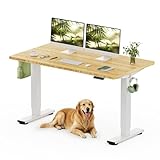
Finally, bamboo is exceptionally cost-effective. You can secure a spacious, high-quality bamboo workspace, such as the FLEXISPOT 55″ x 28″ Solid Bamboo Standing Desk, White Frame ($215.99), for a fraction of the cost of premium hardwoods. This lighter weight also makes shipping cheaper and assembly much easier on your back.
Where Solid Wood Standing Desk Wins
There is an undeniable, prestigious tactile experience that only genuine timber can provide. Solid wood standing desks win decisively on aesthetics, structural dampening, and long-term restoration potential. Each solid wood top is a unique piece of nature, featuring distinct grain swirls, knots, and color gradients that cannot be replicated by the uniform, repetitive strip pattern of bamboo.
The sheer mass of a solid wood top is a major engineering advantage for a height-adjustable desk. When a standing desk is raised to 40 inches or higher, the entire structure becomes susceptible to lateral sway, commonly referred to as “desk wobble.” The substantial weight of a solid timber top—such as a dense walnut or oak slab—acts as a natural ballast. It lowers the system’s center of gravity and dampens vibrations from typing or mouse movements. If you run a multi-monitor setup on articulated arms, this weight difference is crucial for keeping your screens perfectly still.
While solid wood can dent or scratch more easily than compressed bamboo depending on the species, it has a major advantage: repairability. If you gouge a solid wood desk, you can simply sand down the affected area, apply a fresh coat of stain or polyurethane, and restore it to brand-new condition. Bamboo, because of its laminated strip construction and thin protective sealants, cannot be easily sanded down or refinished without risking delamination.
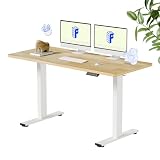
You can find incredibly accessible entry points to timber, such as the FLEXISPOT 55″ x 24″ Solid Wood Standing Desk, White Frame ($209.99). If you want to invest in a truly premium, dense hardwood workspace, opting for a Solid Wood Electric Standing Desk, 55″x23.6″ Walnut Standing Desk ($439.99) provides a level of luxury and structural permanence that elevates an entire room.
Cost Over 5 Years
When calculating the true cost of a standing desk, you must look past the initial checkout price and consider the cost of ownership over a five-year lifecycle.
A bamboo standing desk represents a lower initial financial hurdle. However, because bamboo cannot be deeply sanded or easily repaired, a severe scratch, water ring, or deep gouge from a monitor mount can make the desk look worn by year four or five. If the aesthetic degrades to the point where you want to replace the desktop, your five-year cost includes the initial purchase plus a replacement top.
A solid wood standing desk has a higher upfront cost, particularly if you choose premium hardwoods like walnut or cherry. However, its value retention is exceptional. Over five years, any minor blemishes can be spot-repaired or completely refinished over a weekend. If your style preferences change, you can sand the wood and apply a completely different stain color. Additionally, solid wood desks command a much higher price on the secondhand furniture market. When viewed as a long-term investment, the cost-per-year of a solid wood desk often ends up lower than that of cheaper alternatives.
Which One for Your Home
As we design home workspaces for 2026 and beyond, the criteria for a great desk have expanded. The right choice depends heavily on your specific living situation and household dynamics.
Small Apartment
In a compact living space, every square inch and pound of weight matters. A bamboo standing desk is highly recommended here. Its lighter weight makes it much easier to assemble in tight quarters, maneuver around narrow hallways, or reposition when you want to rearrange your room. It offers a bright, airy aesthetic that makes small rooms feel larger and less cluttered.
Family with Kids or Pets
If your home office double-functions as a homework station or is situated in a high-traffic area where kids and pets roam, durability is your top priority. Bamboo’s natural resistance to scratching and denting makes it a highly practical shield against stray toys, colored markers, and pet claws. However, if you prefer the look of wood grain but want to keep costs low in a busy household, a budget-friendly option like the FEZIBO Standing Desk 48 × 24 Inch Electric Height Adjustable, Maple ($112.99) offers a highly resilient, worry-free alternative for family spaces.
Rental Home
If you move every year or two, solid wood can be a liability. Heavy timber tops are prone to getting dinged, chipped, or gouged in transit by moving companies. Their sheer weight also makes moving day significantly more exhausting. A bamboo desk is far more forgiving during moves; it is lightweight, easy to pack, and tough enough to survive being loaded into a moving truck without requiring heavy blankets and meticulous crating.
Long-Term Home
If you are settled in a permanent home and want to establish a dedicated, sophisticated study or home office, a solid wood standing desk is the clear winner. It coordinates beautifully with existing high-end cabinetry, bookshelves, and flooring. A solid wood desk acts as a statement piece of furniture that anchors the room, growing more beautiful with age and developing a rich patina over decades of use.
FAQ
Is bamboo more sustainable than solid wood?
Yes, bamboo is generally considered more sustainable than most solid hardwoods. Bamboo is a fast-growing grass that can be harvested every 3 to 5 years without destroying the root system, allowing it to naturally regenerate. Hardwood trees can take anywhere from 30 to 100 years to reach maturity, and harvesting them requires replanting and waiting decades for regrowth.
Will a solid wood standing desk warp over time?
Solid wood can warp, cup, or split if it is exposed to extreme, rapid shifts in humidity and temperature, or if it is placed directly over a heating vent. However, high-quality solid wood standing desks are properly sealed with protective lacquers, varnishes, or oils to slow down moisture exchange and prevent warping under normal indoor conditions.
Which material is better for mounting heavy dual-monitor arms?
Both materials can handle monitor mounts, but solid wood is slightly better suited for exceptionally heavy or complex multi-monitor setups. Because solid wood is uniform throughout, it handles the concentrated compression force of a heavy clamp mount exceptionally well. Bamboo is also strong, but you should use a reinforcement plate to distribute the clamp’s pressure and protect the laminated layers from localized stress.
Do bamboo desks look cheap compared to real wood?
No, high-quality bamboo desks do not look cheap; they simply have a different aesthetic. Bamboo features a distinct, modern, linear grain with visible knuckles or nodes, giving it a clean, Scandinavian, or Zen-like vibe. Solid wood, by contrast, has a traditional, luxury furniture appearance characterized by organic, flowing grain patterns and deep natural color variations.