Choosing the right home office setup is no longer just a matter of picking a flat surface to hold a laptop. It is a critical decision that impacts your daily physical comfort, your productivity, and the spatial flow of your home. The core dilemma for most remote professionals and gamers boils down to a fundamental choice of layout: the sprawling, corner-hugging L-shaped desk versus the active, health-conscious straight standing desk.
As we design our home workspaces for 2026 and beyond, we are forced to balance two competing priorities. On one hand, we have the need for maximum desktop real estate to manage multiple screens, papers, and peripherals. On the other hand, we have the physiological necessity of movement to combat the sedentary strains of a eight-to-ten-hour workday. While one layout optimizes the horizontal plane by wrapping around you, the other optimizes the vertical plane, allowing you to transition from sitting to standing at the press of a button. Understanding how these configurations perform in real-world home environments is key to making an investment you will not regret.
Our top picks
 ODK 53" L Shaped Gaming Desk with
- 【Computer Desk with Powerful Storage Function】This L-shaped computer…
- 【Built-in USB Charging Ports & Power Outlets 】Equipped…
- 【L Gaming Desk with Adjustable LED Lighting】The gaming…

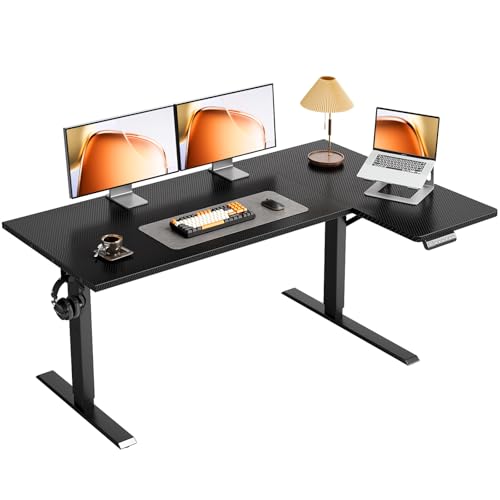

As an Amazon Associate we earn from qualifying purchases at no extra cost to you.
Quick Verdict
If your daily workflow requires intense multitasking, physical documents, multiple monitors, or if you need to tuck your workspace into the corner of a multi-use room, the L-shaped desk is your best option. It maximizes dead corner space and offers unmatched surface area per dollar spent.
However, if your priority is long-term physical health, spinal alignment, and maintaining an active, minimalist workspace, the straight standing desk layout wins. It forces you to declutter, fits easily along flat walls, and encourages regular postural shifts that keep fatigue at bay throughout the day.
Side by Side
To help you visualize how these two layouts compare across the most critical buying factors, we have outlined their performance characteristics below:
| Feature | L-Shaped Desk Layout | Straight Standing Desk Layout |
|---|---|---|
| Comfort & Ergonomics | Excellent arm support; encourages sitting but limits postural movement. | Outstanding; allows seamless transitions between sitting and standing. |
| Durability | Highly stable; fewer moving parts mean less structural wear over time. | Dependent on motor quality; lifting mechanisms can wear out over 5–10 years. |
| Price Range | $80 to $350 for static models; $250 to $700+ for motorized versions. | $150 to $600+ depending on single vs. dual motor configurations. |
| Maintenance | Low; simple dusting and occasional bolt tightening. | Moderate; requires cable management clearance and occasional motor resets. |
| Space Needed | Requires a dedicated corner or a large open floor area (minimum 5′ x 5′). | Compact; fits against any flat wall segment (typical footprint 5′ x 2′). |
| Aesthetic Look | Commanding, executive feel; can look bulky in smaller rooms. | Clean, modern, and minimalist; keeps the room feeling open. |
| Resale Value | Moderate; harder to transport, which limits the local buyer pool. | High; highly sought after by remote workers and easy to disassemble. |
| Best For | Multi-monitor users, paper-heavy workflows, and gamers. | Health-conscious professionals, minimalist setups, and tight spaces. |
Where L Shaped Desk Wins
The primary advantage of an L-shaped desk layout is the sheer volume of accessible workspace. By wrapping around your seating position, it puts two distinct work zones within arm’s reach without requiring you to slide your chair across the floor. This “cockpit” effect is incredibly efficient for professionals who manage hybrid workflows—such as keeping a computer setup on one wing and a writing or sketching station on the other.
Additionally, L-shaped desks are the undisputed champions of corner optimization. Standard rectangular desks often leave awkward, unusable gaps when pushed into a corner, whereas an L-shaped frame utilizes every square inch of wall intersection. This layout is also highly economical if you do not require motorized height adjustment. For instance, budget-friendly options like the ODK 53″ L Shaped Gaming Desk with Shelves, LED & Outlets, Black (priced at $89.98) or the AODK L Shaped Desk Gaming Desk with LED Light & Power Outlet (priced at $109.99) offer massive amounts of storage, integrated power strips, and ambient lighting for a fraction of the cost of a motorized standing frame.
Finally, static L-shaped desks offer incredible physical stability. Because they sit on at least four, and often six, widely spaced steel legs, they experience virtually zero lateral wobble. This makes them ideal for heavy equipment setups, including desktop tower PCs, large printer units, and clamp-on multi-monitor arms that can cause lesser, two-legged desks to sway during typing.
Where Straight Standing Desk Layout Wins
Where the straight standing desk layout lacks in sheer surface area, it more than makes up for in physical wellness and layout flexibility. Sit-stand ergonomics are designed to combat the cardiovascular and musculoskeletal risks of prolonged sitting. By allowing you to raise your entire workspace to a standing height (typically ranging from 28 to 48 inches), a straight standing desk layout keeps your core engaged, improves circulation, and relieves pressure on your lumbar spine.
A straight desk also boasts a highly compact footprint. A standard 60-inch by 24-inch model, such as the VIVO Black 60 x 24 in Standing Desk, DESK-KIT-1B6B (priced at $199.99), can fit comfortably against almost any flat wall, inside a bedroom alcove, or even floated in the middle of a room without dominating the space visually. The clean, linear lines of a straight desk prevent a room from feeling crowded, making it a favorite for modern, minimalist home aesthetics.
If you want the best of both worlds, the market has evolved to offer hybrid options. The OffiGo 55″ Reversible L Shaped Electric Standing Desk, Carbon Fiber Black (priced at $149.99) demonstrates that you no longer have to choose strictly between an L-shaped footprint and motorized height adjustment. These hybrid desks use advanced multi-motor synchronization to lift an asymmetrical desktop safely, though they do require more careful cable planning and a bit more floor space than a traditional straight standing desk.
Cost Over 5 Years
When calculating the true cost of ownership for these layouts, you must look beyond the initial purchase price and consider durability, electricity, and potential component replacement over a five-year lifecycle.
A static L-shaped desk is incredibly cost-effective over time. With an initial purchase price of $90 to $150, its maintenance cost over five years is effectively $0. Because there are no motors, control boxes, or moving structural joints, there is nothing to break down. Even under heavy daily use, a well-constructed static frame will easily last a decade, resulting in an annualized cost of under $20 to $30 per year.
A motorized straight standing desk carries a higher long-term cost profile. The initial purchase of a quality standing desk ranges from $150 to $400. Over five years, you must factor in the following:
Therefore, expect a quality straight standing desk to cost roughly $40 to $90 annually over a five-year span, factoring in the initial purchase and potential wear-and-tear repairs.
Which One for Your Home
The Small Apartment Scenario
In a small apartment or studio, floor space is your most precious commodity. A straight standing desk layout is almost always the superior choice here. Its shallow depth (usually 24 inches) allows it to sit flush against a living room wall or behind a couch without blocking walkways. When raised to a standing position, it also allows you to slide an active office chair completely underneath the frame, reclaiming valuable floor space when you are off the clock.
The Family with Kids and Pets
If your home office is situated in a high-traffic area shared with children or pets, safety and stability are paramount. A heavy, static L-shaped desk is highly stable and difficult to tip over, making it incredibly safe. Motorized standing desks present unique challenges in these environments. If you choose a standing desk, ensure it features built-in anti-collision sensors to prevent the desk from crushing an object, toy, or pet underneath it as it lowers. Additionally, you will need to invest in strict cable management to prevent children or pets from pulling on dangling cords while the desk is in motion.
The Rental Home
For renters, portability and ease of assembly are crucial. Heavy, complex L-shaped desks can be a nightmare to move, often requiring complete disassembly to fit through standard 30-inch apartment doorways. A straight standing desk, while heavy due to its steel lifting columns (often weighing 60 to 80 pounds), is much easier to transport. The rectangular desktop can be detached quickly, leaving a simple, compact metal frame that lays flat in a moving truck.
The Long-Term Dedicated Home Office
If you have a dedicated room for your home office in a house you own, you have the luxury of choosing based purely on your workflow. If your job involves physical paperwork, reference books, or complex hardware testing, an L-shaped desk provides the ultimate “command center” feel. However, if your work is entirely digital and you want to prioritize your physical health, posture, and energy levels for the next decade, investing in a high-quality, wide straight standing desk is the most rewarding choice you can make.
FAQ
Can you turn a standard L-shaped desk into a standing desk?
Yes, but it requires specialized hardware. You can purchase desktop standing desk converters designed specifically for corner setups. These units sit on top of your existing static L-shaped desk and lift your monitors and keyboard straight up. Alternatively, you can purchase a dedicated motorized L-shaped frame and mount your existing desktop surfaces to it, provided the pre-drilled holes align or you are comfortable drilling new ones.
How much weight can these desk layouts typically support?
Static L-shaped desks are incredibly robust, often supporting between 150 to 300 pounds of evenly distributed weight because the load is spread across four to six legs. Standard motorized straight standing desks typically have a lifting capacity of 150 to 220 pounds, which includes the weight of the desktop itself. Premium dual-motor or three-stage standing frames can lift up to 350 pounds smoothly.
Which desk layout is better for a dual or triple-monitor setup?
The L-shaped desk is generally superior for multi-monitor setups. The 90-degree return allows you to position secondary monitors along your peripheral vision, creating a natural, curved viewing arc. While a wide straight standing desk (60 to 72 inches) can physically hold three monitors, you will need to invest in a highly adjustable articulated monitor arm to curve the outer screens inward for comfortable viewing angles.
How much clearance space do I need behind a standing desk compared to a fixed desk?
A fixed L-shaped desk can be pushed completely flush against your walls. A motorized standing desk, however, requires at least 1 to 2 inches of clearance from the wall and surrounding furniture. This prevents the moving desktop from scraping your drywall, pinching power cords, or colliding with window sills and bookshelves as it transitions up and down.