Key takeaways
- Capture geometry: A hood should sit close enough to the blade’s discharge path to intercept dust without restricting bevel, miter, or sliding movements.
- Vacuum connection: Check the port diameter and included adapters against your shop vacuum. A loose connection leaks suction and can make even a well-designed hood perform poorly.
- Material durability: Heavy Oxford fabric, reinforced seams, and a stable frame generally tolerate repeated folding, setup, and contact with sharp offcuts better than thin fabric.
- Access and visibility: Lighted designs and accessory openings can improve control around the work area, but they should not interfere with blade guards, fences, or workpiece support.
- Workshop fit: Consider whether you need a portable hood for occasional furniture projects or a more permanent adapter for a frequently used saw. Storage bags are useful when bench space is limited.
What's inside
A miter saw can produce a surprisingly large cloud of fine dust, especially when cutting MDF, plywood, trim, or hardwood. The saw’s blade throws material in several directions, while a small dust port often captures only part of the debris. The result is a messy bench, reduced visibility, and airborne particles that can settle throughout a workshop.
This guide evaluates miter-saw dust solutions from an ergonomics-and-durability perspective. We focus on capture design, hose compatibility, fabric strength, access to controls, portability, and how well each option suits repeat cutting in a home furniture workshop. These accessories work best alongside a properly fitted respirator and a shop vacuum with an appropriate filter.
As an Amazon Associate we earn from qualifying purchases.



How to Choose a Miter Saw Best Dust Collection (2026)
- Capture geometry: A hood should sit close enough to the blade’s discharge path to intercept dust without restricting bevel, miter, or sliding movements.
- Vacuum connection: Check the port diameter and included adapters against your shop vacuum. A loose connection leaks suction and can make even a well-designed hood perform poorly.
- Material durability: Heavy Oxford fabric, reinforced seams, and a stable frame generally tolerate repeated folding, setup, and contact with sharp offcuts better than thin fabric.
- Access and visibility: Lighted designs and accessory openings can improve control around the work area, but they should not interfere with blade guards, fences, or workpiece support.
- Workshop fit: Consider whether you need a portable hood for occasional furniture projects or a more permanent adapter for a frequently used saw. Storage bags are useful when bench space is limited.
The Best Miter Saw Best Dust Collection (2026)s Reviewed
Tredre Dust Collection Hood with Light
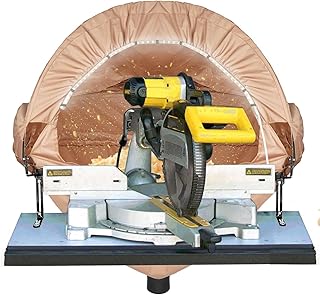
The Tredre Miter Saw Dust Collection Hood with Light is a versatile choice for owners of 10- and 12-inch miter saws. Its 4-inch-to-2.5-inch shop-vac adapter broadens compatibility, while the integrated light can help illuminate the cut zone in a garage with uneven lighting. The included storage bag is practical for users who set up and pack away their saw regularly.
Heavy-Duty Oxford Fabric Dust Hood
This Miter Saw Dust Collection Hood uses heavy-duty Oxford fabric and a 4-inch vacuum port, making it appealing for workshops that prioritize straightforward, robust construction. Its broad fit for standard 10-inch sliding and chop saws should suit common home-shop setups, although users should confirm clearance around the saw’s slide rails before installation.
Universal Hood with Light and Accessory Holes
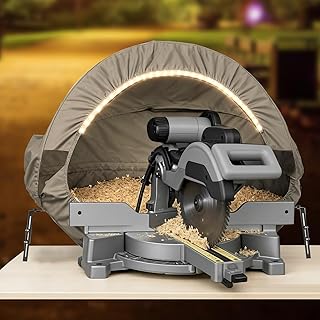
The Miter Saw Dust Collection Hood with Light combines illumination with accessory holes that can make hose routing or tool organization more convenient. Its universal-fit design and storage bag favor portability, while the khaki fabric gives it a less industrial appearance. It is best suited to users who want flexible placement rather than a permanently mounted collection system.
GARVIN Hood with Light
The GARVIN Miter Saw Dust Collection Hood with Light is designed around standard 10-inch miter saws and includes accessory holes for a more adaptable setup. The hood’s light may be particularly helpful when cutting furniture components in a dim workshop, but careful positioning remains important so the collection enclosure does not obstruct the operator’s view of the blade and cut line.
Bench Miter Saw Dust Hood with 4-Inch Port
This Miter Saw Dust Hood with Light focuses on a simple bench-oriented arrangement, pairing a 4-inch dust collection port with a storage bag. It is a sensible option for a stationary miter saw where the vacuum hose can remain connected, though its usefulness will depend on how closely the hood matches the saw’s rear dust plume and available bench clearance.
Frequently Asked Questions
Do miter saw dust hoods eliminate all dust?
No. They can substantially reduce airborne and surface dust when paired with a strong shop vacuum, but some debris will still escape from the blade’s lower cutting area and from the front of the workpiece. Use extraction, ventilation, and suitable respiratory protection together.
Is a 4-inch port better than a 2.5-inch port?
A 4-inch port can move more air when connected to a compatible dust extractor, while 2.5-inch hoses are common with compact shop vacuums. The best choice is the one that matches your vacuum without restrictive reducers, leaks, or excessively long hose runs.
Will these hoods fit sliding miter saws?
Several are marketed for standard sliding saws, but fit is not universal in practice. Before buying, compare the hood’s opening and mounting area with the saw’s slide mechanism, bevel range, fence height, and rear clearance.
What about a saw-specific adapter?
The Improved Miter Saw Dust Collection Adapter, compatible with DWS779 and DWS780 saws, may be preferable when you own one of those models and want a more targeted connection. Its five-in-one vacuum connector is intended to simplify hose compatibility, but it is less universal than a freestanding hood.
Final Thoughts
For broad compatibility, the Tredre hood is a strong starting point; the heavy-duty Oxford fabric model is attractive for straightforward workshop use, while the GARVIN hood adds useful lighting and flexible accessory access. Whichever design you choose, prioritize an airtight vacuum connection and unobstructed saw movement—those details determine whether dust collection remains effective after the novelty wears off.