Key takeaways
- Compare assembled and flat-pack office storage by usable capacity, delivery route, assembly space and the work needed before use.
Choose between assembled and flat-pack office storage by comparing the complete route from delivery to daily use. Check the delivered dimensions, the work still required in your room and the usable storage inside. “Assembled” does not always mean ready to use, while “flat-pack” does not guarantee that the boxes will be light or easy to carry.
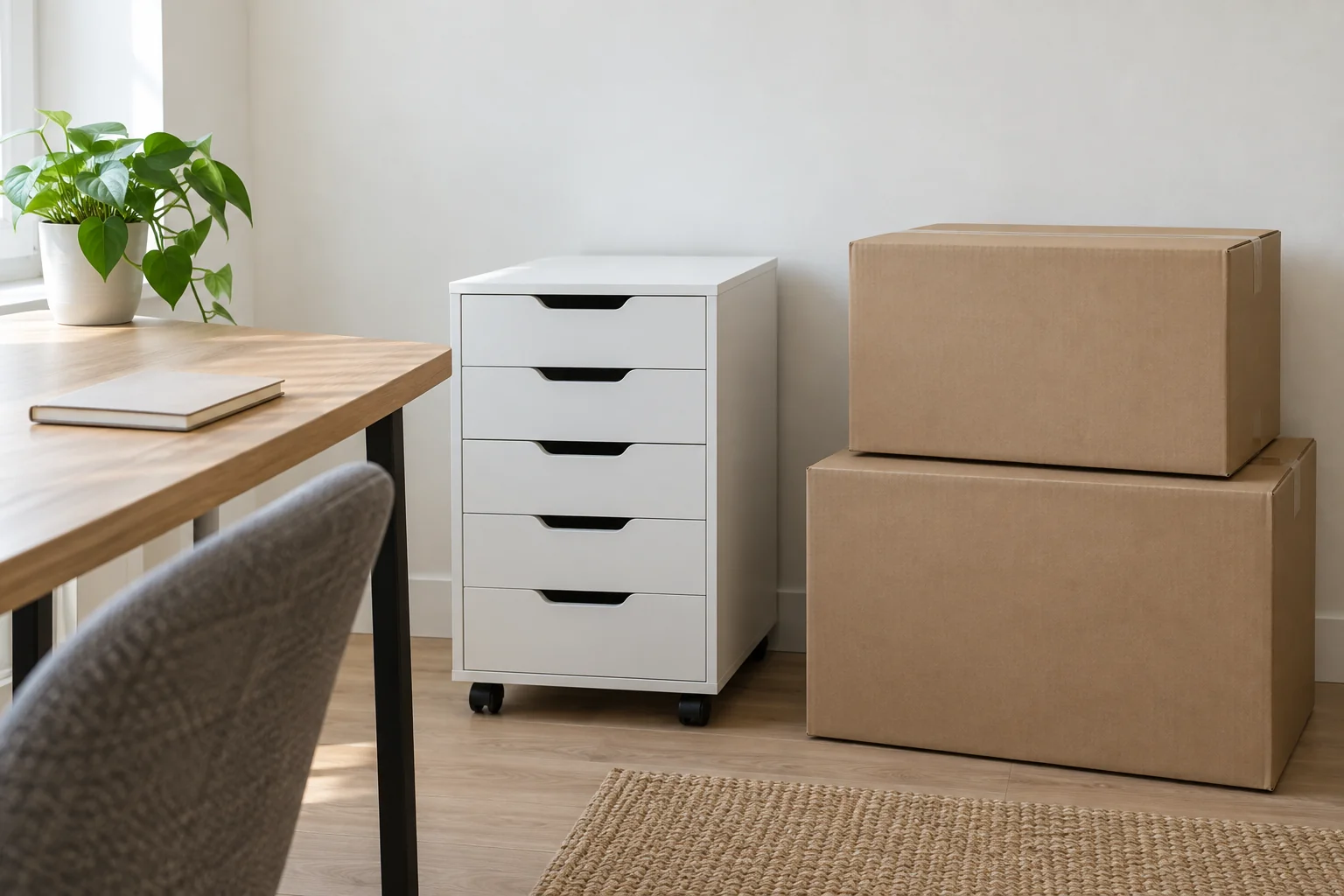
Make the storage job the same for both options
List what the unit must hold: hanging files, tall binders, stationery or equipment. Record the dimensions of the actual items, including any file rails or organizers they need. Two cabinets with equal outside dimensions can offer different usable interior space.
Write down the desired location and how doors or drawers will open there. A candidate should meet those everyday requirements before delivery format enters the comparison. Otherwise, you may choose an easy-to-assemble unit that cannot hold the materials it was bought for.
Compare the exact selected models. Drawer counts, shelf adjustments and permitted loads are product specifications, not reliable consequences of being assembled or flat-packed. Avoid assigning one format an automatic quality advantage without examining the construction and instructions of the candidates.
Keep delivered and finished dimensions separate
The IKEA US ALEX drawer unit 004.735.46 listing illustrates why this matters: it separately lists assembled dimensions, package measurements and assembly instructions. Its listed package is 32 inches long, 23 1/2 inches wide and 4 1/4 inches high, rather than the finished cabinet’s upright shape. Check the current selected version before planning a delivery.
For each option, obtain the number of delivered pieces or cartons, their dimensions and weights, and the delivery service’s actual scope. An assembled cabinet may still need feet, handles, shelves or required installation steps completed. A seller’s photograph of the finished item does not describe how it will arrive.
Measure door openings, turns, stairs and the final approach to the room. A box fitting through one doorway does not prove it can turn on a landing. Ask the delivery provider to assess an uncertain route rather than planning to remove structural parts or tip a heavy load without suitable assistance.
Use this original two-option decision sheet
| Requirement | Assembled candidate | Flat-pack candidate |
|---|---|---|
| Useful storage | Interior measurements and load limits | Equivalent usable space and limits |
| Delivery route | Delivered item dimensions and handling plan | Every carton, not only the largest-looking one |
| Remaining work | Fittings, placement and required installation | Full assembly sequence and required installation |
| Working space | Unpacking and positioning area | Space for parts, assembly and any instructed turning step |
| Help and timing | Delivery or setup assistance confirmed | Required people, tools and uninterrupted work period |
| Disruption | Existing storage emptied and moved when? | Where contents stay until assembly is complete |
| Problem handling | Damage reporting and return conditions | Missing-part support and return conditions |
Mark each entry confirmed, needs checking or unsuitable. Do not use a total score to cancel an essential failure. A cabinet that cannot reach the room does not become a good fit because it wins several less important categories.
Account for the temporary workspace
Read the assembly instructions before deciding that an empty corner is enough. The finished footprint can be smaller than the space needed to lay out panels or complete an instructed turning step. Keep the work area and the normal exit route separate.
For an illustrative paper plan, a cabinet will occupy 30 by 18 inches after assembly. A proposed clear work rectangle is 60 by 48 inches. Its area is 20 square feet, compared with 3.75 square feet for the cabinet footprint. The difference shows why a finished-size sketch alone is incomplete; it does not establish that this particular work rectangle is adequate for an unspecified product.
Check the actual instructions and available assistance against your room. If the only assembly area is also needed for daily work, decide how to pause safely and keep incomplete furniture and loose hardware away from unintended users. Do not load an incomplete unit to reclaim space sooner.
Choose the option with a complete plan
Compare the full agreed cost only after both options meet the essential requirements. Include the delivery and assembly services you actually need, while keeping quoted costs separate from assumptions about your time. Obtain clarification for missing services instead of entering zero in the budget.
For a future move, ask whether the unit is designed to be disassembled and rebuilt, and what instructions or replacement parts would be required. Do not assume every flat-pack cabinet tolerates repeated dismantling or every assembled cabinet must remain in one piece.
Keep the finished decision with the product references: why it fits the storage job, how it reaches the room and what must happen before it is used. That record gives you a practical choice between two specific products rather than a blanket verdict about an entire furniture category.