Key takeaways
- Clear photo-driven steps suitable for zero-experience builders
- Lowest entry price of any construction-focused guide in this roundup
- Lacks detailed drainage and footing calculations for complex sites
A fire pit sounds like a weekend project until you realize that the difference between a feature you use all season and a sunken crater in your lawn comes down to footings, airflow, and whether you understood what you were reading before you started digging. The problem every first-time builder faces is information quality. Plenty of guides tell you to stack stones in a ring. Far fewer explain why a dry-stacked ring without a gravel base will settle into your yard by the second autumn, or why your fire will pour smoke into the patio seating area if the draft geometry is wrong.
We compared these eight resources by looking at published content depth, construction scope, price relative to detail, and what owners report after following the instructions through to a finished build. The guides that consistently separate themselves from the rest do three things: they cover site prep and drainage before they touch stone, they provide at least one complete build plan with measured dimensions, and they address local code concerns and fuel-burning safety without you needing to cross-reference a second source. Below, you will find what each option does well, where it falls short, and who should reach for it.
Our top picks


As an Amazon Associate we earn from qualifying purchases at no extra cost to you.
Quick Picks
| Product | Best for | Price |
|---|---|---|
| DIY Fire Pits for Beginners | Absolute beginners wanting a low-cost first attempt | $9.99 |
| The Backyard Fire Pit & Outdoor Fireplace Building Bible | Full-featured builds with footings, stone, and drafting plans | $18.99 |
| How to Fire Pit | DIY Fire Pit Guide | Step-by-step clarity with troubleshooting and FAQ support | $13.97 |
| How to Build and Maintain Outdoor Fire Pits | Long-term care and seasonal maintenance alongside construction | $9.99 |
| How to Build Dry-Stacked Stone Walls | Mortars-free stonework that feeds directly into fire pit construction | $29.95 |
| Magic Campfire Fire Color Packets | Adding visual flair to an already-built pit for family gatherings | $7.95 |
| Tabletop Fire Pit by AmazStove | Portable smoke-free burning in tight spaces without permanent construction | $19.99 |
| Pure Garden Outdoor Fire Pit with Cross Weave Pattern | Ready-made metal pit with a decorative profile at moderate cost | $103.49 |
How We Picked
Four criteria drove our rankings. First, build completeness: does the resource walk you through excavation, base preparation, structural assembly, and finishing, or does it assume you already know which steps matter most? Second, plan specificity: a guide with one fully dimensioned plan beats three vague sketches, because you need exact gravel depths, stone courses, and ring diameters to get the geometry right. Third, safety and code coverage: whether the resource addresses minimum clearance distances, fuel-type restrictions, and local permitting so you do not build something that fails inspection. Fourth, value relative to scope: a $9.99 booklet covering only a basic ring is not a better deal than an $18.99 guide with three complete plans, because the latter eliminates the need for supplemental research.
The 8 Best How To Build A Fire Pit in 2026
DIY Fire Pits for Beginners (DIY Projects Book Series)
At $9.99, this book targets homeowners who have never held a trowel and want permission to start small. It covers paver rings, simple steel bowls, and a handful of stone configurations that a single person can assemble in a weekend. The step-by-step photo sequences are its strongest asset for visual learners who freeze at text-only instructions. Owner feedback highlights the beginner-friendly pacing as the reason they actually completed their first build. The tradeoff is depth: drainage strategy, footing math, and fuel-draft theory get one or two paragraphs each rather than full chapters. If your yard has slopes, poor soil, or you want a raised masonry structure, you will outgrow this guide before the second weekend. Skip it if you need more than the simplest ring-in-the-ground configuration.
- Clear photo-driven steps suitable for zero-experience builders
- Lowest entry price of any construction-focused guide in this roundup
- Lacks detailed drainage and footing calculations for complex sites
The Backyard Fire Pit & Outdoor Fireplace Building Bible
This $18.99 volume is the most technically complete resource in our lineup. It walks through reinforced footings, stone and brick courses, and draft geometry for both open pits and enclosed fireplaces. The three complete build plans include measured dimensions that owners report are sufficient to size materials at the yard before a single truck load arrives. If you are building a raised structure with a chimney cap or want an outdoor fireplace integrated into a retaining wall, this guide covers that scope. The primary drawback is that the advanced masonry content can overwhelm someone who just wants a thirty-inch round pit for roasting marshmallows. Skip it only if your project is strictly a basic ground-level ring and you will not revisit masonry work later.
- Three complete plans with dimensions ready for material ordering
- Covers footings, stone, brick, and safe drafting in one volume
- Overkill for a single ground-level pit with no structural ambitions
How to Fire Pit | DIY Fire Pit Guide
Priced at $13.97, this guide splits the difference between the beginner book and the full Bible. Its distinguishing feature is the troubleshooting and FAQ sections, where common failure modes like smoke blowback, ring settlement, and ash drainage are addressed as standalone entries rather than buried in narrative text. The beginner-to-advanced progression is explicitly marked, so you can skip chapters you have already mastered. Owners praise the conciseness and the ability to reference a specific problem without re-reading the whole book. The limitation is that the build plans, while functional, offer fewer material variations than the Bible covers. Skip this if you need specialty masonry guidance or are building an enclosed fireplace rather than an open pit.
- Troubleshooting and FAQ format saves time on specific problems
- Clearly labeled skill tiers let you skip mastered sections
- Fewer material variations and plan options than top-tier guides
How to Build and Maintain Outdoor Fire Pits (The Fixers Handbook)
At $9.99, this handbook is the only entry that treats maintenance as a first-class chapter rather than an afterthought. It covers seasonal cleaning, rust prevention on metal components, mortar repointing schedules for stone structures, and fuel-storage practices that reduce creosote buildup. The construction portion is lighter than dedicated guides, but the year-round care framework means your pit stays safe and attractive through multiple seasons. Owners who live in freeze-thaw climates specifically call out the expansion-joint guidance as the reason their stonework survived winters intact. Skip this if you are mid-build and need dimensioned plans or structural details rather than ongoing care instructions.
- Dedicated maintenance chapters extend pit life across seasons
- Freeze-thaw and expansion-joint guidance for cold-climate builders
- Construction details are thinner than plan-focused competitors
How to Build Dry-Stacked Stone Walls
This $29.95 reference is not a fire pit guide per se, but it is the most thorough treatment of mortarless stonework available, and dry-stack construction underpins many fire pit designs. It teaches batter angles, core packing, cap selection, and how to build free-standing walls, bridges, and garden follies without a single bag of mortar. Owners report that after reading this, they could design custom pit walls that the dedicated fire pit guides only describe generically. The steep price reflects the depth and the photography quality. Skip it if your pit will be a steel bowl or poured concrete ring, because none of the masonry technique applies.
- Definitive reference for mortarless stone construction of any type
- Teaches batter, core, and cap principles applicable to custom pits
- Highest price and narrowest scope if you are not doing masonry
Magic Campfire Fire Color Changing Packets (10 Pack)
Not a build resource at any price point, but a $7.95 pack of ten color-change packets is the single most effective way to turn an existing fire pit into a family event. The packets produce blue, green, red, and violet flames when tossed onto an open fire. Owner feedback consistently notes the wow-factor for children and casual gatherings without requiring any fuel modifications or structural changes to your pit. The main caveat is that some colors burn with a faint chemical smell, and they are not suitable for cooking fires. Skip this if your pit is used primarily for grilling or cooking, since flavor contamination is a real risk.
- Instant visual upgrade with zero construction required
- Safe for kids and adults at casual outdoor gatherings
- Not compatible with cooking or food-preparation fires
Tabletop Fire Pit by AmazStove
For $19.99, the AmazStove tabletop pit eliminates construction entirely. At 8.0 by 5.8 inches, it fits on patio tables, balcony railings, and camp surfaces. It runs on wood pellets or small sticks and produces minimal smoke because the combustion chamber geometry promotes secondary burn. The included travel bag makes it a practical gift or a backup heat source for tailgates. Owners praise the ease of use and the near-instant setup. The limitation is obvious: this is not a ground fire pit and cannot replace one for roasting, cooking, or heating a seating ring. Skip it if you want a structural centerpiece for a yard gathering space.
- Zero construction; functional immediately out of the box
- Low-smoke pellet burning suits enclosed patios and balconies
- Too small to serve as a primary yard fire feature
Pure Garden Outdoor Fire Pit with Cross Weave Pattern, 32-Inch
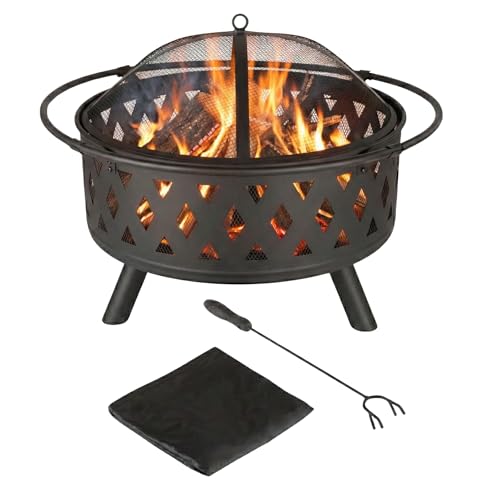
At $103.49, this 32-inch steel bowl with a decorative cross-weave mesh screen is the most affordable ready-made pit with genuine aesthetic presence. The screen serves a dual purpose: spark containment and visual texture that elevates it above plain round bowls. Owner feedback notes the steel is thin enough to feel lightweight for its size, which is convenient for moving but raises long-term rust concerns if left uncovered. Assembly takes under fifteen minutes with a single hand tool. Skip it if you want masonry permanence, a cooking grate that locks into the rim, or a diameter larger than thirty-two inches.
- Cross-weave screen adds safety and visual character at low cost
- Assembles quickly without specialized tools or construction skill
- Thin steel and small diameter limit long-term durability claims
Buying Guide
Base Preparation and Drainage
Before any stone or steel goes into the ground, your pit needs a compacted gravel base that directs water away from the fire chamber. Most build failures owners report trace back to a base that was too thin or too poorly compacted. Aim for a minimum of four inches of crushed gravel beneath any masonry structure, sloped slightly away from the seating area. Guides that skip this step entirely are not worth buying, because every subsequent layer inherits the drainage decision.
Draft Geometry and Smoke Management
A pit that pours smoke into your face is almost always a geometry problem, not a fuel problem. The ratio of air intake area at the base to the opening diameter at the top determines whether combustion draws cleanly upward or stalls and spills laterally. Enclosed fireplaces require a narrower throat and taller chimney than open pits. If your chosen resource does not explain this relationship with numbers or diagrams, you are relying on trial and error that could take an entire season to correct.
Local Code and Clearance Requirements
Most municipalities restrict pit placement relative to property lines, structures, and overhead vegetation. Some ban open wood fires entirely and permit only gas or pellet-burning units. A good 2026 guide addresses this by directing you to check your local fire code before ordering materials, and by noting minimum clearance distances as a baseline. Failing to verify your jurisdiction rules can mean a completed build that you are forced to dismantle.
Our Verdict
The Backyard Fire Pit & Outdoor Fireplace Building Bible is our top pick for anyone who wants one resource to cover a full build from footing through cap. The Fixers Handbook is the budget pick, delivering the most complete maintenance and longevity guidance for $9.99. However, the Dry-Stacked Stone Walls book wins outright if your design vision centers on mortarless masonry, because it teaches the structural principles that every other guide on this list merely references.
FAQ
Do I need a permit to build a fire pit?
Most single-family residential properties do not require a formal permit for a small open pit, but many jurisdictions do require one for raised masonry structures, enclosed fireplaces, or any unit with a chimney. Always check with your local building authority and fire marshal before you break ground.
How far should a fire pit be from my house?
A commonly referenced minimum is ten feet from any structure, though local codes may require fifteen or twenty feet for wood-burning pits and less for gas units. Trees, fences, and overhangs count as structures, and wind patterns on your specific lot matter as much as the published number.
Can I convert a wood-burning pit to gas later?
Yes, provided the original pit has adequate airflow and a serviceable bowl. Most conversions require drilling a gas line access point into the existing structure and installing a burner ring beneath the decorative media layer. Plan your initial build with at least six inches of clearance below the fuel bed so a future gas line can be routed without demolition.
Is a tabletop fire pit worth it if I already have a yard pit?
They solve different problems. A tabletop unit provides ambient light and gentle warmth at a dining table or on a balcony without the heat output of a ground pit, and its low-smoke profile makes it safe under partial roof covers. Many owners end up with both for different evenings.