Our Top Picks
 ROVSUN 9000 BTU Wifi Enabled Mini Split Air8.07"D x 31.92"W x 11.49"H7.99 x 31.92 x 11.49 inches70 poundsCheck on Amazon
 Best Quiet-Focused PickTemprium 12000 BTU Mini Split Air Conditioner12,000 BTU, 115V, 22 SEER27.87 x 29.96 x 11.61 inches40.8 poundsCheck on Amazon
A heat pump is an air conditioner that can run in reverse, and a mini split is simply a heat pump (or cooling-only unit) built without ductwork. If you have no ducts and want one or two rooms handled, a single-zone ductless mini split such as the COSTWAY 12000 BTU or the Rellytech 12000 BTU is the usual starting point; if you already have ducts and an air handler closet, a ducted split system such as the MrCool Hyper Heat central unit is the better fit. This guide answers the questions people actually type into search boxes, from “what is a ductless heat pump” to “do geothermal systems make sense for me”, then matches each answer to real models sold in the store.
One honest note before the picks: this guide is research-based. We did not personally use these products, and we do not quote efficiency ratings or savings figures, because those numbers depend on your climate, your electricity rate, the installer and the exact model revision. Where a detail is not shown in the listing we write “not listed”, and we point you to the manual for your exact model.

Albott 12,000 BTU Mini Split Air Conditioner and Heater SEER2 18, 115V | Inverter Energy-Efficient AC with Self-Cleaning, Remote and APP Control, HVAC Tech Needed, Cools up to 750 Sq.Ft.
Chosen because it specifies 000 BTU Mini Split Air Conditioner and Heater SEER2 18 and 115V.
View on AmazonROVSUN 9000 BTU Wifi Enabled Mini Split Air Conditioner & Heater with Inverter, 20 SEER2 Energy Saving 115V Ductless Split AC Unit with Pre-Charged Condenser, Heat Pump & Installation Kit
Chosen because it specifies Heat Pump & Installation Kit.
View on AmazonTemprium 12000 BTU Mini Split Air Conditioner, 115V 22 SEER2 AC & Heat Pump | Quiet ductless system for up to 750 Sq.Ft. Features R32 refrigerant, WiFi smart control & complete installation kit.
Chosen because it specifies 115V 22 SEER2 AC & Heat Pump and WiFi smart control & complete installation kit..
View on Amazon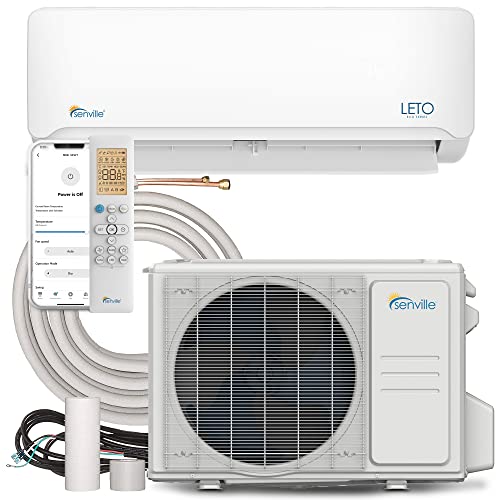
Senville LETO Mini Split Air Conditioner, Heat Pump, White, 12000 BTU | Ductless, Wall Mounted, Works with Alexa, Quiet Operation, 1 Ton, 110/120V, Energy Efficient Inverter
Chosen because it specifies Heat Pump and White.
View on AmazonTop Picks at a Glance
- Best Overall for One Large Room or Studio: COSTWAY 12000 BTU Mini Split, a wall-mounted ductless unit listed for spaces up to about 750 square feet.
- Best Value: Rellytech 12000 BTU Mini Split, a 115V single-zone unit at the budget end of the 12,000 BTU group.
- Best Quiet-Focused Pick: Temprium 12000 BTU Mini Split, which the listing describes as a quiet ductless system for up to 750 square feet.
- Best for Larger Open Spaces: Temprium 24000 BTU Mini Split, a 230V unit listed for up to 1,500 square feet.
- Best 230V Mid-Size Option: Rellytech 18000 BTU Mini Split, which needs a 208-230V supply.
- Best for Houses With Ducts: MrCool Hyper Heat Central Ducted Split System, a 2.5-ton multiposition air handler with an outdoor unit.
- Best for Campers and Vans: TURBRO 13.5K BTU Inverter RV Air Conditioner with heat pump, a low-profile rooftop unit.
Quick Comparison Table
| Product | Best for | Key specs (from the listing) | Watch for | Price tier |
|---|---|---|---|---|
| COSTWAY 12000 BTU Mini Split | One large room or studio | 12,000 BTU, 115V, listed up to 750 sq ft | Check remote and app features on your version | Mid-range |
| Rellytech 12000 BTU Mini Split | Bedroom, den, small apartment | 12,000 BTU, 115V, wall-mounted ductless, pre-charged | Line-set length and wall-hole position | Budget |
| Temprium 12000 BTU Mini Split | Noise-sensitive rooms | 12,000 BTU, 115V, listed up to 750 sq ft | Noise figures are the maker’s own | Mid-range |
| Rellytech 18000 BTU Mini Split | Open living area | 18,000 BTU, 208-230V | Needs a 230V circuit | Mid-range |
| Temprium 24000 BTU Mini Split | Large room, garage workshop, bonus room | 24,000 BTU, 230V, listed up to 1,500 sq ft | Circuit size and outdoor unit weight | Premium |
| MrCool Hyper Heat Central Ducted Split | Whole house with ducts | 2.5 ton, multiposition air handler, heat pump | Duct condition and installer needed | Premium |
| TURBRO 13.5K Inverter RV AC | RV, camper, roof-opening installs | 13,500 BTU, non-ducted, low-profile rooftop, heat pump | Roof opening and weight limits | Premium |
What Is the Difference Between a Heat Pump and a Mini Split?
A heat pump describes how the machine works, while a mini split describes how it is built. A heat pump moves heat rather than making it: in summer it pulls heat out of your room and dumps it outside, and in winter the refrigerant flow reverses so it pulls heat from outdoor air into the room. A mini split is a heat pump (or cooling-only air conditioner) that splits the system into an outdoor compressor and one or more indoor heads, joined by a thin refrigerant line set and a control cable, with no ducts.
That means “best ductless mini split heat pumps” and “best ductless split heat pumps” are the same shopping list, and “best electric heat pumps” covers nearly everything in this article, because air-source heat pumps run on electricity. The one thing to check on any listing is that it says heat pump, or “AC and heater”, rather than cooling only. A surprising number of cheap mini splits are sold as cooling-only, and the title is the quickest way to tell.
What Types of Heat Pumps Are There?
Energy.gov lists air-source, ductless mini-split, geothermal (ground-source or water-source) and absorption heat pumps as the main families. For homes, the practical choices are these:
- Air-source, ducted: an outdoor unit plus an indoor air handler that pushes air through your existing ductwork. This is what people mean by “best ducted cool heat pumps”.
- Air-source, ductless mini split: an outdoor unit plus one or more wall heads. One outdoor unit can feed several indoor heads on multi-zone systems; the mini split models here are single-zone.
- Geothermal (ground-source): buried loops of water and antifreeze exchange heat with the ground. Ground temperatures stay fairly steady, which is why running costs can be low, but installation requires excavation or drilling and is a contractor project.
- Portable or window units with heat: self-contained, no outdoor unit. We searched the store for a portable air conditioner with heat and found no matching listings, so none are recommended here.
- RV and camper heat pumps: rooftop units, sold ducted or non-ducted, which is the answer to the “best ducted rv air heat pumps” question.
Absorption heat pumps, which use a heat source such as gas or solar-heated water instead of an electric compressor, are mostly a specialist product and we found nothing for them in the store.
1. COSTWAY 12000 BTU Mini Split: Best for One Large Room
- 12,000 BTU class, 115V wall-mounted ductless air conditioner and heater
- Listing states it cools up to 750 square feet
- Inverter split design; a Wi-Fi version is also sold under the same brand
- Heating performance at low outdoor temperatures: not listed in the title, check the manual
Best for: a studio, garage conversion or large bedroom where you want cooling and heating from one wall head. Skip if: your winters are far below freezing and you plan to use it as the only heat, unless the manual lists its low-temperature operating range.
A 12,000 BTU unit on a regular 115V circuit is the easiest ductless system to fit into a home that has no 230V line nearby. In practice the number to focus on is the room, not the label: a well-insulated 400 square foot room is comfortable territory, while a 750 square foot open plan with high ceilings and lots of glass is at the edge of what the label implies. The maker’s coverage claim assumes typical ceiling height and insulation, so treat it as an upper bound.
Installation is the part most buyers underestimate. The indoor head needs a mounting plate on a stud-backed wall, a roughly three-inch hole through the exterior wall, a condensate drain path and a place for the outdoor unit. Many pre-charged kits are meant to be connected with flared line sets, but refrigerant work and electrical wiring are regulated in many places, so confirm local rules and consider a licensed installer.
Pros: fits a 115V circuit; heat and cool in one unit; wall head saves floor space; app-capable version exists. Cons: installation is not plug-and-play; low-temperature heating output is not stated in the listing.
2. Rellytech 12000 BTU Mini Split: Best Value
- 12,000 BTU, 115V/110V, AC and heating system
- Described as ductless and pre-charged
- Inverter design per the listing
- Line set length included: not listed here, check the box contents
Best for: a first mini split for a bedroom or small apartment living room. Skip if: you need a Wi-Fi app or a very low noise rating, which are not highlighted in this listing.
Rellytech also sells 9,000 and 18,000 BTU versions, which makes it easy to scale the same brand up or down. For most bedrooms up to roughly 350 to 400 square feet, a 9,000 BTU model is often plenty, and the larger 12,000 BTU unit is the safer choice for sunny rooms, kitchens or rooms that are open to the next room.
A common mistake is buying a bigger unit than needed. An oversized unit costs more up front and can cycle on and off in a small space, while an undersized unit runs flat out on hot afternoons. Size to the room, then go one step up only when the room has unusual heat gain such as a west-facing window wall.
Pros: lower entry cost in this group; 115V; family of sizes. Cons: fewer smart features listed; accessories such as longer line sets are separate.
3. Temprium 12000 BTU Mini Split: Best for Quiet Rooms
- 12,000 BTU, 115V, AC and heat pump
- Listing promotes a quiet ductless system for up to 750 square feet
- Inverter-driven
- Decibel levels: not listed in the title, check the spec sheet
Best for: bedrooms and home offices where sound matters. Skip if: you only need occasional cooling and want the lowest cost.
Noise has two parts: the indoor head, which is what you hear in the room, and the outdoor unit, which matters for neighbors and for bedrooms on the same wall. Makers quote indoor sound at the lowest fan speed in a lab, so a “quiet” claim describes the best case. Mount the indoor head away from the headboard wall if you are a light sleeper, and keep the outdoor unit off a wall shared with a bedroom.
Pros: positioned as quiet; 115V; heat pump function. Cons: noise numbers are the maker’s; priced above the most basic units.
4. Rellytech 18000 BTU Mini Split: Best 230V Mid-Size Pick
- 18,000 BTU, 208-230V
- Pre-charged ductless AC and heating system
- Coverage claim: not listed in the title
- Requires a dedicated 230V circuit per the voltage spec
Best for: a big living-dining area, finished basement or sunroom. Skip if: your panel has no room for a 230V breaker.
The step up from 12,000 to 18,000 BTU is only useful if your electrical service allows it. A 230V mini split needs a correctly sized breaker and disconnect near the outdoor unit, and the required amperage is on the nameplate, not the product title. Ask an electrician to confirm panel capacity before you buy, because upgrading a panel can cost more than the unit.
Pros: more capacity for open spaces; same brand family as the budget pick. Cons: needs 230V; heavier outdoor unit.
5. Temprium 24000 BTU Mini Split: Best for Large Open Spaces
- 24,000 BTU, 230V, AC and heat pump
- Listing states quiet ductless system for up to 1,500 square feet
- Inverter system
- Number of indoor heads: single, per the listing description
Best for: a big garage, barn conversion, open great room or shop. Skip if: your space is divided into several small rooms, where one large head will not push air around corners.
A single head cannot condition rooms behind closed doors. If your plan is to heat and cool three bedrooms and a living room, a multi-zone system with several heads or a ducted system is the correct tool, and one 24,000 BTU head will leave the back rooms behind. This is also the point where a licensed HVAC installer can run a proper load calculation, which is more accurate than any square-foot rule.
Pros: highest capacity in the ductless group; one outdoor unit for a large open area. Cons: premium cost; 230V; heavy to mount.
6. MrCool Hyper Heat Central Ducted Split System: Best for Homes With Ducts
- 2.5 ton central ducted split system with multiposition air handler
- Heat pump, described as Hyper Heat for colder climates
- Includes a 10-year labor warranty per the listing
- Refrigerant and line-set details: see the listing for your size
Best for: a house with existing ducts that needs a replacement for an old furnace-and-AC pairing, or a home addition. Skip if: your ducts are leaky or undersized, because even a good heat pump delivers poor comfort through bad ductwork.
This is the answer to the “best ducted cool heat pumps” and “best efficient heat pumps” questions: a ducted heat pump takes the place of both the furnace and the air conditioner for many homes, but only if the ducts are sound. Auxiliary electric heat kits are sold separately for these air handlers, and the kit must be the one the manufacturer lists as compatible with your air handler. We do not list part numbers here, so check your model’s manual or the maker’s compatibility chart before ordering a heat kit.
Pros: whole-home comfort from one system; multiposition air handler for varied layouts; labor warranty per the listing. Cons: professional installation needed; duct quality decides results.
7. TURBRO 13.5K Inverter RV Air Conditioner with Heat Pump: Best for Campers
- 13,500 BTU rooftop unit with heat pump function
- Non-ducted, low-profile design
- Inverter technology
- Roof opening and weight limits: check your RV manual
Best for: travel trailers and motorhomes with a standard roof vent opening. Skip if: your camper has a ducted ceiling system, in which case look at ducted models such as the Furrion Chill Cube listed in the store.
RV heat pumps are meant for mild cold: they can take the chill off a camper on a cool morning but are not a substitute for a furnace in deep winter. Rooftop units also draw significant startup power, so your generator, shore power or inverter must be sized to the unit. Check the start-up and running amps in the manual rather than guessing.
Pros: heat and cool from one roof unit; low profile; inverter design. Cons: premium cost; power draw needs planning.
Also Consider
- Albott 12,000 BTU Mini Split: a 115V inverter unit with a self-cleaning feature in the listing; a direct rival to the Rellytech and COSTWAY.
- Senville Central Air Conditioning System, 24000 BTU: a complete ducted heat pump system with air handler and condenser for smaller ducted homes.
- EROMMY 10000 BTU RV Air Conditioner with Heat Pump: a smaller rooftop RV unit for vans and short trailers.
- ROVSUN 25 ft Mini Split Line Set: a flared copper line set with insulation for connecting indoor and outdoor units when the included length is short; check that the diameters (1/4 inch and 3/8 inch) match your unit.
Heat Pump and Mini Split Questions Answered
What are the best ductless mini split heat pumps for a single room?
For a single room, a 9,000 to 12,000 BTU wall-mounted single-zone unit is the usual choice, such as the COSTWAY or Rellytech models above. Match capacity to the room size and sun exposure rather than choosing the biggest number, and confirm the listing says heat pump or heating function.
Are ductless and “duct less” heat pumps the same thing?
Yes, duct less heat pumps and ductless heat pumps are the same product category. They mount indoor heads directly on a wall or ceiling and need no ductwork, which is why they suit additions, garages and older homes.
Can a mini split be the only heat in my home?
It can be in mild climates, but in cold regions you should check the manual for the minimum outdoor temperature at which the unit still heats and consider a backup. Cold-climate models exist, and some sellers use names like Hyper Heat for them, but the exact capacity at low temperatures is something to read on the spec sheet, not assume.
Do geothermal and ground-source heat pumps make sense for a home?
Geothermal can be a strong long-term system because ground temperature is steady, but it requires drilling or trenching for ground loops and is a significant contractor project, so it is not a store-shelf purchase. If you are curious, ask local installers for a quote and ask about any available incentives; we make no savings claims here.
What about portable and efficient heat pumps?
Portable heat pump units exist, but we found no matching listings in the store, so we cannot recommend one. For efficiency, compare the ratings printed on each maker’s spec sheet within the same type, and remember that installation quality and room sizing affect real-world results as much as the label.
Can I install a mini split myself?
Some kits are pre-charged with flared lines to simplify installation, but electrical connections and refrigerant handling are regulated in many places. Check local rules, read the manual, and use a licensed professional if you are unsure.
How We Chose
This guide is research-based. We reviewed the listing details for each product in the store, manufacturer pages, and the way Energy.gov and ENERGY STAR describe heat pump types. We did not personally use these products. We kept to the specs shown in listing titles (BTU, voltage, coverage claims, system type), left out efficiency ratings and savings claims, and wrote “not listed” for anything we could not confirm. Models were chosen to cover a single room, a large open space, a ducted home and an RV, with no more than two per brand except where one brand offers different sizes for different voltages.
Buying Guide
Match the Type to Your Home
Start with whether you have ducts. If you do and they are in good condition, a ducted heat pump can replace both furnace and AC. If you do not, ductless is the path. For one or two rooms use a single-zone unit; for many rooms use a multi-zone system with a separate head per room. If your ducts run through an unheated attic or crawlspace, ask an installer how much comfort you would lose in the pipes before committing to a ducted replacement.
Size by Room, Not by Hope
As rough starting points used across the industry, 9,000 BTU suits a small bedroom, 12,000 BTU suits a larger bedroom or small living area, 18,000 BTU suits a large open room, and 24,000 BTU is for very large open spaces. Ceiling height, windows, insulation and sun exposure all change this. A proper load calculation by an installer is more accurate than any chart, and it is usually free or cheap when you buy the installation from the same company.
Check Voltage and Your Electrical Panel
115V units plug into a dedicated circuit with its own breaker; 208-230V units need a larger breaker and a disconnect. The amperage on the nameplate decides the wire size and breaker. Confirm your panel has space before buying, and ask an electrician about permit requirements in your area.
Plan the Line Set and Placement
The line set connects the indoor and outdoor units, and kits ship with a fixed length. If the outdoor unit must sit farther away, buy a longer line set with the same diameter and flare fittings, and check the manual for the maximum allowed length and height difference. Also plan the condensate drain; it needs a downward slope or a condensate pump, and in cold climates the outdoor unit should sit on a stand above expected snow depth.
Think About Cold Weather
Heat pumps lose output as outdoor temperature falls. Look for a stated low-temperature operating range in the manual, and keep a backup heat source if you live in a very cold area. A cold-climate label from a seller is not the same as a published capacity chart, so ask for the chart.
Common Mistakes to Avoid
- Buying only on BTU without checking that the unit is a heat pump.
- Choosing a single head for a house with many small rooms.
- Ignoring the 230V requirement until the box arrives.
- Skipping the manual’s installation clearances around the outdoor unit.
- Ordering a heat kit or accessory without confirming compatibility for your exact model.
- Mounting the indoor head directly above a bed or couch where airflow hits you.
Frequently Asked Questions
Is a mini split the same as a heat pump?
Not exactly: a mini split is a ductless system that may be a heat pump or cooling only. Check that the listing mentions heating.
How long does installation take?
It depends on the layout and who does the work, so ask your installer for an estimate. The wall hole, line set run, wiring and drain all take time, and a first-timer should plan for more than a day.
Do I need a permit?
Many areas require permits for electrical and HVAC work. Ask your local building department before you start.
What maintenance does a heat pump need?
Clean the indoor filter regularly as the manual instructs, keep the outdoor unit clear of leaves and snow, and have a professional check refrigerant and drain lines if performance drops.
Can an RV unit heat my shed or cabin?
RV roof units are designed for RV roofs. For a shed or cabin, a wall-mounted mini split is the intended product.
Do mini splits work with smart home apps?
Some versions include Wi-Fi control and voice assistant compatibility; the COSTWAY and ROVSUN listings mention Wi-Fi on certain models. Check the exact model before buying.
How do I choose between a ducted system and mini splits?
If your ducts are in good shape and you want every room conditioned, ducted is simpler. If you have no ducts, an addition or a few problem rooms, ductless wins. A multi-zone ductless system is the compromise for homes without ducts.
Which One Should You Buy?
For a single room without ducts, the COSTWAY or Rellytech 12000 BTU units are the simplest starting points; choose Temprium if quiet matters most. For big open areas with a 230V supply, step up to the Rellytech 18000 BTU or the Temprium 24000 BTU. If you have working ductwork, the MrCool ducted system is the more complete answer, and campers should look at the TURBRO rooftop heat pump. Whatever you choose, confirm voltage, line-set length and local installation rules first.
Sources
- U.S. Department of Energy, Energy.gov heat pump overview
- ENERGY STAR air-source heat pump product information
- Manufacturer listing details for COSTWAY, Rellytech, Temprium, MrCool and TURBRO
- Vermont Energy Saver heat pump guide
Last updated: October 2026