Key takeaways
- Hinge and detent quality: A 360° rotating head is only useful if it stays where you put it. Look for stepped detents or firm friction joints rather than smooth free-swinging pivots, which sag as soon as the magnet is on a vertical surface and vibration sets in.
- Magnet mounting, not just magnet strength: Check whether the magnet is recessed into the base and mechanically retained. A strong magnet on a glued pad will eventually separate under shear load, especially in engine bay heat that softens adhesive over time.
- Runtime at usable output: Advertised hours are usually measured on the lowest mode. Assume roughly a third of headline runtime at full brightness, and size the battery to your longest realistic job. A 4400–5000mAh pack is a sensible baseline for extended repairs.
- Grip strategy for your workspace: Hooks suit hood latches and steering wheels; clamps suit door edges, radiator supports, and jack stands. If you work on aluminum panels or composite trim, a clamp or hook matters far more than magnetic pull.
- Beam shape and glare control: Broad, diffused flood panels reduce hard shadows in tight cavities and cut reflected glare off painted surfaces. Reserve narrow spot beams for peering into long, deep gaps rather than general bay lighting.
What's inside
Anyone who has held a flashlight in their teeth while reaching past a serpentine belt knows the real failure point of most car work lights isn’t brightness — it’s the body. Housings crack on the first drop onto concrete. Hinges go floppy after a hundred cycles and won’t hold an angle. Magnets shear off the base because they were glued, not seated. Clips bite plastic trim instead of gripping sheet metal. Meanwhile the actual light output is often fine, which is why so many buyers end up with a drawer of dim, dead, dangling lamps and no clear idea what went wrong.
This guide looks at car work lights the way a durability tester would: hinge detent strength, magnet pull relative to weight, grip geometry, thermal behavior over a long session, and whether the thing can be positioned once and left alone. Below are six rechargeable options suited to underhood work, wheel wells, footwells, and roadside repairs, plus the specification details that separate a two-season tool from a two-week one.
As an Amazon Associate we earn from qualifying purchases.


How to Choose a/an Work Light For Car (2026)
- Hinge and detent quality: A 360° rotating head is only useful if it stays where you put it. Look for stepped detents or firm friction joints rather than smooth free-swinging pivots, which sag as soon as the magnet is on a vertical surface and vibration sets in.
- Magnet mounting, not just magnet strength: Check whether the magnet is recessed into the base and mechanically retained. A strong magnet on a glued pad will eventually separate under shear load, especially in engine bay heat that softens adhesive over time.
- Runtime at usable output: Advertised hours are usually measured on the lowest mode. Assume roughly a third of headline runtime at full brightness, and size the battery to your longest realistic job. A 4400–5000mAh pack is a sensible baseline for extended repairs.
- Grip strategy for your workspace: Hooks suit hood latches and steering wheels; clamps suit door edges, radiator supports, and jack stands. If you work on aluminum panels or composite trim, a clamp or hook matters far more than magnetic pull.
- Beam shape and glare control: Broad, diffused flood panels reduce hard shadows in tight cavities and cut reflected glare off painted surfaces. Reserve narrow spot beams for peering into long, deep gaps rather than general bay lighting.
The Best Work Light For Car (2026)s Reviewed
Tool LED Rechargeable Work Light with Magnetic Base and Hook
The five-mode layout is genuinely useful rather than padded, letting you drop to a low flood for close inspection work without washing out detail. Its combination of magnetic base and hook covers the two mounting scenarios that account for most underhood positioning, and the 360° head holds angle well enough for hands-free use.
2400LM Underhood Work Light, 4400mAh
This is the pick for long sessions: the larger cell and higher output make it a legitimate primary bay light rather than a supplementary one. The dual-hook design distributes load better than single-point hangers, which reduces the swing and drift that plague lighter lamps when you bump a hose.
Rechargeable 5000mAh Magnetic Foldable Work Light
The folding body is the standout ergonomic feature here — it collapses to a pocketable form and opens into a stand, so it works both as a handheld and a set-and-forget floor light for footwell wiring. At 1200 lumens with the largest battery in this group, it favors endurance over peak brightness.
Easymaxx Rechargeable Clip Light, 2 Pack
The 2.3-inch clamp is what earns this a spot: it grips hood lips, jack stand posts, and door frames where magnets have nothing to hold. USB-C input plus USB-A pass-through output also makes it a practical phone top-up in a roadside situation.
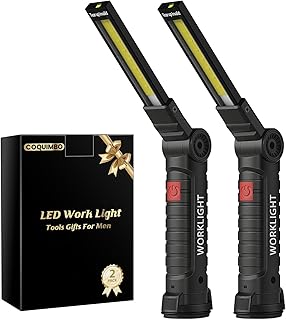
Rechargeable Work Light with Magnetic Base and Hanging Hook, 2 Pack
Two lights beats one bright light for shadow control, and this pair lets you cross-light a cavity from opposing angles to eliminate the dark seams that cause missed fasteners. The roughly seven-hour runtime is realistic for a full afternoon of intermittent use.
Frequently Asked Questions
How many lumens do I actually need for car repair?
For general underhood work, 1000–1500 lumens of flood output is ample. Beyond about 2400 lumens, glare off painted panels and chrome becomes the limiting factor rather than illumination, so beam diffusion matters more than raw numbers.
Will engine bay heat damage a rechargeable work light?
Sustained contact with hot exhaust components can degrade lithium cells and soften adhesives. Mount on cooler sheet metal such as the hood underside or fender lip, and avoid leaving a light clamped near a running engine for extended periods.
Are magnetic bases safe on painted surfaces?
Only if the contact face is rubber-coated or you place a cloth between the magnet and the paint. Grit trapped under a bare magnet will scratch clear coat as soon as the light shifts.
Should I choose a clamp light or a magnetic light?
Match it to your vehicle. Magnets work well on steel-bodied cars and steel jack stands; clamps are the better choice for aluminum hoods, composite panels, and any spot where you need the light held off a surface rather than against it.
Final Thoughts
For most home garages, the 2400LM 4400mAh underhood light is the strongest all-round choice thanks to its runtime and stable dual-hook mounting. If portability and a built-in stand matter more, the 5000mAh foldable magnetic light offers the best endurance-to-size ratio, while the Easymaxx clip light pair is the one to add when your vehicle’s panels won’t cooperate with a magnet.