Key takeaways
- Size airflow to the room, not the box: One CFM per square foot is the working baseline for bathrooms under 100 sq ft, with an added allowance for a jetted tub or an enclosed shower. Multi-speed units rated 50-80-110 CFM let you commission the fan correctly after installation instead of guessing at the store.
- Read sone ratings as fatigue, not volume: Anything at or below 1.0 sone disappears into the background; 1.5 sones is audible but not intrusive. The number to distrust is airflow achieved through blade speed, since high-RPM units get louder as bearings wear and mounting hardware loosens.
- Judge the light where your eyes actually are: A frosted, edge-lit panel spreads output across the ceiling plane and avoids the hot spot you notice while lying down. Selectable color temperature (3CCT or 5CCT) plus dimming lets you set a low warm level for night use and a neutral white for grooming.
- Check what the install demands of your body: Retractable brackets and no-attic-access designs mean the entire job happens from below, on a ladder, with the unit supported rather than balanced. Confirm duct diameter (4-inch is standard) before you commit, because forcing a mismatch strains the motor for the life of the fan.
- Prioritize serviceability and certification: Tool-free grille release, a galvanized or corrosion-resistant housing, and ETL or Energy Star listing are the practical durability signals. Integrated LEDs are common now, so treat the light module as part of the unit’s expected lifespan and favor brands with parts availability.
What's inside
Bathroom fans get chosen in a hurry, usually after the old one starts groaning or the mirror stops clearing. That rush is why so many replacements disappoint within two years: the unit rattles at the housing seams, the light throws a hard cone of glare straight into your eyes from the tub, and the grille needs a screwdriver and a stepladder every time it collects lint. Ventilation hardware lives in a hot, humid, corrosive box, and it is operated by people who are barefoot, half-awake, or reaching overhead. Those two facts should drive the purchase more than raw airflow numbers do.
This guide evaluates ceiling-mounted bath fans with integrated lighting through an ergonomics-and-durability lens: how the unit feels to live with over a decade, not just how it performs on a spec sheet. We weigh motor construction and bearing type, housing rigidity, grille removal without tools, lens diffusion at typical 8-foot ceiling heights, sensor logic that removes the need to reach for a switch at all, and how serviceable each model stays once the warranty lapses. Airflow and sone ratings matter, and we cover them, but they are the beginning of the assessment rather than the end of it.
As an Amazon Associate we earn from qualifying purchases.


🛒 Best Price Today on Amazon
Prime members get fast, free shipping on everything above, plus member-only deals. New members get a 30-day free trial — cancel anytime.
How to Choose a Bathroom Ceiling Fans With Light (2026)
- Size airflow to the room, not the box: One CFM per square foot is the working baseline for bathrooms under 100 sq ft, with an added allowance for a jetted tub or an enclosed shower. Multi-speed units rated 50-80-110 CFM let you commission the fan correctly after installation instead of guessing at the store.
- Read sone ratings as fatigue, not volume: Anything at or below 1.0 sone disappears into the background; 1.5 sones is audible but not intrusive. The number to distrust is airflow achieved through blade speed, since high-RPM units get louder as bearings wear and mounting hardware loosens.
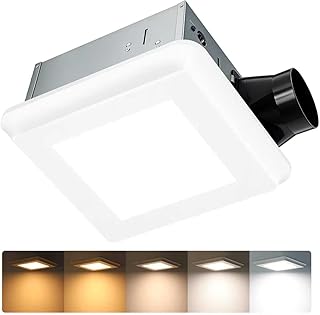
- Judge the light where your eyes actually are: A frosted, edge-lit panel spreads output across the ceiling plane and avoids the hot spot you notice while lying down. Selectable color temperature (3CCT or 5CCT) plus dimming lets you set a low warm level for night use and a neutral white for grooming.
- Check what the install demands of your body: Retractable brackets and no-attic-access designs mean the entire job happens from below, on a ladder, with the unit supported rather than balanced. Confirm duct diameter (4-inch is standard) before you commit, because forcing a mismatch strains the motor for the life of the fan.
- Prioritize serviceability and certification: Tool-free grille release, a galvanized or corrosion-resistant housing, and ETL or Energy Star listing are the practical durability signals. Integrated LEDs are common now, so treat the light module as part of the unit’s expected lifespan and favor brands with parts availability.
The Best Bathroom Ceiling Fans With Light (2026)s Reviewed
Panasonic WhisperFit FV-0511VFL1
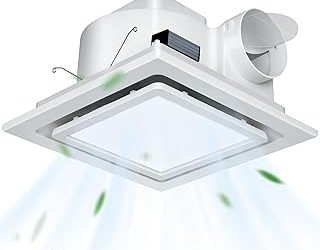
Panasonic’s DC motor with SmartFlow logic holds its rated airflow even against imperfect ductwork, which is the single biggest reason cheap fans underperform in real houses. The low-profile housing suits shallow joist cavities, the dimmable LED diffuses cleanly, and build quality here is the benchmark the rest of this list is measured against.
AUPU 3CCT Fan with Humidity Sensor
The retractable bracket makes this one of the least punishing units to install solo, and the humidity sensor handles run-time automatically so nobody has to remember the switch. Energy Star and HVI listing at 0.8 sone signals a motor that is doing its work efficiently rather than aggressively.
130 CFM Humidity-Sensor Fan with 5CCT Light
At 130 CFM and 1.0 sone, this is the sensible pick for larger or double-fixture bathrooms where lower-output fans leave moisture lingering on the walls. Five color temperatures and adjustable speed give you room to tune both light and airflow after the fact.
AHAWILL 8″ Ultra Quiet 80 CFM
An 8-inch footprint and 80 CFM make this the right match for a standard 60 to 80 sq ft bathroom, where oversizing just wastes conditioned air. The 1000-lumen dimmable panel is genuinely useful as the room’s only ceiling fixture.
Fitop 110 CFM Ceiling Fan with Light
Fitop’s no-attic-access design is the practical answer for finished ceilings and second-floor baths where crawling above the fixture is not an option. At 1.0 sone with 1200 lumens, it delivers strong light output without the buzz that usually accompanies budget housings.
Frequently Asked Questions
How much CFM does my bathroom need?
Use one CFM per square foot for rooms up to 100 sq ft, then add roughly 50 CFM for a separate shower enclosure or soaking tub. Bathrooms above 100 sq ft are better calculated by fixture count.
Is a humidity sensor worth it?
Yes, particularly in shared or guest bathrooms. Sensors run the fan long enough to actually dry the space and shut off on their own, which protects paint and grout far better than a user who flips the switch off on the way out.
Can I install one without attic access?
Several models on this list are engineered for it, using retractable brackets and bottom-side wiring so the whole job is done from the room below. Verify your existing duct run and electrical box location first.
Do the LED lights need replacing eventually?
Integrated LED modules are typically rated for 25,000 to 50,000 hours, which usually outlasts the motor in ordinary use. Because they are not user-replaceable bulbs, buy from a brand that stocks replacement modules.
Final Thoughts
If you want the unit you will not think about again for a decade, the Panasonic WhisperFit FV-0511VFL1 earns it through motor engineering and housing quality. The AUPU 3CCT model is the smarter buy for a straightforward DIY replacement thanks to its retractable bracket and automatic humidity control, while the Fitop 110 CFM fan solves the finished-ceiling problem with strong light output and a quiet 1.0-sone rating.