Key takeaways
- Frame construction: Look for reinforced ribs, corrosion-resistant aluminum, or fiberglass components that can flex slightly without permanently bending. A rigid frame is not automatically a stronger one.
- Base stability: A wind-capable canopy still needs a properly weighted base matched to its size and installation surface. For table umbrellas, confirm that the table and base work together rather than relying on the tabletop alone.
- Canopy engineering: Vents, layered tops, UV-resistant fabric, and tightly finished seams help reduce pressure and extend service life. A vented canopy generally handles passing gusts better than a completely sealed one.
- Adjustment ergonomics: A smooth crank, accessible tilt control, and manageable rotation mechanism make it more likely that users will reposition or close the umbrella when conditions change.
- Operating discipline: “Wind resistant” does not mean storm proof. Close and tie the umbrella whenever it is unattended, during strong gusts, or when severe weather is expected.
What's inside
A patio umbrella can look sturdy on a calm afternoon yet become a liability when gusts arrive. The weak point is rarely the canopy alone: an undersized base, flexible pole, loose fittings, or an umbrella left open in worsening weather can turn a comfortable shade setup into a damaged frame or flying object.
This guide evaluates wind-resistant patio umbrellas through an ergonomics-and-durability lens. We focus on frame design, rib support, adjustment effort, canopy construction, stability, and day-to-day usability—not just advertised wind ratings. The right choice depends on whether you need a practical table umbrella or a larger cantilever design, and every model should be closed and secured before serious wind.
As an Amazon Associate we earn from qualifying purchases.


How to Choose a Wind Resistant Patio Umbrella (2026)
- Frame construction: Look for reinforced ribs, corrosion-resistant aluminum, or fiberglass components that can flex slightly without permanently bending. A rigid frame is not automatically a stronger one.
- Base stability: A wind-capable canopy still needs a properly weighted base matched to its size and installation surface. For table umbrellas, confirm that the table and base work together rather than relying on the tabletop alone.
- Canopy engineering: Vents, layered tops, UV-resistant fabric, and tightly finished seams help reduce pressure and extend service life. A vented canopy generally handles passing gusts better than a completely sealed one.
- Adjustment ergonomics: A smooth crank, accessible tilt control, and manageable rotation mechanism make it more likely that users will reposition or close the umbrella when conditions change.
- Operating discipline: “Wind resistant” does not mean storm proof. Close and tie the umbrella whenever it is unattended, during strong gusts, or when severe weather is expected.
The Best Wind Resistant Patio Umbrellas (2026) Reviewed
PURPLE LEAF 10′ x 10′ Double-Top Cantilever
This is the strongest choice for broad, furniture-friendly shade when a center pole would interfere with seating. Its double-top canopy and heavy-duty frame are designed to manage airflow, while the stated 35-mph wind-resistant rating provides a useful reference point—provided the base is correctly installed and the umbrella is closed in unsuitable conditions.
PURPLE LEAF 10′ x 10′ Heavy-Duty Patio Umbrella
The grey PURPLE LEAF combines a 240 GSM UV-resistant canopy with a stable triangular frame, 360-degree rotation, and five tilt positions. Its cast handle and broad adjustment range are especially practical for households that need to track the sun without repeatedly moving the base.
9′ Outdoor Patio Umbrella with Crank and Tilt
This straightforward market umbrella is a sensible fit for a standard patio table. Eight sturdy ribs, push-button tilt, and a crank lift keep operation familiar and relatively low effort, although its real-world wind performance will depend heavily on the table, pole fit, and weight of the separate base.
9ft 3-Tier Patio Umbrella
The three-tier canopy is the distinguishing feature here, giving wind a path to escape rather than trapping all of its force beneath one broad sheet. With eight ribs, UV protection, push-button tilt, and a crank, it offers a useful balance of airflow management and everyday convenience for decks, pools, and garden seating.
Ayge 9 FT Fiberglass Patio Umbrella
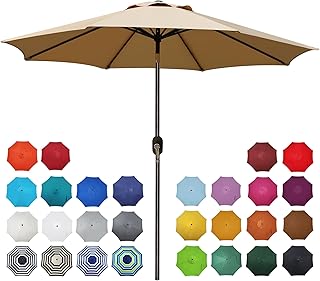
Fiberglass ribs can be a good durability choice because they flex under intermittent loading instead of behaving as brittle, completely rigid members. This beige Ayge model adds a crank-and-tilt mechanism, eight ribs, and a UV50+ canopy; pair it with a substantial base for the best stability.
Frequently Asked Questions
What makes a patio umbrella wind resistant?
Wind resistance comes from the complete system: canopy vents or layered construction, flexible or reinforced ribs, a secure pole, strong joints, and an adequately weighted base. No single feature can compensate for an unstable installation.
Should I leave a wind-resistant umbrella open?
No. Close and secure the umbrella whenever you leave it unattended or notice increasing wind. Even a well-designed frame can be damaged by repeated gusts, sudden directional changes, or debris.
Is a cantilever umbrella better in windy conditions?
Not automatically. A cantilever design offers unobstructed shade, but its offset load demands a carefully engineered base and a solid, level surface. A conventional table umbrella may be easier to stabilize for smaller seating areas.
How heavy should the umbrella base be?
The correct weight varies with canopy size, pole design, exposure, and the manufacturer’s instructions. Use the recommended base system rather than choosing by weight alone, and consider additional anchoring in open or elevated locations.
Final Thoughts
For maximum coverage and refined adjustment, the PURPLE LEAF 10′ x 10′ Double-Top Cantilever is the standout, while the PURPLE LEAF Heavy-Duty model suits users who value rotation and multiple tilt angles. For a simpler table setup, the 9ft 3-Tier Patio Umbrella offers a practical airflow advantage without the complexity of a cantilever frame.