Key takeaways
- Inspect the hooks, screws, and wall area twice a year for looseness, rust, cracks, or bent metal.
- Lift with a partner when storing a long or heavy ladder; do not twist while reaching overhead.
- Place a visible label near the storage point showing the ladder’s weight and the hanger’s intended capacity.
- Keep the floor beneath the ladder clear so a dropped tool or tripping hazard does not interfere with retrieval.
What's inside
Storing a ladder well is less about finding an empty patch of wall and more about controlling weight, movement, and access. A poorly supported ladder can slide, deform over time, damage drywall, or become a shoulder-height obstacle in a busy garage. The best setup keeps the ladder off the floor, distributes its load into sound framing, and lets you remove it without twisting or lifting awkwardly.
This guide explains how to choose the right hanger, locate secure mounting points, install it at an ergonomic height, and check that the finished arrangement remains safe in daily use. You will also find practical buying guidance for different ladder sizes, wall types, and storage needs.
As an Amazon Associate we earn from qualifying purchases.


1. Match the hanger to the ladder
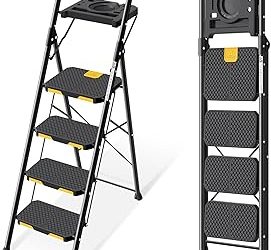
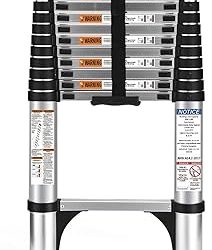
Start with the ladder itself. Measure its overall length, width, rail depth, and weight, then consider how it will sit on the wall. A step ladder often stores horizontally with two padded hooks supporting its side rails. An extension ladder may need wider, deeper supports or a dedicated rack that prevents the sections from shifting.
Do not select a hook solely because its advertised capacity exceeds the ladder’s weight. The support must also accommodate the ladder’s shape without concentrating force on a narrow edge. Look for rounded contact surfaces, protective coating, and enough hook depth to keep the ladder from rolling forward. If you expect to hang a wheelbarrow, folding chair, or garden equipment as well, a multi-purpose hook set such as the Ladder Hanger Set of 4 for Garage Wall can provide useful flexibility.
Published capacity is a ceiling, not a target. Leave a sensible margin for accidental loading, vibration, and hardware wear. A hook rated for 50 pounds may be suitable for a light household ladder, while a heavier extension ladder calls for a more substantial system.
2. Mount into structure, not just wall covering
The wall covering is not the primary support. Drywall, thin paneling, and even masonry-facing materials may crack or pull away when subjected to a ladder’s leverage. For a framed garage wall, locate the studs with a stud finder and confirm their positions with a small pilot hole or by measuring from a known corner. Standard framing is commonly spaced 16 inches on center, but verify before drilling.
Whenever possible, place both mounting points over studs. Use screws of the diameter and length recommended by the hanger manufacturer, and make sure they penetrate solid wood deeply without striking wiring or plumbing. If the desired position does not align with framing, attach a properly secured plywood backer across multiple studs first, then mount the hooks to that backer.
For concrete or masonry, use anchors specifically rated for the substrate and the expected load. Ordinary plastic drywall anchors are not an appropriate substitute for structural fastening. The Little Giant Ladder Rack Wall-Mount Ladder Storage Accessory is worth considering when a dedicated rack and standard 16-inch stud layout suit your garage; its stated 75-pound capacity still depends on correct installation.
3. Set an ergonomic storage height
Install the ladder high enough to clear vehicles, work surfaces, and walking paths, but not so high that retrieving it requires a stool or an unstable overhead lift. A good height lets you stand close to the wall, bend your elbows slightly, and guide the ladder down under control. The heavier the ladder, the more important this becomes.
For a long ladder, two or more supports should carry the load at balanced points rather than near the extreme ends. Follow the rack’s instructions for spacing; excessive distance can allow sagging, while supports placed too close together may create unnecessary stress in the rails. Keep the ladder parallel to the wall and check that doors, garage tracks, lighting, and parked vehicles remain clear.
If the ladder is used frequently, favor a position near the work area but outside the main route. If it is used only seasonally, a higher location may be reasonable, provided you have a safe retrieval method and enough clearance to lower it without striking stored items.
4. Prioritize contact protection and retention
Metal-on-metal contact can scratch ladder rails and gradually wear through paint or protective finishes. Rubber, vinyl, or foam-coated hooks reduce abrasion and help dampen rattling. They also increase friction, which is useful when the ladder is bumped or the garage door vibrates.
For exposed or high-traffic locations, choose supports with a lip, strap, or other retention feature. A deep J-hook can work well for a folded step ladder, but a shallow hook may allow a tall extension ladder to roll out. Products such as the niffgaff Heavy Duty Garage Storage Hooks advertise a 120-pound capacity and are designed for large items including ladders, kayaks, and bikes; use that rating only with the specified hardware and structural mounting.
For lighter-duty household organization, the Garage Storage Ladders Hooks, 6 Pack offers multiple hooks and a stated 50-pound holding capacity. More hooks are not automatically safer: every fastener must be installed correctly, and unused hooks should not create head-level hazards.
5. Choose a system that fits the whole garage
Consider what else needs to share the wall. A compact hook set may be ideal beside a workbench, while a larger pack can organize ladders, cords, hoses, and hand tools throughout the garage. The KOFANI Steel Garage Storage Hooks 16 Pack is a practical option when quantity matters, while the HORUSDY 6-Pack Heavy Duty Metal Wall Hooks suits a smaller group of general-purpose storage points.
Before drilling, sketch the wall at full scale with painter’s tape. Mark the ladder outline, vehicle clearance, walking zone, and the swing of nearby doors. This simple test often reveals that a seemingly convenient position is too low, too close to a bumper, or blocked by a garage-door mechanism.
Tips
- Inspect the hooks, screws, and wall area twice a year for looseness, rust, cracks, or bent metal.
- Lift with a partner when storing a long or heavy ladder; do not twist while reaching overhead.
- Place a visible label near the storage point showing the ladder’s weight and the hanger’s intended capacity.
- Keep the floor beneath the ladder clear so a dropped tool or tripping hazard does not interfere with retrieval.
Frequently Asked Questions
Can I hang a ladder directly from drywall?
Not for a substantial ladder. Drywall anchors may be suitable for very light accessories, but ladder storage creates leverage and repeated loading. Fasten into studs, masonry, or a securely mounted backer board spanning multiple studs.
Should a ladder be stored vertically or horizontally?
Either arrangement can work. Horizontal storage usually offers easier handling and stable support, especially for extension ladders. Vertical storage saves wall width but requires reliable retention and enough ceiling clearance to lift the ladder into place safely.
How many hooks do I need?
Use the number specified by the rack manufacturer, generally at least two for a short or medium ladder and additional supports for long, heavy models. Space supports to distribute weight evenly and prevent rail deflection.
What is the safest height for a garage ladder hanger?
There is no universal height. Install it high enough to keep the ladder out of the traffic lane, but low enough that you can remove it while standing securely on the floor. If retrieval requires climbing, lower the mounting position or use a purpose-built access solution.
Conclusion
The best way to hang a ladder in a garage is to combine a correctly rated, protective hanger with structural fastening and an easy-to-reach layout. Measure first, plan around studs and clearance, support the ladder evenly, and test the installation with controlled loading. A well-designed setup protects the ladder, reduces trip hazards, and makes an awkward piece of equipment simple to use.