Key takeaways
- Use a gradual, low-height test before allowing children, pets, or multiple adults into the hammock.
- Respect the lowest-rated component and leave a generous margin below its published capacity.
- Keep the hammock’s fabric and suspension away from abrasive concrete, brick corners, and unprotected metal.
- Recheck the setup whenever you move it, after heavy rain or wind, and at the start of each outdoor season.
What's inside
Hanging a hammock well is less about finding two convenient attachment points and more about controlling load, posture, movement, and wear. A hammock that is too tight can feel rigid and overload its suspension; one hung too high can create an unnecessarily hard fall. Poorly chosen hardware may also damage trees, pull out of framing, or rotate unpredictably under a swinging load.
This guide explains how to choose a safe location, set a comfortable hanging angle, select suitable straps or hardware, and inspect the setup over time. The recommendations focus on everyday durability and body-friendly use, whether you are hanging a hammock between trees, from a stand, or indoors from a properly reinforced ceiling structure.
As an Amazon Associate we earn from qualifying purchases.


Our Recommended Picks
For tree installation, MalloMe Hammock Straps are a practical starting point because their adjustable loops make height changes simple without tying knots. SZHLUX Hammock Straps offer another flexible option, with two 10-foot straps, numerous adjustment loops, and carabiners included. Both are preferable to narrow rope or improvised cord because broad webbing distributes pressure more gently across bark.
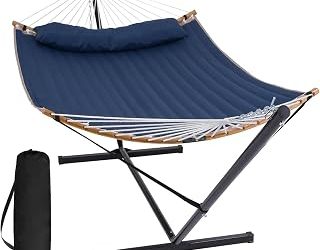
For a freestanding solution, the Sunnydaze Heavy-Duty Hammock Stand supports up to 550 pounds and fits 9- to 14-foot hammocks. Its tool-free design is useful when you want to reposition the hammock, although the frame still needs a level, stable surface. Indoor or structural installations require different hardware: the MHMYDZ 1000 lb Hammock Hanging Kit and the 360-degree rotating Hammock Hanging Kit are examples of ceiling-hook systems, but their rated capacity does not replace proper joist attachment or professional assessment.
Choose the Right Location and Support
Begin with the structure, not the hammock. Healthy, mature trees should have solid trunks with no visible rot, deep cracks, loose bark, or major dead limbs above the resting area. Do not attach to a branch merely because it looks thick; a trunk or professionally verified structural point is more predictable. For indoor use, locate a ceiling joist or engineered beam. A drywall anchor alone is not an acceptable suspension point for a person.
Measure the hammock’s total end-to-end length, including its suspension hardware. A useful starting distance between attachment points is roughly 85 to 95 percent of that length. If the points are farther apart, you will need more height or longer straps. Keep the hammock clear of walls, sharp edges, hot grills, pools, and hard objects that could worsen a fall.
Set a Comfortable, Stable Hang
A relaxed hammock should form a noticeable curve rather than a taut, nearly straight line. As a starting point, place each suspension point about 4 to 5 feet above the ground, then adjust after a cautious test. When occupied, the lowest part of the hammock should generally sit around 12 to 18 inches above a clear surface. Heavier users or a deeper-cupped hammock may require slightly more initial height.
For ergonomic support, lie diagonally across the fabric instead of lengthwise. This spreads your body more evenly, reduces the “banana” bend through the hips, and gives your shoulders and knees more room. If your lower back feels compressed, loosen the setup slightly or change your diagonal position. A hammock should cradle you, not force your spine into a sharply flexed posture.
Match Hardware to the Installation
Tree straps should be wide, smooth, and long enough to wrap fully around the trunk without extending beyond the manufacturer’s intended adjustment range. Place the webbing above any roots or irregular bark, keep it flat, and avoid twisting it. Never substitute thin utility rope, wire, or a ratchet strap designed for cargo tie-downs.
Ceiling hooks and rotating connectors are appropriate only when installed into suitable structural material with the specified fasteners. Products such as the 1000 lb Hammock Hanging Kit with 360-degree rotation can improve movement for a hanging chair, but “1000 lb capacity” is a component rating, not a guarantee for an entire ceiling assembly. The weakest part—wood, fastener, eye, carabiner, or connector—sets the real limit. Follow the installation instructions and consult a qualified professional if the framing is concealed or uncertain.
Check that carabiners are fully closed and that loaded connectors sit in their strongest orientation. Avoid side-loading gates, sharp bends, and hardware that can rub continuously against fabric. A rotating fitting should turn smoothly without binding; it should not be used to compensate for a poorly aligned anchor.
Test, Inspect, and Maintain
Before climbing in, apply weight gradually with one hand, then sit near the center while keeping one foot on the ground. Listen for creaking, watch for strap movement, and check whether the anchor points shift. Test again after the first few uses, because webbing and knots can settle. Keep the hammock dry when possible and store it indoors during severe weather or long periods of nonuse.
Inspect fabric for fraying, stretched stitching, mildew, or sun damage. Replace straps when fibers look fuzzy, flattened, cut, or permanently discolored. Examine metal parts for cracks, deformation, corrosion, and gates that no longer close completely. Do not repair load-bearing webbing with household stitching or tape. A stand should remain square, with secure feet and no bent tubes or loose joints.
Tips
- Use a gradual, low-height test before allowing children, pets, or multiple adults into the hammock.
- Respect the lowest-rated component and leave a generous margin below its published capacity.
- Keep the hammock’s fabric and suspension away from abrasive concrete, brick corners, and unprotected metal.
- Recheck the setup whenever you move it, after heavy rain or wind, and at the start of each outdoor season.
Frequently Asked Questions
How high should a hammock be hung?
Start with the attachment points about 4 to 5 feet high and aim for roughly 12 to 18 inches of clearance at the lowest point when occupied. Adjust for user weight, hammock stretch, and the softness of the landing surface. Lower is generally safer than higher, provided the hammock does not drag.
Can I hang a hammock from a ceiling?
Yes, but only from verified structural framing or an engineered support. A ceiling hook fixed solely to drywall, plaster, or a lightweight hollow-wall anchor can pull out. The fastener, wood or beam, and surrounding structure must all be suitable for dynamic loads.
Are tree straps better than rope?
Purpose-made tree straps are usually safer for both the tree and the user. Their broad webbing spreads pressure, adjustment loops simplify setup, and compatible carabiners reduce improvised connections. They still need correct placement and regular inspection.
Can two people use one hammock?
Only if the hammock, suspension system, and anchor points are explicitly rated for the combined load and movement. Two people increase shifting and shock forces, not just static weight. A compatible stand, such as the Sunnydaze 550-pound model, must also be placed on firm, level ground.
Conclusion
The best hammock setup combines sound support, a relaxed curve, low clearance, correctly matched hardware, and routine inspection. Choose broad tree straps or properly installed structural hardware, avoid relying on ratings without checking the complete system, and make small ergonomic adjustments after testing. A few careful measurements will produce a more comfortable hammock—and a suspension system that lasts considerably longer.