Key takeaways
- Working height and wand geometry: Count the extensions and add them up. Three 15-inch sections put the handle near hip level for most adults, which lets you drive the head with body weight instead of a bent-wrist push. Too short and you stoop; too long and the bar wanders.
- Swivel bearing quality: The rotating union is the first thing to fail. Look for stainless internals and a serviceable seal rather than a sealed plastic housing, and expect a smooth, quiet spin — grittiness out of the box predicts a leak within weeks.
- Bar material and nozzle mounting: Stainless or coated steel bars resist the dings that come from clipping a curb. Threaded, replaceable nozzle inserts matter more than nozzle count; a clogged fixed jet turns a whole bar into scrap.
- Caster diameter and clearance: Small hard wheels stall on expansion joints and gravel, forcing you to shove harder and load your lumbar spine. Larger wheels roll over transitions and keep the spray distance consistent, which is what actually cleans.
- Dual-mode versatility: A head that pivots from undercarriage spray to a downward water broom earns its storage space, letting one purchase handle wheel wells, driveways, patios, and deck boards.
What's inside
Sliding a wand under a vehicle on your back is where most driveway cleaning projects go wrong. Your shoulders end up doing work your legs should handle, spray rebounds off the pan and frame into your face, and after ten minutes of holding a torqued-open trigger at an awkward angle your grip fatigues before the road salt ever lets go. The undercarriage is also the one surface where poor coverage costs real money: trapped brine and de-icer chew through brake lines, subframe welds, and fuel tank straps long before anything shows on the paint.
An undercarriage attachment solves this by moving the nozzles to the ground and the effort to your forearms in a neutral, upright push. That said, these tools live a hard life — dragged across aggregate, kicked, and pressurized to 4000 PSI — so build quality varies enormously between models that look identical in photos. This guide evaluates the leading 2026 options through two lenses I use professionally: postural load during a full session, and how the swivel, bar, and caster assemblies hold up after a season of abrasive contact.
As an Amazon Associate we earn from qualifying purchases.


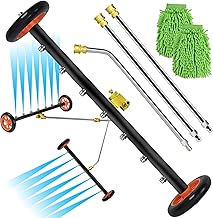

How to Choose a/an Undercarriage Pressure Washer Attachment (2026)
- Working height and wand geometry: Count the extensions and add them up. Three 15-inch sections put the handle near hip level for most adults, which lets you drive the head with body weight instead of a bent-wrist push. Too short and you stoop; too long and the bar wanders.
- Swivel bearing quality: The rotating union is the first thing to fail. Look for stainless internals and a serviceable seal rather than a sealed plastic housing, and expect a smooth, quiet spin — grittiness out of the box predicts a leak within weeks.
- Bar material and nozzle mounting: Stainless or coated steel bars resist the dings that come from clipping a curb. Threaded, replaceable nozzle inserts matter more than nozzle count; a clogged fixed jet turns a whole bar into scrap.
- Caster diameter and clearance: Small hard wheels stall on expansion joints and gravel, forcing you to shove harder and load your lumbar spine. Larger wheels roll over transitions and keep the spray distance consistent, which is what actually cleans.
- Dual-mode versatility: A head that pivots from undercarriage spray to a downward water broom earns its storage space, letting one purchase handle wheel wells, driveways, patios, and deck boards.
The Best Undercarriage Pressure Washer Attachments (2026) Reviewed
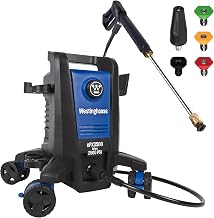
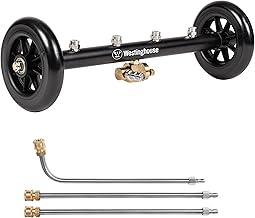
Westinghouse Universal 16″ Undercarriage Cleaner and Water Broom
Westinghouse builds this one with the tolerances you expect from a company that also sells the machines, and the 4400 PSI rating gives you genuine headroom on a gas unit rather than a number printed at the ragged edge of the seals. The broom conversion is quick enough that you will actually use it, which spreads the ergonomic benefit across driveway work too.
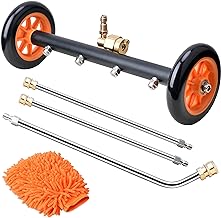
EVEAGE 2-in-1 16″ Dual-Mode Surface Washer
The dual-mode head is the most thoughtfully balanced of the group — it tracks straight without needing constant corrective input from your wrists, and the wide 1500 to 4000 PSI window makes it a safe pick if you are running a mid-tier electric washer. The included wash mitt is a throwaway, but the three-wand stack sets a comfortable upright posture.
RIDGE WASHER Undercarriage Cleaner with Foam Cannon
RIDGE WASHER has the strongest track record for parts availability, which is what separates a three-year tool from a one-season one. The straight extension wand is stiffer than the segmented competition, so it transmits your push efficiently instead of flexing, and the bundled foam cannon means pre-soaking and rinsing happen with one purchase.
Upgrade 24 Inch 2-in-1 Undercarriage Attachment
At 24 inches with seven nozzles, this is the efficiency choice for trucks, SUVs, and long driveways — fewer passes means fewer minutes in a loaded posture. Be aware that the wider bar demands more flow to keep all jets working, so pair it with a machine rated at 2.5 GPM or better.
16 Inch Undercarriage Attachment with 3 Extension Wands, 4000 PSI
This is the sensible baseline: a 16-inch bar, a full three-wand stack, and a 4000 PSI ceiling with no extras inflating the price. It is the model I recommend to homeowners doing two or three seasonal salt rinses a year rather than weekly work.
Frequently Asked Questions
Will one of these work with my electric pressure washer?
Usually yes, provided your machine produces at least 1.4 GPM and roughly 2000 PSI. Below that, a 16-inch bar splits the flow too thinly to lift bonded grime, and a 24-inch bar will barely mist.
How often should I rinse the undercarriage?
Every two to three weeks through a salted winter, and once immediately after the final thaw. Corrosion is cumulative, so consistency beats intensity.
Do I need to worry about spraying electrical connectors or sensors?
Keep the bar moving and avoid parking a jet on wiring harnesses, exhaust sensors, or grease-packed CV boots. The ground-level spray angle helps here, since it sheets across surfaces rather than driving straight into them.
Why did my swivel start leaking?
Almost always debris ingress or a dry start. Flush the attachment with clean water after each use, store it off concrete, and never trigger the wand before the head is seated on the ground.
Final Thoughts
For most buyers the Westinghouse Universal 16″ is the safest blend of durable hardware and pressure headroom, while the EVEAGE 2-in-1 offers the best posture and tracking for anyone who wants a genuine dual-purpose tool. If you are cleaning a truck or a long drive and want to cut your pass count, step up to the Upgrade 24 Inch and make sure your machine has the flow to feed it.