Key takeaways
- Working height and reach: A table between 34 and 37 inches lets you push stock with a straight wrist and locked elbows instead of hunching. Equally important is depth — a table more than about 26 inches front to back forces you to lean over the blade to reach the fence lock, which is both fatiguing and unsafe.
- Fence mechanism, not fence length: Rack-and-pinion fences move parallel by design and stay square after thousands of adjustments. Single-point clamp fences require you to tap and re-check, and the wear shows up as creeping inaccuracy within a season of regular use.
- Stand deployment force: Ask how the saw goes from stored to ready. Rolling stands with a foot-release lift the mass for you; folding leg sets require a controlled 60-to-90-pound rotation at knee height. If you store the saw in a garage corner and set up weekly, this single factor decides whether you actually use the tool.
- Rip capacity you’ll genuinely use: 32 inches lets you break down a full sheet of plywood with the factory edge against the fence. Around 24 inches you’ll be crosscutting sheets first with a track saw or circular saw. Both workflows are valid — just don’t pay for capacity your projects never demand.
- Vibration and dust at the source: Cast or heavily ribbed tabletops with tight arbor bearings transmit less buzz into your hands, which matters over long sessions. A shrouded blade with a 2-1/2-inch dust port keeps fine particulate off your face rather than in it.
What's inside
Most DIYers don’t abandon a table saw because it stopped cutting. They abandon it because the fence started drifting after eighteen months, or the stand takes two people and a bad back to deploy, or the table sits at a height that turns a ninety-minute cabinet build into a shoulder ache that lasts through dinner. Power is the easy part — every saw on this list has a 15-amp motor. What separates a tool you’ll still be using in 2036 from one you’ll quietly list on Marketplace is how it handles repeated setup, repeated adjustment, and repeated stress on the parts you touch most.
This guide evaluates portable and jobsite table saws through two lenses I care about professionally: ergonomics — working height, reach depth, lever forces, and how much your body absorbs during a cut — and durability, meaning the fence mechanism, trunnions, bearings, and stand hardware that determine whether the saw stays accurate. Below you’ll find the models worth your money, a short checklist for matching a saw to your shop, and honest notes on where each one compromises.
As an Amazon Associate we earn from qualifying purchases.



How to Choose a Table Saw For Diyers (2026)
- Working height and reach: A table between 34 and 37 inches lets you push stock with a straight wrist and locked elbows instead of hunching. Equally important is depth — a table more than about 26 inches front to back forces you to lean over the blade to reach the fence lock, which is both fatiguing and unsafe.
- Fence mechanism, not fence length: Rack-and-pinion fences move parallel by design and stay square after thousands of adjustments. Single-point clamp fences require you to tap and re-check, and the wear shows up as creeping inaccuracy within a season of regular use.
- Stand deployment force: Ask how the saw goes from stored to ready. Rolling stands with a foot-release lift the mass for you; folding leg sets require a controlled 60-to-90-pound rotation at knee height. If you store the saw in a garage corner and set up weekly, this single factor decides whether you actually use the tool.
- Rip capacity you’ll genuinely use: 32 inches lets you break down a full sheet of plywood with the factory edge against the fence. Around 24 inches you’ll be crosscutting sheets first with a track saw or circular saw. Both workflows are valid — just don’t pay for capacity your projects never demand.
- Vibration and dust at the source: Cast or heavily ribbed tabletops with tight arbor bearings transmit less buzz into your hands, which matters over long sessions. A shrouded blade with a 2-1/2-inch dust port keeps fine particulate off your face rather than in it.
The Best Table Saw For Diyers (2026)s Reviewed
DEWALT DWE7491RS 10-Inch with Rolling Stand
This remains the reference point for DIY ergonomics: the rolling stand releases with a foot pedal so your back never takes the full load, and the rack-and-pinion fence holds parallel with almost no re-checking across its 32-1/2-inch capacity. The tradeoff is bulk — at roughly 110 pounds with the stand, it wants a dedicated parking spot, not a shelf.
SKIL TS6307-00 10-Inch Jobsite Saw
SKIL’s rack-and-pinion fence and integrated foldable stand deliver most of the DEWALT’s setup comfort at a noticeably friendlier price, and the onboard dust port genuinely moves debris. Fit and finish are a step below the DEWALT, so budget an afternoon to verify blade-to-fence parallelism out of the box.
DEWALT DWE7485 8-1/4-Inch Compact
The smart pick for anyone lifting a saw onto a bench or into a truck bed regularly — roughly 54 pounds, a compact footprint, and the same confident fence action in a smaller package. The 8-1/4-inch blade caps depth of cut near 2-1/2 inches, so thick hardwood ripping means two passes.
SKIL SPT99-11 Worm Drive with Stand
Worm drive gearing trades top RPM for sustained torque, and you feel it in dense stock where belt-drive saws bog and vibrate. It’s the heaviest option here and the most demanding to move, but the drivetrain and stand hardware are built for years of hard duty rather than occasional weekends.
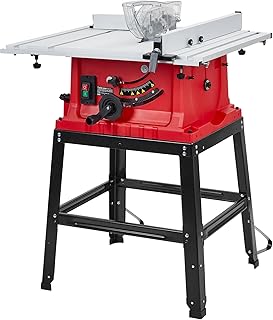
10-Inch 5000 RPM Saw with 36 x 25-Inch Tabletop
The generous 36-by-25-inch table gives sheet goods real support, and the protective cover plus bevel range from 0 to 45 degrees cover typical DIY work. Expect a clamp-style fence that needs verification before each critical rip — acceptable at this price, but plan on it as part of your routine.
Frequently Asked Questions
Is an 8-1/4-inch saw enough for furniture projects?
For plywood casework, drawer parts, and stock under 2-1/2 inches, yes. If you regularly rip 4/4 or thicker hardwood or cut thick tenon shoulders, the extra depth of a 10-inch blade saves real time.
What actually makes a table saw last?
Trunnions, arbor bearings, and the fence rail system. Motors rarely fail first — accuracy does, and accuracy lives in those three components plus a flat table.
Do I need a riving knife?
Yes, and use it. A riving knife rises and falls with the blade and prevents the kerf from closing on the back teeth, which is the mechanism behind most kickback injuries.
How do I improve comfort on an existing saw?
Add an outfeed support at table height, stand on an anti-fatigue mat, and keep the blade sharp — a dull blade increases feed force and hand strain more than any other single factor.
Final Thoughts
If you want one saw that stays accurate and spares your back, the DEWALT DWE7491RS earns its price through the rolling stand and fence alone. Tight on space or lifting the saw often? The DWE7485 is the ergonomic compromise worth making. And if your projects lean toward thick hardwood and heavy use, the SKIL SPT99-11’s worm drive is the durability play.