Key takeaways
- Deflection under side load: Push hard against the fence face at its far end with the lock engaged. A well-built extrusion or box-section body barely moves; thin folded steel telegraphs the load down the rail. Anything you can feel with your hand, your workpiece can feel too.
- Lock ergonomics: You’ll operate the lever hundreds of times a day. Look for a low-effort cam that seats with a short throw, a handle that clears your knuckles against the rail, and enough leverage that you’re not recruiting your shoulder. High-effort locks train people into sloppy habits.
- Wear surfaces and materials: Hardened steel cams against anodized aluminum will eventually polish a groove. Check for replaceable pads, brass or nylon glides, and adjustable set screws that let you take up slack years later instead of buying a new head.
- Repeatability, not just accuracy: A fence that reads dead-on once is less useful than one that returns to the same number every time. Self-squaring T-square geometry, where the head references the front rail rather than the tabletop, is the most reliable way to get that consistency.
- Accessory integration: T-track channels let you mount featherboards, stops, and hold-downs where your hands would otherwise be. That’s the single cheapest ergonomic upgrade available: it moves pressure off your fingers and onto the machine.
What's inside
Most rip cuts don’t go wrong at the blade. They go wrong at the fence, in the half-second when your left hand leans into the workpiece and the fence face gives up a few thousandths. That flex is invisible while it happens and obvious afterward, in a joint line that opens toward one end. Buyers usually blame the saw, replace the blade, then re-cut the same tapered board. The real culprit is often a stamped-steel fence body with a single clamping point at the front rail, working against a wide plate and a long lever arm.
This guide looks at replacement and add-on fences through two lenses I trust more than spec sheets: how the hardware treats your body over a long session, and how it behaves after a few thousand lock cycles. Lever throw, hand clearance, grip height, how far you have to bend to read a scale, whether the locking cam wears its own seat into soft alloy. Below are the systems worth your money in 2026, from full T-track platforms to straight OEM replacements, plus what to check before you commit.
As an Amazon Associate we earn from qualifying purchases.


How to Choose a Table Saw Fence (2026)
- Deflection under side load: Push hard against the fence face at its far end with the lock engaged. A well-built extrusion or box-section body barely moves; thin folded steel telegraphs the load down the rail. Anything you can feel with your hand, your workpiece can feel too.
- Lock ergonomics: You’ll operate the lever hundreds of times a day. Look for a low-effort cam that seats with a short throw, a handle that clears your knuckles against the rail, and enough leverage that you’re not recruiting your shoulder. High-effort locks train people into sloppy habits.
- Wear surfaces and materials: Hardened steel cams against anodized aluminum will eventually polish a groove. Check for replaceable pads, brass or nylon glides, and adjustable set screws that let you take up slack years later instead of buying a new head.
- Repeatability, not just accuracy: A fence that reads dead-on once is less useful than one that returns to the same number every time. Self-squaring T-square geometry, where the head references the front rail rather than the tabletop, is the most reliable way to get that consistency.
- Accessory integration: T-track channels let you mount featherboards, stops, and hold-downs where your hands would otherwise be. That’s the single cheapest ergonomic upgrade available: it moves pressure off your fingers and onto the machine.
The Best Table Saw Fences (2026) Reviewed
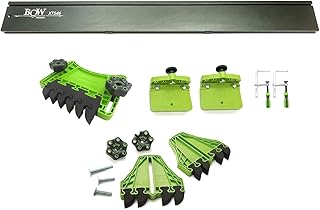
BOW Products Ultimate Table Saw XTENDER & Safety Kit
This is the package I’d hand someone who wants their setup solved in one purchase: the 46″ XT fence, two feed supports, T-track clamps, and both the FeatherPRO and FencePRO featherboards. The value here is postural as much as mechanical, since the featherboards keep your hands well outside the blade path and let you commit to a smooth, single-pass feed.
BOW Products 46″ XT XTENDER Fence System
The standalone XTENDER gives you a long, rigid T-track face that spans far beyond the stock capacity of most portable and contractor saws, and it moves across router tables and band saws too. The extrusion resists twist better than any folded-steel fence in this range, though you’ll want to verify your rail spacing before ordering.
36″ Professional Advanced Self-Aligning T-Square Fence
The self-aligning T-square head is the headline feature and it earns the billing: the body squares itself to the rail on every lock, so you’re not chasing parallelism with a feeler gauge each morning. At 36 inches of rip capacity it suits cabinet and contractor saws handling full sheet goods without an outfeed wrestling match.
Delta T3 Fence System, 30 in.
Delta’s T30T3 is the conservative, durable choice, and after years of watching these in shared shops I’ve seen very few worn out. The lock effort is moderate, the scale sits at a readable angle, and 30 inches covers most furniture work without pushing your reach past comfortable.
Ryobi-Compatible Rip Fence Assembly (RTS10G, RTS10NS)
When a factory fence gets dropped or bent, a correct-fit OEM-style replacement beats improvising with a clamped board. Confirm your model number carefully, since the RTS10G and RTS10NS castings differ from earlier revisions.
Frequently Asked Questions
Will an aftermarket fence fit my saw?
Not automatically. Fit depends on your front rail geometry, table thickness, and mounting hole pattern. Measure your rail height and the distance from the table surface to the rail’s top face before ordering, and treat “universal” as “usually adaptable with drilling.”
How much rip capacity do I actually need?
For furniture work, 30 inches handles nearly everything, including half-sheet breakdown. Capacity beyond that mostly costs you floor space and forces longer reaches, which is its own ergonomic penalty.
Are T-track fences worth the extra cost?
Yes, if you plan to use featherboards or stop blocks. The track lets you add hold-downs that keep material tight to the fence while your hands stay clear, which reduces both kickback risk and fatigue.
How do I keep a fence accurate over time?
Clean the rail and glide surfaces, avoid over-torquing the lock, and check parallelism to the blade every few months with a dial indicator. Most drift comes from grit in the glides or a cam that needs its set screws taken up.
Final Thoughts
For most furniture builders, the BOW Products Ultimate XTENDER & Safety Kit delivers the best combination of rigidity, capacity, and hands-off workholding in a single box. If you’d rather keep it simple on a cabinet or contractor saw, the Delta T3 is the long-haul durability pick, while the 36″ self-aligning T-square fence is the one to choose when repeatable squareness matters more than accessories.