Key takeaways
- Fence repeatability: A rack-and-pinion fence stays parallel as it travels, which matters more than raw rip capacity. Test it by locking at 12 inches, moving away, and returning — the reading should land in the same place every time. Single-point clamp fences drift and cost you accuracy on glue-ready edges.
- Working height and lift strategy: Comfortable deck height for most adults is 34 to 36 inches. Rolling stands let you move a 100-pound saw without lifting it at all; folding stands are lighter but ask you to hoist the whole assembly. Match the mechanism to your back, not the marketing photo.
- Deck flatness and surface: Run a straightedge across the table before you commit. Stamped steel decks with pressed ribs stay flatter under load than thin unsupported sheet. A slick, sealed surface also cuts the feed pressure your shoulders absorb on wide panels.
- Sustained cut, not peak numbers: Every saw here draws 15 amps. What separates them is thermal behavior in hardwood — how well the motor housing vents, whether there is overload protection, and how much the blade slows in 8/4 maple. Prioritize cooling design over advertised RPM.
- Guard hardware you will actually reinstall: Tool-free riving knife and guard changes get used. Ones requiring two wrenches get left in a drawer, which is where injuries start. Check the dust port diameter too — 2-1/2 inches connects to a standard shop vac hose without adapters.
What's inside
Most table saw comparisons stop at the spec sheet: amps, RPM, rip capacity. Those numbers tell you almost nothing about the two things that actually decide whether a saw earns its footprint in a garage shop. The first is how the machine treats your body across a long session of breaking down sheet goods and milling case parts. The second is which components loosen, drift, or wear out after a few hundred board feet. A fence that needs a tap from a dead-blow hammer to square up, or a stand that forces you to bend at 32 inches, will sour you on an otherwise capable saw within a month.
This guide looks at the current crop of portable and jobsite saws through that lens: working height and stand mechanics, fence repeatability, deck flatness, trunnion rigidity, and the small hardware details that survive being loaded into a truck bed. Below are the models worth watching for price drops in 2026, followed by a buying framework and reviews of the five strongest options for furniture work.
As an Amazon Associate we earn from qualifying purchases.



How to Choose a Table Saw Deals (2026)
- Fence repeatability: A rack-and-pinion fence stays parallel as it travels, which matters more than raw rip capacity. Test it by locking at 12 inches, moving away, and returning — the reading should land in the same place every time. Single-point clamp fences drift and cost you accuracy on glue-ready edges.
- Working height and lift strategy: Comfortable deck height for most adults is 34 to 36 inches. Rolling stands let you move a 100-pound saw without lifting it at all; folding stands are lighter but ask you to hoist the whole assembly. Match the mechanism to your back, not the marketing photo.
- Deck flatness and surface: Run a straightedge across the table before you commit. Stamped steel decks with pressed ribs stay flatter under load than thin unsupported sheet. A slick, sealed surface also cuts the feed pressure your shoulders absorb on wide panels.
- Sustained cut, not peak numbers: Every saw here draws 15 amps. What separates them is thermal behavior in hardwood — how well the motor housing vents, whether there is overload protection, and how much the blade slows in 8/4 maple. Prioritize cooling design over advertised RPM.
- Guard hardware you will actually reinstall: Tool-free riving knife and guard changes get used. Ones requiring two wrenches get left in a drawer, which is where injuries start. Check the dust port diameter too — 2-1/2 inches connects to a standard shop vac hose without adapters.
The Best Table Saw Deals (2026)s Reviewed
DEWALT DWE7491RS 10-Inch with Rolling Stand
The rack-and-pinion fence on this saw is the benchmark for portable accuracy, and the 32-1/2-inch rip capacity handles a half-sheet reference cut without an outfeed jig. The foldable rolling stand is the ergonomic argument: you tilt and wheel a heavy machine instead of deadlifting it, which is why this remains the durable long-term pick for furniture builders.
SKIL TS6307-00 15 Amp Portable Jobsite Saw
SKIL pairs a rack-and-pinion fence with a lighter folding stand, landing in a sweet spot for shops where the saw gets stowed against a wall between projects. Setup and breakdown are genuinely one-person jobs, and the fence holds a setting well enough for repeat rips on drawer stock.
DEWALT DWE7485 8-1/4-Inch Compact
Dropping to an 8-1/4-inch blade trades depth of cut for a saw that one person can carry up basement stairs without a second thought. For 3/4-inch plywood, hardwood face frames, and trim, the reduced capacity is rarely a limitation, and the smaller footprint means less table to keep flat.
DOVAMAN DTS10A 10-Inch with Stand
The copper-wound motor and 3.35-inch cut height at 90 degrees cover thick stock that compact saws cannot reach, and the single-side extension adds support exactly where wide panels want to tip. Budget extra shop time for initial fence and blade alignment before your first critical cut.
10-Inch 15 Amp Saw with 36 x 25-Inch Tabletop
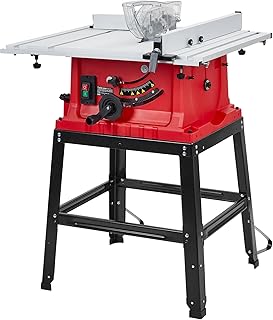
The oversized deck is the standout here, giving panels real support rather than relying on your left hand to keep things flat. Full 0 to 45 degree bevel range, adjustable depth, and an included protective cover make it a reasonable value pick for occasional furniture work in a dusty garage.
Frequently Asked Questions
Is a 10-inch saw worth the extra weight over 8-1/4?
Only if you regularly cut stock thicker than about 2-1/2 inches or bevel through 4/4 hardwood. If your work is sheet goods and dimensional lumber, the lighter saw reduces handling strain and setup friction, which usually translates to more time actually cutting.
How much does the stand really matter?
More than the motor, in daily use. A rolling stand converts a two-person lift into a one-person wheel-and-tilt, and a stable stand at the right height keeps your wrists neutral through long rip sessions. Wobbly legs also introduce vibration that shows up as blade marks.
Can these saws cut plastics and aluminum?
Yes, with the right blade — a high tooth count, negative or neutral hook design — plus a slower feed rate and full guarding. Non-ferrous and acrylic cuts throw chips aggressively, so treat eye protection and a zero-clearance insert as mandatory rather than optional.
What maintenance keeps a portable saw accurate?
Check blade-to-miter-slot parallelism monthly, keep the elevation and bevel screws clean and lightly waxed, and vacuum the trunnion area rather than blowing dust deeper into it. Ten minutes of upkeep prevents the slow accuracy loss that makes people replace saws prematurely.
Final Thoughts
If you want one saw to keep for a decade, the DEWALT DWE7491RS earns it through fence repeatability and a rolling stand that spares your back. The SKIL TS6307-00 is the smarter buy for tight shops that need the saw stowed between projects, and the DEWALT DWE7485 is the right call when portability outranks maximum cut depth.