Key takeaways
- Compatibility: Check the connector type, maximum PSI, and flow requirements against your pressure washer. A 1/4-inch quick-connect attachment is common on many consumer machines, while some heavy-duty models use 3/8-inch fittings.
- Cleaning width: Wider housings cover more ground per pass, but they can feel cumbersome on compact patios or when paired with a lower-flow electric washer. Choose width according to both surface area and machine capacity.
- Ergonomics: Wheels should roll smoothly without wobbling, and the handle or extension wand should keep your hands near a comfortable working height. A stable housing reduces the need to press down or fight spray torque.
- Construction: Stainless steel generally offers better resistance to dents, corrosion, and long-term outdoor wear than thin plastic. Still, inspect fittings, swivel components, and wheel mounts because those parts experience the most stress.
- Nozzle maintenance: Rotating spray bars depend on clean, correctly sized nozzles. Replaceable tips and easy access under the housing make troubleshooting simpler and help preserve an even spray pattern.
What's inside
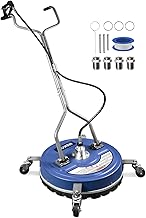
Cleaning a large patio, driveway, or deck with a pressure-washer wand can be surprisingly hard on the body. The narrow spray path encourages repeated passes, while uneven nozzle height often leaves visible stripes and forces the operator to bend, twist, and reposition constantly. A surface cleaner attachment spreads the spray beneath a covered housing, making the work more uniform and usually much less tiring.
This guide evaluates pressure-washer surface cleaners from an ergonomics-and-durability perspective. The focus is on housing strength, wheel stability, handle control, connector compatibility, cleaning width, and how easily each attachment can maintain a consistent working height. The best choice depends on both your washer and the size of the surfaces you clean most often.
As an Amazon Associate we earn from qualifying purchases.




How to Choose a/an Surface Cleaner For Pressure Washer (2026)
- Compatibility: Check the connector type, maximum PSI, and flow requirements against your pressure washer. A 1/4-inch quick-connect attachment is common on many consumer machines, while some heavy-duty models use 3/8-inch fittings.
- Cleaning width: Wider housings cover more ground per pass, but they can feel cumbersome on compact patios or when paired with a lower-flow electric washer. Choose width according to both surface area and machine capacity.
- Ergonomics: Wheels should roll smoothly without wobbling, and the handle or extension wand should keep your hands near a comfortable working height. A stable housing reduces the need to press down or fight spray torque.
- Construction: Stainless steel generally offers better resistance to dents, corrosion, and long-term outdoor wear than thin plastic. Still, inspect fittings, swivel components, and wheel mounts because those parts experience the most stress.
- Nozzle maintenance: Rotating spray bars depend on clean, correctly sized nozzles. Replaceable tips and easy access under the housing make troubleshooting simpler and help preserve an even spray pattern.
The Best Surface Cleaner For Pressure Washer (2026)s Reviewed
Westinghouse Universal 16.5-inch Surface Cleaner
The Westinghouse Universal 16.5” Pressure Washer Surface Cleaner Attachment is a strong all-purpose option for homeowners who want substantial coverage without moving into an oversized commercial-style tool. Its stainless-steel housing and 4,400-PSI rating suggest good resistance to everyday knocks, while the four-wheel layout should help keep the spray bar at a consistent height. The 1/4-inch connector makes it broadly useful with compatible gas and electric washers.
Hourleey 14-inch Stainless Steel Surface Cleaner
Hourleey’s 14-inch cleaner is sized well for sidewalks, patios, and smaller driveways where maneuverability matters more than maximum throughput. Four wheels support the housing, and the included extension wands can reduce stooping for taller users. Its 4,000-PSI rating provides useful headroom, but buyers should still verify their washer’s flow before expecting fast, streak-free coverage.
MEKOH 20-inch Heavy-Duty Surface Cleaner
The MEKOH 20” Heavy-Duty Pressure Washer Surface Cleaner is the productivity-oriented pick for broad driveways, decks, and concrete areas. Its dual-handle design can distribute pushing force more comfortably than a single wand, particularly when the attachment is moving across textured pavement. The large footprint and 4,500-PSI rating are best matched with a capable gas pressure washer; the 3/8-inch quick-connect also makes compatibility especially important.
Westinghouse Universal 15-inch Surface Cleaner
This 15-inch Westinghouse model occupies a practical middle ground: wider than compact residential attachments, but not so large that it becomes awkward around furniture, steps, or narrow paths. The 3,400-PSI limit suits many household gas and electric machines, provided the connector and flow specifications match. It is a sensible choice for buyers who value predictable handling and moderate coverage over the highest possible cleaning rate.
LidoDola 14-inch Pressure Washer Surface Cleaner
LidoDola’s 14-inch attachment emphasizes a complete maintenance package, including two extension wands and replacement nozzles. That is useful from a durability standpoint because worn or blocked nozzles can make a surface cleaner appear ineffective even when the housing and swivel remain sound. The stainless-steel body and four wheels make it a versatile fit for common residential concrete and patio jobs, assuming a compatible 1/4-inch quick-connect washer.
Frequently Asked Questions
Are surface cleaners better than a pressure-washer wand?
For broad, flat surfaces, usually yes. A surface cleaner helps maintain a more even distance from the ground and contains much of the overspray, reducing striping and limiting the repetitive arm movement associated with wand-only cleaning.
Can I use a surface cleaner on wood decking?
Only with care. Use the lowest effective pressure, keep the attachment moving, and test an inconspicuous area first. Soft, weathered, or previously damaged boards can still be etched or lifted by concentrated spray.
Why does my surface cleaner leave lines?
Common causes include clogged or mismatched nozzles, insufficient water flow, a damaged swivel, or moving too quickly. A pressure washer that cannot provide the attachment’s required flow may also produce uneven rotation and incomplete cleaning.
Should I choose a 14-inch or 20-inch model?
Choose 14 inches for better control around residential features and smaller machines. A 20-inch cleaner can save time on large concrete areas, but it needs stronger water delivery and may feel heavier or less responsive during turns.
Final Thoughts
For a balanced residential setup, the Westinghouse Universal 16.5-inch offers durable construction and useful coverage, while the Hourleey 14-inch is easier to manage on varied household surfaces. If your washer has the required flow and a 3/8-inch connection, the MEKOH 20-inch is the productivity pick for large expanses of concrete.