Key takeaways
- Mobility: Choose large, smooth-rolling casters and a solid push handle if the chest will cross garage thresholds, rough concrete, or crowded work areas. Small wheels are easier to tip and harder to steer when loaded.
- Drawer ergonomics: Full-width pulls, smooth slides, and drawers that open without excessive force reduce wrist strain. Place commonly used hand tools between waist and chest height rather than at floor level.
- Load stability: A broad footprint, locking casters, and a low center of gravity matter more than maximum drawer count. Heavy power tools should sit low so the cabinet remains steady while drawers are open.
- Construction: Look for reinforced metal panels, protective drawer liners, dependable hinges, and a finish that can tolerate occasional oil, dust, and impact. Thin sheet metal may dent during ordinary garage use.
- Storage flexibility: Detachable top boxes, internal trays, hooks, and dividers make a chest adaptable. Measure both the available floor space and the tools you plan to store before choosing a configuration.
What's inside
A roller tool chest can look like a straightforward storage upgrade, yet the wrong one quickly becomes a source of noise, clutter, and back strain. Thin drawers, flexing casters, awkward handles, and shallow compartments may be acceptable for occasional use but frustrating in a busy garage or workshop. The best design keeps heavy tools stable, moves predictably, and puts frequently used equipment within comfortable reach.
This guide evaluates roller tool chests from an ergonomics-and-durability perspective. We focus on drawer access, wheel behavior, structural rigidity, locking systems, portability, and how well each format suits real home projects rather than simply counting compartments.
As an Amazon Associate we earn from qualifying purchases.


How to Choose a/an Roller Tool Chest (2026)
- Mobility: Choose large, smooth-rolling casters and a solid push handle if the chest will cross garage thresholds, rough concrete, or crowded work areas. Small wheels are easier to tip and harder to steer when loaded.
- Drawer ergonomics: Full-width pulls, smooth slides, and drawers that open without excessive force reduce wrist strain. Place commonly used hand tools between waist and chest height rather than at floor level.
- Load stability: A broad footprint, locking casters, and a low center of gravity matter more than maximum drawer count. Heavy power tools should sit low so the cabinet remains steady while drawers are open.
- Construction: Look for reinforced metal panels, protective drawer liners, dependable hinges, and a finish that can tolerate occasional oil, dust, and impact. Thin sheet metal may dent during ordinary garage use.
- Storage flexibility: Detachable top boxes, internal trays, hooks, and dividers make a chest adaptable. Measure both the available floor space and the tools you plan to store before choosing a configuration.
The Best Roller Tool Chest (2026)s Reviewed
20-Drawer Tool Chest with Stainless Countertop
This multi-section chest is designed for users who need substantial sorting capacity across five-, seven-, and eight-drawer modules. Its stainless countertop, locking system, wheels, foot pads, connection buckle, and included portable toolbox create a flexible station for a garage or home workspace. The modular arrangement is useful, although buyers should keep heavier items in the lower drawers to preserve stability during movement.
DEWALT DWST17820 Rolling Tool Box
The DEWALT DWST17820 takes a different approach: it is a large wheeled carrier with a telescopic handle and stackable TSTAK compatibility rather than a traditional bank of metal drawers. That makes it particularly practical for transporting selected tools between rooms or job areas. Its advantage is controlled portability and modular organization; it is less suitable for someone who wants every tool permanently displayed in individual drawers.
5-Drawer Rolling Tool Chest
This compact five-drawer cabinet is a sensible fit for a smaller garage, apartment workshop, or repair corner where floor space is limited. The locking system helps secure contents, while the wheeled base allows repositioning without lifting. It should be loaded thoughtfully: keeping bulky equipment low will make the relatively compact chest feel more planted and easier to maneuver.
VEVOR 2-in-1 Rolling Tool Chest
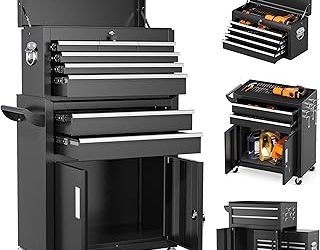
The VEVOR combines a five-drawer rolling cabinet with a detachable top metal toolbox, giving users both workshop storage and a portable hand-tool case. A lock bar, protective liners, and tool rack improve everyday organization and help prevent tools from sliding when drawers move. This is one of the more versatile choices for a mixed-use workshop, especially when tools regularly need to travel from the main bench.
8-Drawer Rolling Tool Chest with Detachable Top Box
With eight drawers, a removable upper toolbox, hooks, a tray divider, and liners, this assembled chest emphasizes separation between small hardware, hand tools, and larger equipment. The added accessories can reduce repeated bending and searching, provided each drawer receives a deliberate role. Its usefulness will be greatest in a repair room or warehouse-style workspace where the cabinet can remain on a reasonably level surface.
Frequently Asked Questions
Are roller tool chests suitable for home garages?
Yes. They are especially useful when tools need to be consolidated and moved around a shared garage. Check the chest’s width, turning clearance, and wheel design before buying, and use the caster brakes whenever the drawers are open.
Should heavy tools go in the top or bottom drawers?
Heavy tools belong in the lower drawers. This lowers the center of gravity, reduces tipping risk, and makes the chest easier to push. Reserve upper drawers for lighter items such as drivers, pliers, bits, and measuring tools.
Is a detachable top toolbox worth having?
It is worthwhile if you frequently carry a smaller selection of tools to another room, vehicle, or work surface. If all tools stay in one place, a fixed upper compartment may offer simpler access and slightly better rigidity.
How can I make a rolling chest last longer?
Do not exceed its practical load capacity, avoid dragging it sideways over thresholds, and keep the casters free of tangled debris. Wipe spills promptly, inspect drawer slides periodically, and close and lock drawers before moving the chest.
Final Thoughts
The VEVOR 2-in-1 Rolling Tool Chest is the strongest all-rounder for flexible garage organization, while the DEWALT DWST17820 is the better mobility-first choice for carrying selected tools. For maximum compartmentalization, the 20-Drawer Tool Chest with Stainless Countertop offers the most adaptable storage layout.