Key takeaways
- Independent articulation: Confirm the headrest runs on its own motor rather than moving as part of a single back-and-footrest sweep. Independent control is what lets you keep your gaze level at a 40-degree recline, which is the whole point of the feature.
- Occipital contact, not chin tuck: A well-shaped headrest cradles the base of the skull and the top of the neck. If it only pushes the crown of your head forward, you’ll get a flexed neck and airway compression instead of relief. Sit and check where the pad lands relative to your ears.
- Frame and mechanism substance: Look for kiln-dried hardwood or steel-reinforced frames, welded steel reclining hardware, and motors rated for repeated daily cycles. Wall-hugger geometry is convenient, but it puts more leverage on fewer pivot points, so hardware quality matters more, not less.
- Upholstery that matches your household: Top-grain leather ages well and breathes; high-abrasion performance faux leather resists claws, spills, and sunscreen better. Neither is universally superior. Choose based on what will actually be sitting on it.
- Seat depth and clearance: Measure your thigh from hip crease to the back of the knee. You want two or three fingers of clearance behind the knee, plus enough seat width that your hips aren’t pinched. Then measure the wall gap the chair needs when fully extended.
What's inside
Most recliners are engineered from the hips down. The seat, the footrest, and the mechanism get all the design attention, while the top of the backrest stays locked at whatever angle a factory template settled on years ago. The outcome is predictable: you lean back, your lumbar spine gets supported, and your head keeps traveling until your neck muscles quietly take over the work of holding your skull in place. Twenty minutes in, you are propping yourself up on a chair you bought so you wouldn’t have to.
A power headrest solves that by letting the upper back panel pivot forward on its own motor, independent of the recline angle, so your cervical spine stays neutral whether you’re sitting up to read or stretched out near flat. Below are six chairs assessed through the two things I care about professionally: postural fit across different body sizes, and whether the frame, foam, and actuators will still perform the same way in year seven.
As an Amazon Associate we earn from qualifying purchases.


How to Choose a Recliner With Power Headrest (2026)
- Independent articulation: Confirm the headrest runs on its own motor rather than moving as part of a single back-and-footrest sweep. Independent control is what lets you keep your gaze level at a 40-degree recline, which is the whole point of the feature.
- Occipital contact, not chin tuck: A well-shaped headrest cradles the base of the skull and the top of the neck. If it only pushes the crown of your head forward, you’ll get a flexed neck and airway compression instead of relief. Sit and check where the pad lands relative to your ears.
- Frame and mechanism substance: Look for kiln-dried hardwood or steel-reinforced frames, welded steel reclining hardware, and motors rated for repeated daily cycles. Wall-hugger geometry is convenient, but it puts more leverage on fewer pivot points, so hardware quality matters more, not less.
- Upholstery that matches your household: Top-grain leather ages well and breathes; high-abrasion performance faux leather resists claws, spills, and sunscreen better. Neither is universally superior. Choose based on what will actually be sitting on it.
- Seat depth and clearance: Measure your thigh from hip crease to the back of the knee. You want two or three fingers of clearance behind the knee, plus enough seat width that your hips aren’t pinched. Then measure the wall gap the chair needs when fully extended.
The Best Recliners With Power Headrest (2026), Reviewed
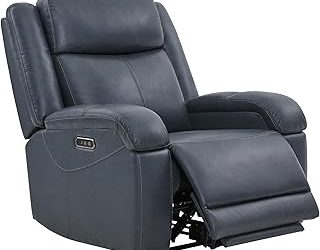
Watson & Whitely Oversized Genuine Leather Power Recliner (Navy)
Built for big-and-tall users who normally get squeezed by standard 20-inch seats, this one pairs generous hip room with a wall-hugger mechanism that only needs a few inches of clearance. The genuine leather seating surfaces and integrated charging ports make it a practical long-session chair rather than a decorative one.
Flexsteel Crew Power Recliner
Flexsteel’s blue steel seat spring is one of the few components in this category with a genuine multi-decade track record, and the Crew adds powered lumbar alongside the powered headrest, which lets you tune the two ends of your spine separately. It’s the pick I’d make for someone with an existing low-back complaint who plans to keep the chair for fifteen years.
Watson & Whitely Swivel Recliner in Khaki Fabric
A compact glider-rocker footprint that still delivers powered headrest adjustment, which is unusual at this size. The fabric upholstery breathes better than leather in warm rooms, and the swivel base is genuinely useful in an apartment where seating angles change depending on who’s visiting.
Watson & Whitely Genuine Leather Recliner in Grey
The same small-scale swivel-glider concept in leather, with a USB-C port that’s already the more relevant standard for current phones and tablets. Leather here means easier cleanup and a firmer feel over time as the foam settles.
Pet Friendly Leather Power Recliner in Gray
Scratch-resistant waterproof faux leather is the sensible answer when cats treat furniture as a scratching surface, and the down-filled cushioning keeps it from feeling like the vinyl compromise it could have been. Zero-wall clearance and side pockets make it a strong fit for RVs and tight living rooms.
Frequently Asked Questions
Does a power headrest make the chair more likely to break?
It adds an actuator and a wiring harness, so yes, there are more parts. In practice, motor failures are less common than upholstery wear or foam collapse. The bigger reliability variable is frame and spring construction, not motor count.
What’s the difference between a power headrest and a lift chair?
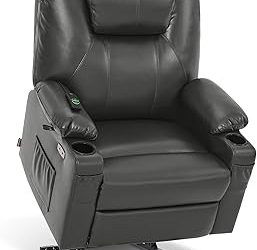
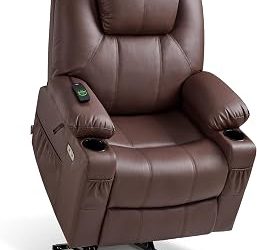
A power headrest adjusts your neck position. A lift chair tilts the whole frame forward to help you stand. If getting out of the chair is the harder problem, a dual-motor model like the Korser Oversized Lift Recliner, with its adjustable headrest plus massage and heat, is the more appropriate category.
How much wall clearance do I need?
Standard recliners want 12 to 18 inches. Wall huggers and zero-wall designs typically need three to six. Always verify against the specific model’s fully extended depth, not the category label.
Can I use one at a desk or for sleeping?
They’re excellent for extended reading, recovery, and napping. For habitual overnight sleeping, talk to a clinician first, since sustained semi-upright positions affect circulation and airway mechanics differently than lying flat.
Final Thoughts
For long-term durability and the most precise postural control, the Flexsteel Crew is the one I’d invest in. Larger frames are better served by the Watson & Whitely Oversized Leather Power Recliner, and anyone who needs assistance standing should skip straight to the Korser dual-motor lift recliner.