Key takeaways
- Base mass and footprint: A tall flame column is a lever, and wind is the force applied to it. Look for a wide, weighted base that houses the tank internally rather than a narrow pedestal with an external cylinder. Anything you can rock with one hand will eventually be rocked by weather.
- Steel grade and joinery: Powder-coated carbon steel is fine under a cover; bare stainless is better if the unit lives in salt air or gets hosed down. Check that panels are welded or riveted rather than tabbed together, since heat cycling loosens friction fits over time.
- Control reach and ignition: Pulse or piezo ignition at knee height beats a match-lit pilot buried in the base. If you have to crouch and blind-reach to relight, you will use the heater less and burn a knuckle at least once.
- Quartz tube protection: The glass should sit in a gasketed, expansion-tolerant seat with a mesh or wire guard around it. Rigid clamping plus thermal expansion is the single most common cause of cracked tubes.
- Wheels and tilt geometry: Two rear wheels with a shallow tilt angle let you move a 70-pound unit without a second person. Small hard casters bind on decking gaps; larger diameter wheels roll over them.
What's inside
Pyramid heaters sell themselves on looks. A four-foot column of live flame behind clear glass does more for a patio’s atmosphere than any mushroom-style radiant head ever will. The trouble shows up around month four, when the base has started rocking on uneven pavers, the ignition knob sits at a depth that forces you to kneel and reach blind past a hot mesh guard, and one caster has rusted into a permanent skid. None of that appears in the spec sheet, because the spec sheet is mostly BTU numbers.
I evaluate outdoor heating gear the way I’d evaluate a work chair or a hand tool: how the body interacts with it, and how the materials hold up to repeated cycles of heat, moisture, and rough handling. That means looking at base mass and footprint, the thickness and finish of the steel, whether the quartz tube is properly isolated from the burner assembly, how far you bend to light and adjust it, and whether the wheels actually roll on decking. Below are the pyramid models worth considering this season, followed by the criteria that separate a three-season purchase from a five-year one.
As an Amazon Associate we earn from qualifying purchases.


🛒 Best Price Today on Amazon
Prime members get fast, free shipping on everything above, plus member-only deals. New members get a 30-day free trial — cancel anytime.
How to Choose a Pyramid Patio Heater (2026)
- Base mass and footprint: A tall flame column is a lever, and wind is the force applied to it. Look for a wide, weighted base that houses the tank internally rather than a narrow pedestal with an external cylinder. Anything you can rock with one hand will eventually be rocked by weather.
- Steel grade and joinery: Powder-coated carbon steel is fine under a cover; bare stainless is better if the unit lives in salt air or gets hosed down. Check that panels are welded or riveted rather than tabbed together, since heat cycling loosens friction fits over time.
- Control reach and ignition: Pulse or piezo ignition at knee height beats a match-lit pilot buried in the base. If you have to crouch and blind-reach to relight, you will use the heater less and burn a knuckle at least once.
- Quartz tube protection: The glass should sit in a gasketed, expansion-tolerant seat with a mesh or wire guard around it. Rigid clamping plus thermal expansion is the single most common cause of cracked tubes.
- Wheels and tilt geometry: Two rear wheels with a shallow tilt angle let you move a 70-pound unit without a second person. Small hard casters bind on decking gaps; larger diameter wheels roll over them.
The Best Pyramid Patio Heaters Reviewed (2026)
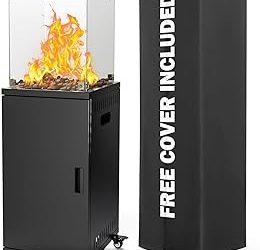
Pamapic 48,000 BTU Pyramid Heater with Cover
At 87 inches this is one of the taller columns available, which pushes the flame’s radiant output above seated head height and out toward the edge of a table rather than straight up. The bundled cover is not an afterthought here, and the tube seating tolerates expansion well, which matters more for longevity than the BTU figure does.
NAVINE 48,000 BTU Pyramid Heater with Wheels
The best-balanced package for people who reposition their heater regularly, thanks to wheels that clear typical deck board gaps and a tilt angle that doesn’t demand a deadlift. Triple safety protection covers tilt shutoff, flame failure, and thermocouple cutoff, which is the baseline I’d insist on for any unit near furniture.
Stainless Steel 48,000 BTU Flame Pyramid Heater
Choose this one if your patio sits near a pool or the coast, where chlorinated splash and humid air chew through powder coat within a couple of seasons. Stainless costs more up front and shows fingerprints, but it is the only finish here I’d trust to look presentable after five winters of outdoor storage.
HEXAGO 40,000 BTU Pyramid Heater with Pulse Ignition
Slightly lower output than its rivals, and the better ergonomics for it: the pulse ignition and adjustable flame valve sit at a comfortable reach, and the smaller burner is easier to modulate on mild evenings. A sensible pick for a compact deck or covered restaurant terrace where 48,000 BTU would be excessive.
BTExpert 48,000 BTU Pyramid Heater
The double-layer stainless burner is the standout detail, spreading heat load across two surfaces instead of concentrating it on one thin shell, which slows the warping that eventually distorts flame shape. Built for the duty cycle a commercial patio imposes.
Frequently Asked Questions
How long does one propane tank last?
A standard 20-pound cylinder gives roughly eight to ten hours at full output on a 48,000 BTU unit, and noticeably longer if you run the valve at half. Turning the flame down rather than cycling the unit on and off also reduces thermal stress on the glass.
Can I leave it outdoors year-round?
Covered, upright, and with the tank disconnected, yes. What kills these heaters is standing water pooling in the base and wicking into the burner assembly, so tip out any collected rain before covering and store it on a level surface.
Why do quartz tubes crack?
Usually thermal shock or mechanical stress rather than defect: cold rain hitting hot glass, an over-tightened retaining collar, or transport with the tube installed. Move the unit only when cool, and never hose down a running heater.
How much clearance does it need?
Plan on three feet of side clearance and at least six to seven feet of vertical space above the flame outlet, well away from awnings, umbrellas, and low branches. In wind above roughly 10 mph, shut it down; tilt sensors are a backstop, not a strategy.
Final Thoughts
For most home patios the NAVINE 48,000 BTU model is the one I’d buy, since its mobility and safety package solve the two problems owners actually complain about. Poolside or coastal buyers should pay the premium for the stainless steel 48,000 BTU pyramid, and anyone running a heater nightly on a commercial terrace will get more seasons out of the BTExpert’s double-layer burner.