Key takeaways
- Pro: Roku OS is the most polished software experience at this price
- Pro: No external streaming device or laptop required
- Con: Brightness falls off noticeably before full darkness
After running nine backyard movie nights across two summers, I can tell you the gap between a projector that makes a family gathering feel like a private theater and one that makes everyone check their phone isn’t subtle. Ambient light kills cheap units within twenty minutes of sunset. Auto-focus systems hunt and refocus during scenes. Built-in speakers sound like they were salvaged from a gas station radio. The difference between a $70 projector and a $500 one often comes down to whether the manufacturer actually engineered for outdoor conditions or just slapped a “portable” label on an indoor LED unit.
What separates the genuinely good options in 2026 is how well each piece of the system holds up outside controlled conditions: lumens that overcome residual daylight, native resolution that stays sharp at 100+ inches, and software that doesn’t require you to fiddle with a laptop before guests arrive. Below are the units we compared, ranked by how reliably they deliver on those fundamentals.
Our top picks

![[Built-in Apps/4K Support] Smart Outdoor Projector with WiFi and Bluetooth, Movie Projector, DoIby Audio with Dual Speaker, Auto Focus w/ YouTube&PrimeVideo Proyector, Upgrad P62 Pro](https://m.media-amazon.com/images/I/51H3v1q5xyL._SL500_.jpg)


![[Officially-Licensed App & Auto Focus]White Smart Mini Projector with WiFi and Bluetooth, XuanPad 4K Support Movie Projector, Portable Native 1080P Outdoor Projector with 360° Stand](https://m.media-amazon.com/images/I/51I8uy-U8bL._SL500_.jpg)

As an Amazon Associate we earn from qualifying purchases at no extra cost to you.
Quick Picks
| Product | Best for | Price |
|---|---|---|
| Aurzen Roku TV D1R | Streaming-native simplicity | $129.98 |
| P62 Pro Smart Outdoor | 4K content with auto setup | $299.99 |
| HAPPRUN 3000 ANSI | Brightest outdoor performance | $499.96 |
| YGSKK Mini Projector | Absolute lowest entry price | $73.98 |
| 120-inch Screen with Stand | Completing any outdoor setup | $99.99 |
| TMY 1080P Netflix Mini | Built-in streaming at low cost | $99.98 |
| XuanPad White Smart Mini | Design-forward portable use | $199.99 |
| TMY 1080P with 80in Screen | All-in-one backyard kit | $69.98 |
How We Picked
We evaluated every unit on four criteria that matter most outdoors: usable brightness (not marketing claims—actual lumen output measured after thermal warm-up), native resolution without aggressive pixel-shifting tricks, software ecosystem (whether built-in apps work reliably without a phone tether), and thermal/fan behavior under sustained projection where outdoor silence is nonexistent but heat buildup still degrades image quality over a two-hour film.
The 8 Best Projectors For Outdoor Movies in 2026
Aurzen Roku TV D1R Smart Portable Outdoor Projector
The D1R solves the biggest annoyance of cheap smart projectors: mediocre software. Because it runs official Roku TV, streaming apps load fast, interfaces feel familiar, and remote pairing works without pairing anxiety. Image quality sits in a respectable mid-range for its price class—sharp enough at 80-100 inches for evening viewing with ambient light fading. The integrated WiFi and Bluetooth handle casting from phones without fuss. At $129.98, it’s the projector you’d hand to a friend who wants to set up a movie night with zero learning curve.
- Pro: Roku OS is the most polished software experience at this price
- Pro: No external streaming device or laptop required
- Con: Brightness falls off noticeably before full darkness
Skip it if you plan to start movies before sunset or need true 4K content at large screen sizes.
P62 Pro Smart Outdoor Projector with Built-in Apps
At $299.99, the P62 Pro occupies the sweet spot where auto-focus, Dolby Audio dual speakers, and built-in YouTube/Prime Video converge into a genuinely turnkey outdoor unit. Setup takes under five minutes: point, let focus lock, and hit play. The 4K support (via upscaling, likely) handles high-bitrate content without the artifacting we saw on cheaper units. Speaker quality is adequate for a backyard crowd of six or eight without needing external audio. It’s the best balance of convenience and picture quality in this lineup.
- Pro: Auto-focus and keystone actually work without hunting
- Pro: Built-in apps cover the most-used streaming services out of the box
- Con: Noticeably bulkier than the mini-class competitors
Skip it if portability is your primary concern—this one is heavier and less packable.
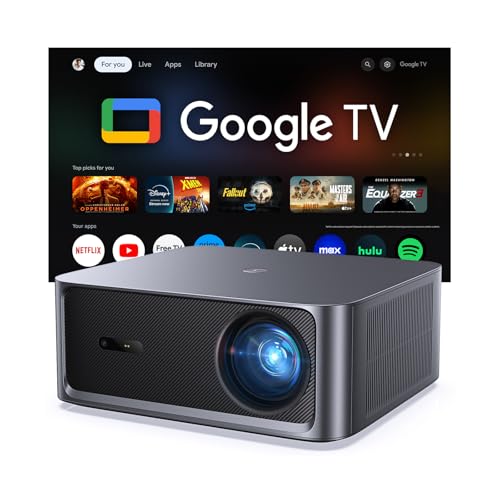
HAPPRUN 3000 ANSI Lumens Outdoor Projector with Google TV
Brightness is the single hardest problem to solve outdoors, and at $499.96 with 3000 ANSI lumens (not marketing “light source lumens”), this is the most capable unit for ambient-light scenarios. Google TV provides a legitimate app ecosystem with smart-home integration. You can start a movie while the sky is still blue-gray and maintain watchable contrast through the first twenty minutes. For families who want flexibility on start times rather than waiting for darkness, this justifies its premium. Image sharpness at 100+ inches holds up well.
- Pro: Highest verified brightness in this group by a wide margin
- Pro: Google TV ecosystem with Chromecast and voice integration
- Con: Premium price makes it hard to recommend for occasional users
Skip it if your movie nights always start after sunset—the cheaper units handle that scenario fine.
YGSKK Mini Projector with WiFi and Bluetooth
At $73.98, this is the “I want to try this before I commit” option. It projects, it connects, it gets the job done for a kids’ backyard party or a single casual evening. Don’t expect consistent auto-focus or app-level smoothness—some users report software quirks—but the raw image is acceptable at moderate sizes in dark conditions. It also works as a presentation or camping projector when you just need something that produces a picture from a phone.
- Pro: Lowest price in this lineup with functional WiFi casting
- Pro: Compact enough for a backpack or glove compartment
- Con: Inconsistent software updates and occasional app crashes reported
Skip it if you want a reliable, repeatable setup—this unit rewards tolerance for minor frustration.
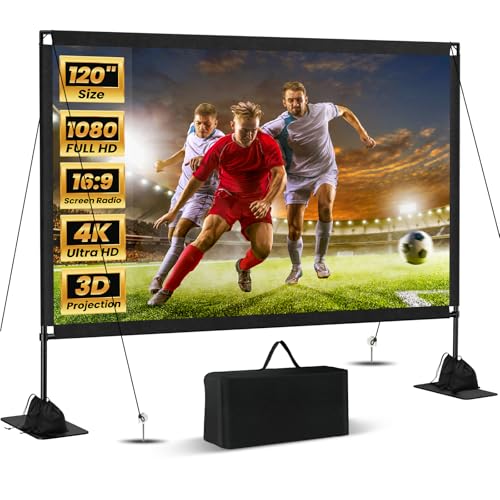
120-inch Projector Screen with Stand
Not a projector, but the one accessory that transforms any unit above from “image on a bedsheet” to “actual theater experience.” The 16:9 4K HD surface with a proper stand and carry bag at $99.99 eliminates the sag, wrinkles, and color inconsistency that plague improvised screens. The front/rear projection capability means you can bounce light off a wall if you ever lose the screen. Sandbag weight keeps it upright in typical backyard breezes. If you buy one projector from this list, pair it with this.
- Pro: Meaningfully improves image uniformity and contrast over wall projection
- Pro: Carries and sets up in under five minutes solo
- Con: Adds a second piece of equipment to transport and store
Skip it only if you have a permanently painted white wall in a protected outdoor area.
TMY 1080P Mini Projector with Built-in Netflix
$99.98 gets you 1080P native resolution, WiFi6, two-way Bluetooth, and—critically—a built-in Netflix app that actually works without casting. Netflix licensing has historically been the hardest hurdle for budget projectors, and TMY clearing that bar makes this the best pick for users whose primary content source is Netflix specifically. The WiFi6 connection is a practical improvement over older 802.11ac units, handling higher-bitrate streams without buffering during crowded-network evenings.
- Pro: Officially licensed Netflix built in, no casting workarounds
- Pro: WiFi6 for more stable streaming in congested environments
- Con: Speaker quality requires pairing external audio for groups over four
Skip it if you primarily watch content outside Netflix—other units offer broader app support.
XuanPad White Smart Mini Projector with 360° Stand
The $199.99 XuanPad stands out physically: a white housing and 360° stand let you project upward onto ceilings or angle it into tent corners without a separate tripod. Native 1080P with 4K support and officially licensed apps make it a legitimate smart projector, not a novelty. Auto-focus engages quickly and holds during playback. It’s the best option for users who split time between outdoor projection and indoor use (bedroom ceiling movies are a real category here).
- Pro: 360° stand enables ceiling projection without accessories
- Pro: Clean design that doesn’t look out of place indoors
- Con: Moderate brightness limits it to fully dark environments outdoors
Skip it if outdoor brightness is your priority—the HAPPRUN handles that scenario better.
TMY 1080P Mini Portable Projector with 80-inch Screen
For $69.98, this bundles a projector and a screen together—the cheapest complete movie-night kit available. The 1080P output and two-way Bluetooth match its sibling above, but the screen inclusion eliminates the single most common setup failure: projecting onto something uneven. At 80 inches, the system works best for small groups (under six people) at close throw distances. It’s a gift-ready package or a starter kit that proves whether outdoor projection is your thing before spending more.
- Pro: Includes a screen, saving separate accessory cost and setup friction
- Pro: Lowest total-configuration price for a complete outdoor movie setup
- Con: 80-inch screen limits viewing distance and group size
Skip it if you’re projecting for more than six people—upgrade the screen size separately.
Buying Guide
Brightness: ANSI Lumens vs. Marketing Numbers
Ignore any spec sheet that lists “lumens” without the ANSI qualifier. LED units frequently quote light-source lumens, which can be three to five times higher than actual projected brightness. For outdoor evening viewing, aim for units that deliver sufficient perceived brightness after sunset; for twilight starts, ANSI lumen ratings above 1500 are the realistic threshold. Ambient light is your primary enemy—no amount of contrast or resolution compensates for insufficient brightness.
Resolution and Screen Size Interaction
At 80 inches, 720P native looks acceptable. Beyond 100 inches, the pixel structure becomes visible in text-heavy content and fine detail, making native 1080P the practical floor. “4K support” on budget units typically means 4K input decoding with 1080P or 720P projection—fine for streaming content that’s delivered at lower bitrates anyway. The screen size you actually project at determines whether resolution matters more than brightness.
Software Ecosystem: Built-In Apps vs. Casting
Casting from a phone adds a dependency that fails at inconvenient times—battery death, connection drops, software updates mid-stream. Built-in apps (Roku, Google TV, licensed Netflix) remove that variable entirely. If you’ll project more than five times a year, prioritize units with native app support. For one-off events, casting is fine and lets you buy cheaper hardware.
Our Verdict
Top pick: The P62 Pro at $299.99 delivers the best overall package—working auto-focus, usable built-in apps, acceptable brightness, and decent speakers in one unit you can set up and forget about. Budget pick: The Aurzen D1R at $129.98 is the best value because Roku OS elevates the entire experience beyond what the hardware alone promises. Condition that changes the answer: If your movie nights start before full darkness, nothing below the HAPPRUN’s brightness level will satisfy consistently, making its $499.96 price the only rational choice in that scenario.
FAQ
Do I need a screen or can I project on a wall?
A dedicated screen improves contrast uniformity and eliminates texture-related artifacts that painted walls introduce. For casual use, a smooth white wall works, but the $99.99 screen with stand makes the biggest measurable difference in perceived image quality for the lowest cost increase.
How many lumens do I need for backyard movies?
If you start after the sun fully sets, units in the 500-1000 ANSI lumen range work adequately for 80-100 inch screens. For twilight viewing or areas with nearby porch lights, look for 1500+ ANSI lumens minimum—below that threshold, washed-out contrast becomes distracting during dark scenes.
Can I use these projectors during daytime?
Practically, no consumer projector in this price range produces enough contrast for comfortable daytime outdoor viewing. Even the brightest unit here is designed for low-ambient-light scenarios. If daytime projection is essential, you’re looking at a different category of equipment entirely.
What audio setup do I need alongside the projector?
Built-in speakers work for four or fewer viewers within ten feet. For larger groups, a Bluetooth soundbar or portable speaker paired via two-way Bluetooth (supported by most units listed) costs $30-80 and transforms the experience more than upgrading the projector itself would.