Key takeaways
- Pressure rating: Choose a hose rated above your machine’s maximum PSI, not merely its typical operating pressure. That margin helps reduce stress during startup and demanding cleaning jobs.
- Diameter: A 1/4-inch hose is usually lighter and easier to handle with electric or compact washers. A 3/8-inch hose can support higher-flow equipment but is heavier and less nimble.
- Fittings: Confirm whether your washer uses M22 fittings, quick-connect couplers, or an adapter. M22-14mm and M22-15mm connections are not automatically interchangeable.
- Flexibility: A hose that bends smoothly around furniture legs and corners reduces pulling force. Look for kink resistance, swivel fittings, and a jacket that remains manageable in the temperatures where you work.
- Length and storage: More reach can prevent moving the washer, but extra hose adds weight and coiling work. Select the shortest length that comfortably covers your usual cleaning area.
What's inside
A pressure washer hose is easy to underestimate until it kinks beside a patio chair, drags across a finished deck, or develops a leak at the fitting. The wrong hose can restrict water flow, fatigue your wrists, and leave you repeatedly stopping to untangle it—small annoyances that become significant during furniture, siding, vehicle, or patio-cleaning projects.
This guide compares pressure washer hoses from an ergonomics-and-durability perspective. We focus on working pressure, flexibility, bend behavior, connector compatibility, temperature range, length, and the practical effort required to reel, carry, and position each hose around a home.
As an Amazon Associate we earn from qualifying purchases.


How to Choose a Pressure Washer Hose (2026)
- Pressure rating: Choose a hose rated above your machine’s maximum PSI, not merely its typical operating pressure. That margin helps reduce stress during startup and demanding cleaning jobs.
- Diameter: A 1/4-inch hose is usually lighter and easier to handle with electric or compact washers. A 3/8-inch hose can support higher-flow equipment but is heavier and less nimble.
- Fittings: Confirm whether your washer uses M22 fittings, quick-connect couplers, or an adapter. M22-14mm and M22-15mm connections are not automatically interchangeable.
- Flexibility: A hose that bends smoothly around furniture legs and corners reduces pulling force. Look for kink resistance, swivel fittings, and a jacket that remains manageable in the temperatures where you work.
- Length and storage: More reach can prevent moving the washer, but extra hose adds weight and coiling work. Select the shortest length that comfortably covers your usual cleaning area.
The Best Pressure Washer Hoses (2026) Reviewed
UBERFLEX Kink Resistant 50-Foot Hose
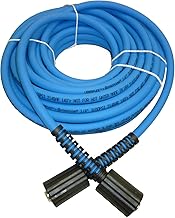
The UBERFLEX 1/4-inch hose is a strong all-purpose choice for homeowners who value low handling effort. Its 3,100 PSI rating and flexible, kink-resistant construction should make it easier to guide around outdoor furniture, while the included 22mm fittings simplify replacement on compatible machines.
YAMATIC 3/8-Inch 4,000 PSI Hose
This 50-foot YAMATIC hose is aimed at users with higher-flow pressure washers who want a more robust line. Steel-braided rubber construction favors durability, and the 360-degree swivel quick connect can help reduce twisting at the tool end; the trade-off is greater bulk than a lightweight 1/4-inch hose.
100-Foot 4,200 PSI Steel-Braid Hose
For large driveways, long walkways, and work areas where relocating the washer is inconvenient, this 100-foot hose provides substantial reach. Its high-pressure steel-braid design is reassuring for demanding use, although the additional length requires more deliberate coiling and may feel cumbersome for smaller cleaning tasks.
Flexzilla 50-Foot Replacement Hose
Flexzilla’s 1/4-inch replacement hose is built around easy handling, with a lightweight profile, no-kink design, and 3,100 PSI rating. The ZillaGreen jacket is highly visible around landscaping and furniture, while the included M22 fittings make it a practical option for compatible residential pressure washers.
YAMATIC 50-Foot 3,200 PSI Hose
This YAMATIC model balances a relatively manageable 1/4-inch format with a 3,200 PSI rating and solid brass fittings. Its stated compatibility with several Ryobi, Greenworks, Troy-Bilt, and Craftsman units makes it appealing as a replacement, but buyers should still verify the exact M22 connector size before ordering.
Frequently Asked Questions
Is a 3/8-inch pressure washer hose better than a 1/4-inch hose?
Neither is universally better. A 3/8-inch hose suits equipment that benefits from higher water flow and typically offers a more heavy-duty build, while a 1/4-inch hose is lighter, easier to coil, and often more comfortable for routine residential cleaning.
Can I use any pressure washer hose with my machine?
No. Check the hose’s maximum PSI, connector type, connector size, and the washer’s required water flow. An M22 fitting may look correct while using the wrong internal dimensions, so compatibility should be confirmed in the machine and hose specifications.
Does a longer hose reduce pressure?
It can contribute to some pressure loss, particularly when the hose diameter is small, the washer has limited flow, or the hose is unusually long. Use the shortest practical length and avoid sharp bends, crushed sections, or partially closed connectors.
How should a pressure washer hose be stored?
Disconnect the water supply, drain the hose, and coil it in broad loops without tight bends. Keep it shaded and away from petroleum products, sharp edges, and freezing conditions unless the manufacturer specifically approves that storage environment.
Final Thoughts
The UBERFLEX 50-foot hose is a compelling everyday choice for comfortable handling, while the Flexzilla is another strong lightweight option. For higher-flow equipment or demanding work, the 3/8-inch YAMATIC offers a sturdier build, and the 100-foot steel-braid model is best reserved for users who genuinely need its extended reach.