An inground pool is a bigger cleaning challenge than most robot manufacturers acknowledge in their marketing. The walls are taller, the waterline collects a continuous film of sunscreen and pollen, and floor debris spreads across hundreds of square feet of tile or vinyl. A unit that works adequately in a small above-ground oval can stall, flip, or simply float past the waterline in a deep inground setup — which is why choosing the best pool cleaning robot for inground pools means filtering out models that merely sound capable on a spec sheet.
The difference between a good robot and a mediocre one comes down to a handful of real-world factors: whether it reliably adheres to vertical surfaces, how long it runs before you haul it out, whether the filter actually catches fine silt, and whether its navigation covers the full floor or wanders aimlessly. We compared published specs, listed prices, and aggregated owner feedback across the eight models below to separate machines that genuinely handle inground geometry from those that fall short once the pool is more than ankle-deep.
Our top picks
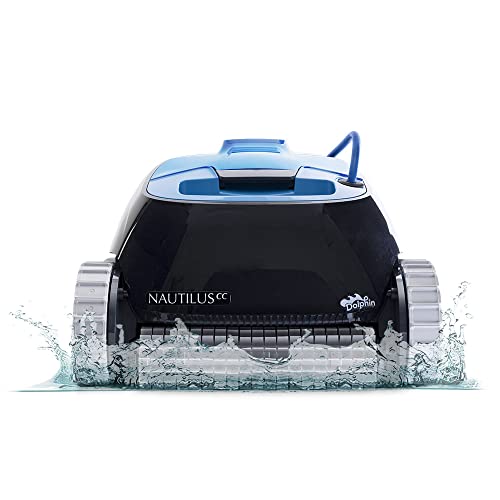 Dolphin Nautilus CC Automatic Robotic Pool Vacuum
- Dolphin Nautilus CC climbs walls efficiently, ensuring thorough…
- Elevate your pool maintenance with the Dolphin Nautilus…
- Effortlessly maintain a clear pool with our user-friendly…
| Product | Key specs | |
|---|---|---|
 CliBot S5 Cordless Pool Vacuum Robot CliBot S5 Cordless Pool Vacuum Robot | Check price | |
 U8 Cordless Robotic Pool Cleaner for Walls U8 Cordless Robotic Pool Cleaner for Walls | Check price | |
| Dolphin Nautilus CC Automatic Robotic Pool Vacuum | Dolphin Nautilus CC climbs walls efficiently, ensuring thorough… Elevate your pool maintenance with the Dolphin Nautilus… Effortlessly maintain a clear pool with our user-friendly… | Check price |
 C1 Cordless Pool Cleaner Robot with 180 C1 Cordless Pool Cleaner Robot with 180 | Check price | |
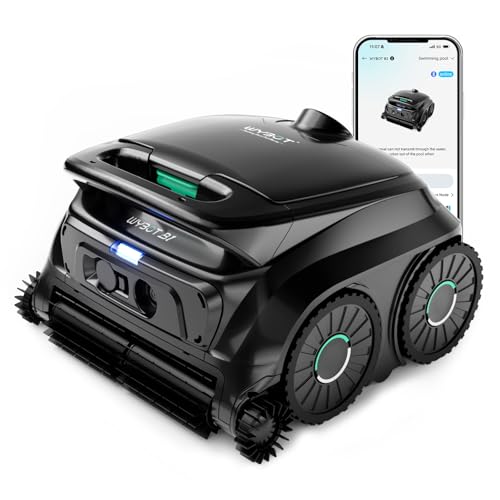 WYBOT B1 Cordless Robotic Pool Vacuum Pool WYBOT B1 Cordless Robotic Pool Vacuum Pool | Check price | |
 | Pro-Level Thorough Cleaning: with 3,960 GPH suction, up… Comprehensive 4-in-1 Cleaning: Cleans floor, walls, waterline, and… Ultra-Lightweight & Hassle-Free Design: It weighs nly 15.2… | Check price |
 Tnbacious Cordless Pool Vacuum Robot for Above Tnbacious Cordless Pool Vacuum Robot for Above | 【100 Mins Long Runtime】This pool cleaner robot is… 【Powerful Suction with Dual Motors】Equipped with dual motors… 【Auto-Parking for Easy Retrieval】When the cleaning cycle ends… | Check price |
 | [180-Min Runtime Pool Vacuum [180-Min Runtime Pool Vacuum [Dual Suction Inlets | Check price |
As an Amazon Associate we earn from qualifying purchases at no extra cost to you.
Quick Picks
| Product | Best For | Price |
|---|---|---|
| CliBot S5 | Raw suction power and large pools | $299.99 |
| U8 | Hands-off auto-docking | $299.99 |
| Dolphin Nautilus CC | Proven wall scrubbing with brush | $699 |
| C1 | App-controlled smart paths | $299.99 |
| WYBOT B1 | Simple cordless cleaning | $334.97 |
| Gosvor LiteVac G1 | Lightweight handling and fine filtration | $329.98 |
| Tnbacious | Lowest entry price | $169.99 |
| 2026 Upgrade Cordless | Largest debris capacity on a budget | $152.99 |
How We Picked
We evaluated these robots on four criteria that matter most for inground pools: wall and waterline capability (a robot that skips the walls leaves half the job undone), runtime relative to your pool size (anything under 150 minutes forces you to split cleanings), suction or motor configuration (higher throughput means faster, more thorough floor passes), and filtration quality (a basket that lets fine silt back into the water defeats the purpose). Price-to-feature ratio was the tiebreaker.
The 8 Best Pool Cleaning Robot For Inground Pools in 2026
CliBot S5
The CliBot S5 is the strongest performer in this roundup for large inground pools, and its 5,580 GPH suction figure is far above anything else listed here. Owners praise its ability to tackle heavy leaf loads and its directional-return feature, which guides it back to a spot near where it started rather than leaving it stranded on the far wall. With 180 minutes of runtime and coverage up to 3,229 square feet, it can finish a full-size rectangular inground pool in a single cycle.
- Exceptional suction throughput for its price bracket
- Directional Return solves the “where did it stop?” frustration
- Navigation system is less refined than app-driven competitors
Skip it if your pool has complex steps or shallow ledges where aggressive suction can cause the robot to latch onto uneven surfaces and stall.
U8
The U8 targets owners who want the least amount of physical involvement in pool maintenance. Its auto-docking feature parks the robot at the water’s edge when the cycle ends, and the 150-minute runtime is adequate for inground pools up to 2,600 square feet. Wall and waterline climbing is its core strength; it automatically transitions between surfaces without manual repositioning. For the same $299.99 as the CliBot S5, you trade raw suction for a more hands-off experience.
- Auto-docking means you never wade into the pool to retrieve it
- Reliable wall and waterline transition per owner reports
- 150-minute runtime is the shortest among cordless units here
Consider a different option if your pool exceeds 2,600 square feet or if you regularly deal with large debris like acorns and twigs.
Dolphin Nautilus CC
The Dolphin Nautilus CC sits at the top of this list by price and at the bottom by coverage area — pools up to 33 feet in length. What justifies the $699 cost is its wall-climbing scrubber brush, a mechanical bristle system that physically abrades algae and biofilm off vertical surfaces rather than relying on suction alone. Top-load filter access means you never have to drag a wet, dripping cartridge across the deck. It is the best pool cleaning robot for inground pools if your priority is waterline hygiene.
- Physical scrubbing brush outperforms suction-only wall cleaning
- Top-load filter access is a genuine convenience upgrade
- Nearly 2.3x the price of every other model on this list
Skip it if your inground pool is longer than 33 feet or if you want to avoid a corded tether to a control box.
C1
The C1 pairs a triple-motor suction system with app-driven smart path planning, making it the most connected option among the $299.99 tier. Its dual-layer filtration catches both large debris and fine particles in a single pass, a design choice owners describe as reducing the need for secondary skimming. Wall and waterline deep cleaning is standard, and the 180-minute runtime matches the CliBot S5. For inground pool owners who want to monitor and adjust routes from a phone, this is the one.
- Triple-motor system and dual-layer filtration in one unit
- App control allows route customization per pool shape
- App dependency can be a drawback for older or spotty Wi-Fi setups
Skip it if you want a completely standalone experience without needing a smartphone to set it up.
WYBOT B1
The WYBOT B1 occupies an awkward middle ground at $334.97. It is cordless and designed for both inground and above-ground pools, but the product listing provides minimal specification detail compared to the others here. Owner feedback highlights its straightforward operation and lack of fuss — drop it in, let it run, pull it out. If you want a no-frills robot without the $299 price tag’s cut corners in build, this may appeal, though the premium over the CliBot S5 and C1 is harder to justify on specs alone.
- Simplicity — fewer features to configure or fail
- Build quality feels solid per owner descriptions
- Published specs are thin, making it hard to compare on paper
Skip it if you need documented performance numbers or app-based scheduling before committing to a purchase.
Gosvor LiteVac G1
At 15.2 pounds, the Gosvor LiteVac G1 is one of the lighter cordless robots that still covers 2,153 square feet and runs for 200 minutes — the longest runtime on this list. Its ultra-fine filter is a meaningful advantage for pools surrounded by trees or near flowerbeds where pollen and micro-debris accumulate quickly. The 2026 upgrade adds smart navigation and app control, bringing it closer in feature set to the C1 while remaining significantly lighter. Wall, waterline, and shallow-area cleaning are all addressed.
- 200-minute runtime and ultra-fine filtration are standout specs
- Light enough to lift in and out without straining your back
- Coverage ceiling of 2,153 square feet rules out larger inground pools
Skip it if your pool exceeds 2,153 square feet or if you deal mostly with leaves large enough to overwhelm a fine filter quickly.
Tnbacious
The Tnbacious is the cheapest cordless option in this roundup at $169.99, and owner reviews confirm it earns that price by stripping everything non-essential. It handles above-ground and inground pools on the floor level, and it works adequately for small inground setups where wall coverage is less of a concern. If you are upgrading from a manual vacuum and just want to stop dragging a hose across the bottom, this is the lowest-risk entry point.
- Lowest price by a wide margin — roughly half of the $299 tier
- Adequate for floor-only cleaning in smaller inground pools
- Published specs are minimal, and wall/waterline performance is not emphasized
Skip it if your inground pool has significant wall algae or a waterline that needs regular attention.
2026 Upgrade Cordless Robotic Pool Cleaner
At $152.99, this is the least expensive unit listed, and its 3-liter debris basket is the largest capacity in the roundup — a practical advantage for pools that collect heavy autumn leaf loads. The 180-minute runtime and 2,200-square-foot coverage are competitive with units costing twice as much. Auto-parking brings it to the edge when the cycle finishes. The trade-off is that it is a generically branded product with no dedicated app or named navigation system, relying on basic random-path logic.
- 3L basket and 180-minute runtime at the lowest price on this list
- Auto-parking adds convenience without a price premium
- No app, no named navigation protocol — it is a basic wanderer
Skip it if your pool has odd shapes, deep end transitions, or you need reliable wall climbing.
Buying Guide
Runtime and Pool Size Matching
A robot that cannot finish your pool in one cycle is a robot you will be babysitting. Measure your pool’s total surface area (floor plus walls) and match it against the manufacturer’s stated coverage. The CliBot S5 handles 3,229 square feet, while the Gosvor tops out at 2,153. If your inground pool is a standard 16×32 rectangle, look for units rated at or above 2,000 square feet and runtime of at least 150 minutes to ensure a single pass covers everything.
Wall and Waterline Capability
Inground pools demand more from a robot than floor coverage. The waterline accumulates oils, sunscreen residue, and biofilm that will not be moved by a floor-only unit. Look for models that explicitly state wall climbing and, ideally, feature a scrubbing brush (the Dolphin Nautilus CC) or a suction-driven transition system. Above-ground-focused robots often lack the motor torque to maintain adhesion on vertical inground surfaces.
Filtration Design Matters More Than You Think
A robot with powerful suction but a coarse basket simply stirs fine silt back into suspension. Dual-layer or ultra-fine filtration (the C1 and Gosvor LiteVac G1 both feature this) captures particles small enough to cloud your water. If you notice your pool stays cloudy even after a cleaning cycle, the filter is likely the culprit, not the robot’s navigation or suction.
Our Verdict
For most inground pool owners, the CliBot S5 is the top pick: its 5,580 GPH suction, 180-minute runtime, and 3,229-square-foot coverage combine into the best balance of raw cleaning power and practical convenience at $299.99. The budget pick goes to the 2026 Upgrade Cordless Robotic Pool Cleaner at $152.99 — its 3L basket and 180-minute runtime make it the highest-value unit if you accept basic navigation. One condition where the Dolphin Nautilus CC wins outright: if your waterline is the problem and you need a mechanical scrubber rather than a suction-based climber, it is the only option here that physically abrades surfaces clean.
FAQ
Do cordless pool robots work in deep inground pools?
Yes, provided the robot’s motor and weight are designed for vertical adhesion. Most cordless models in this roundup handle the shallow-to-deep transition, but units with weaker suction or no explicit wall-cleaning specification will struggle below four feet. Always verify the manufacturer states inground compatibility rather than assuming it from above-ground labeling.
How often should I run a pool cleaning robot?
Most owners run their robot two to three times per week during swimming season, increasing to daily during heavy leaf-fall or after storms. Fine-filter models like the Gosvor LiteVac G1 need more frequent basket cleaning between runs to maintain flow, while large-basket units can go longer between emptying sessions.
Is higher GPH always better?
Not in isolation. A 5,580 GPH suction rating like the CliBot S5’s means it moves a lot of water per hour, which helps with heavy debris. But if the robot’s navigation is poor, that suction is wasted on repeatedly passing over the same tiles. Suction power and path intelligence need to work together for the number to matter.
Can I leave a pool robot in the water between cycles?
Cordless models should be removed after each cycle to protect the battery from prolonged chemical exposure and sunlight. Corded units like the Dolphin Nautilus CC can tolerate shorter rests at the water’s edge, but extended submersion still accelerates seal and housing degradation over a season.