Key takeaways
- Inflation performance: CFM indicates how much air a compressor can move, but real-world speed also depends on tire volume, starting pressure, temperature, and the accuracy of the rating. Larger tires generally benefit from higher airflow and dual-cylinder designs.
- Duty cycle and cooling: Look for a compressor that can run long enough for your tire size without repeated overheating pauses. A thermal cutoff is useful protection, but it should not substitute for sensible cooling breaks.
- Power connection: Heavy-duty battery clamps usually suit high-draw compressors better than a standard 12V accessory socket. Check cable length, fuse protection, and whether the connection point is convenient at all four wheels.
- Controls and gauge: A bright digital display, preset pressure, and automatic shutoff reduce crouching time and prevent overinflation. Analog gauges can work well, but only when they are easy to read and reasonably placed.
- Physical design: Favor sturdy handles, vibration-resistant feet, flexible hoses, and storage for accessories. A compressor should remain stable on gravel and be manageable with cold or dirty hands.
What's inside
Finding the right off-road air compressor is less about chasing the highest pressure number and more about managing heat, hose length, power demand, and awkward working conditions. A pump that looks impressive on paper can become frustrating when its clips get hot, its cable barely reaches a rear tire, or its gauge is difficult to read in dust and glare.
This guide evaluates the strongest choices for 4×4 vehicles, trucks, RVs, SUVs, and ATVs from an ergonomics-and-durability perspective. The emphasis is on inflation speed, handling, control layout, duty-cycle practicality, portability, and the details that matter when lowering tire pressure on a trail means raising it again before driving home.
As an Amazon Associate we earn from qualifying purchases.



How to Choose a/an Off Road Air Compressor (2026)
- Inflation performance: CFM indicates how much air a compressor can move, but real-world speed also depends on tire volume, starting pressure, temperature, and the accuracy of the rating. Larger tires generally benefit from higher airflow and dual-cylinder designs.
- Duty cycle and cooling: Look for a compressor that can run long enough for your tire size without repeated overheating pauses. A thermal cutoff is useful protection, but it should not substitute for sensible cooling breaks.
- Power connection: Heavy-duty battery clamps usually suit high-draw compressors better than a standard 12V accessory socket. Check cable length, fuse protection, and whether the connection point is convenient at all four wheels.
- Controls and gauge: A bright digital display, preset pressure, and automatic shutoff reduce crouching time and prevent overinflation. Analog gauges can work well, but only when they are easy to read and reasonably placed.
- Physical design: Favor sturdy handles, vibration-resistant feet, flexible hoses, and storage for accessories. A compressor should remain stable on gravel and be manageable with cold or dirty hands.
The Best Off Road Air Compressor (2026)s Reviewed
ALL-TOP 12.35 CFM Dual-Cylinder Compressor
The ALL-TOP Air Compressor Kit with dual cylinders is aimed at owners who regularly air up large truck, SUV, 4×4, or RV tires. Its high advertised airflow and 150 PSI maximum make it a compelling speed-focused option, while the substantial kit format is better suited to vehicle recovery gear than occasional garage use. Expect a larger footprint, and plan a stable surface for operation.
ALL-TOP 7.06 CFM Portable Inflator
This smaller ALL-TOP model offers a more manageable compromise for drivers who want serious trail capability without carrying the largest dual-cylinder unit. The 7.06 CFM rating should handle many SUV and light-truck applications effectively, and its portable design is easier to position around a vehicle. It is a sensible choice when storage space and handling matter nearly as much as outright speed.
Off-road 10.6 CFM Digital Tire Inflator
The 10.6 CFM Off-road Air Compressor stands out for its user-friendly control system: preset pressure, automatic shutoff, and a digital display can make repeated inflation less tiring and more consistent. That convenience is especially valuable when checking several tires at dusk or in poor weather. Buyers should still verify the included hose and power-lead reach for their specific vehicle.
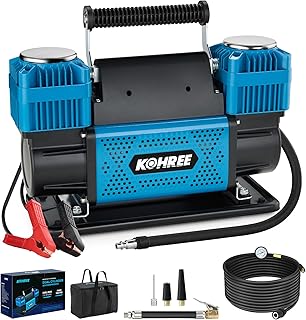
Kohree 12.35 CFM Dual-Cylinder Inflator
Kohree’s 12V Dual Cylinder Air Compressor targets demanding off-road use with high advertised airflow and a heavy-duty format. Its appeal is straightforward: faster recovery for larger tires and a design intended to tolerate the workload associated with trucks, RVs, and 4x4s. The tradeoff is bulk, so it suits a dedicated recovery kit better than a compact emergency-car setup.
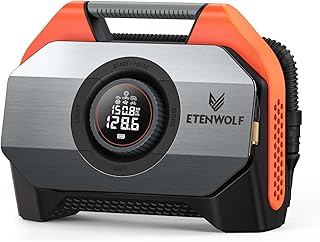
ETENWOLF VORTEX S6 Cordless Inflator
The ETENWOLF VORTEX S6 takes a different approach with a cordless design, a 19,200mAh battery, dual cylinders, and a stated 100% duty-cycle capability. Eliminating a vehicle-side power cable improves reach and setup speed, particularly when access to the battery is inconvenient. Its battery must be kept charged, but the convenience and integrated LED backlight are valuable for users who prioritize fast, self-contained operation.
Frequently Asked Questions
What size compressor is best for off-road tires?
For occasional airing up on moderate-size SUV or pickup tires, a compressor around 2 to 5 CFM may be adequate, although inflation will take longer. Larger tires, frequent trail use, or RV applications are better matched with higher-flow dual-cylinder equipment.
Should I use battery clamps or a 12V socket?
High-output compressors commonly draw more current than an accessory socket is designed to deliver. Battery clamps are generally the safer, more reliable choice when supplied by the manufacturer, provided the connections are clean and secure.
How long should an off-road compressor run?
Follow the manufacturer’s duty-cycle guidance rather than relying only on the maximum PSI figure. Stop if the motor housing, cable, or connectors become excessively hot, and allow the unit to cool before continuing.
Do I need a digital pressure preset?
No, but it can make the job easier and more repeatable. Preset shutoff reduces the need to monitor the gauge continuously, while a manual gauge may be preferable to buyers who want a simpler system with fewer electronic controls.
Final Thoughts
The ALL-TOP 12.35 CFM and Kohree dual-cylinder compressors are strong picks for large tires and frequent recovery work, while the 10.6 CFM digital inflator offers an appealing blend of speed and control. For maximum cordless convenience, the ETENWOLF VORTEX S6 is the standout alternative—provided you maintain its battery charge.