Key takeaways
- Base and bulb shape: Check the socket before you buy. E12 candelabra bases dominate older and decorative fans; E26 medium bases show up on newer kits. Then match the envelope to your shade: slim B11 or T6 tubes for tight glass, G16.5 globes for exposed sockets, compact A15 for standard bowls, and wide BR30 floods only for recessed-style cans.
- Vibration and build quality: A spinning fan transmits steady vibration into the socket. LEDs win here because there’s no filament to fatigue, but the weak point shifts to the joint between base and body. Look for a bonded aluminum or ceramic-collar base rather than a glued plastic shell, and prefer polycarbonate diffusers over thin glass if the fan runs on high often.
- Heat and enclosed fixtures: Closed shades bake drivers. Stick to low-draw 5W to 6W bulbs, favor designs with an aluminum thermal path, and check the packaging for enclosed-fixture approval. Replacing all sockets in one pass with a matched multipack keeps color and brightness consistent and gives you a single service interval instead of four.
- Dimmer compatibility: Non-dimmable bulbs on a dimmed circuit buzz, strobe, and fail early. Confirm which switch feeds the light kit, then buy accordingly. If the fan uses a remote or pull chain with no wall dimmer, non-dimmable bulbs are the more reliable, better-value choice.
- Color temperature and CRI: 2700K reads warm and restful for bedrooms and dining rooms; 4000K stays neutral in kitchens and offices; 5000K is task-bright but harsh overhead. Aim for CRI 85 or higher, and choose frosted envelopes since fan bulbs often sit right in your line of sight.
What's inside
Of every fixture in a home, the ceiling fan light kit is the one that punishes shortcuts. It sits eight or nine feet up, it vibrates every time the blades spin, and its sockets are usually crammed under a glass shade that traps heat with nowhere to vent. That combination shortens bulb life, loosens threads, and puts you back on a ladder far sooner than you planned. Most people discover this the hard way, after buying whatever bulb happened to fit.
This guide looks at ceiling fan bulbs the way a durability tester would: base fit and shade clearance, tolerance for constant low-frequency vibration, thermal headroom inside an enclosed housing, and whether the light itself is comfortable to sit under for hours. Below are the bulbs worth your ladder time in 2026, plus the specs that actually predict how long they’ll last.
As an Amazon Associate we earn from qualifying purchases.


🛒 Best Price Today on Amazon
Prime members get fast, free shipping on everything above, plus member-only deals. New members get a 30-day free trial — cancel anytime.
How to Choose Light Bulbs for Ceiling Fans (2026)
- Base and bulb shape: Check the socket before you buy. E12 candelabra bases dominate older and decorative fans; E26 medium bases show up on newer kits. Then match the envelope to your shade: slim B11 or T6 tubes for tight glass, G16.5 globes for exposed sockets, compact A15 for standard bowls, and wide BR30 floods only for recessed-style cans.
- Vibration and build quality: A spinning fan transmits steady vibration into the socket. LEDs win here because there’s no filament to fatigue, but the weak point shifts to the joint between base and body. Look for a bonded aluminum or ceramic-collar base rather than a glued plastic shell, and prefer polycarbonate diffusers over thin glass if the fan runs on high often.
- Heat and enclosed fixtures: Closed shades bake drivers. Stick to low-draw 5W to 6W bulbs, favor designs with an aluminum thermal path, and check the packaging for enclosed-fixture approval. Replacing all sockets in one pass with a matched multipack keeps color and brightness consistent and gives you a single service interval instead of four.
- Dimmer compatibility: Non-dimmable bulbs on a dimmed circuit buzz, strobe, and fail early. Confirm which switch feeds the light kit, then buy accordingly. If the fan uses a remote or pull chain with no wall dimmer, non-dimmable bulbs are the more reliable, better-value choice.
- Color temperature and CRI: 2700K reads warm and restful for bedrooms and dining rooms; 4000K stays neutral in kitchens and offices; 5000K is task-bright but harsh overhead. Aim for CRI 85 or higher, and choose frosted envelopes since fan bulbs often sit right in your line of sight.
The Best Light Bulbs for Ceiling Fans (2026) Reviewed
comzler E12 LED Candelabra Bulbs, 2700K
A no-fuss B11 candle bulb built for the small-base sockets most fan kits use, with a slim profile that clears tight glass shades without contact rattle. The 2700K tone and CRI 85+ output suit living and sleeping spaces, and the non-dimmable design is a fair trade for stable, long-run performance on switched circuits.
GvvooHome E12 Dimmable T6 Bulbs, 4000K
The pick when your fan light shares a wall dimmer. Its narrow T6/T25 tube slides into cramped fixtures, and 90+ CRI at 4000K renders wood tones and fabrics accurately, which matters in rooms where the fan is the primary light source.
ALAMPEVER G16.5 Dimmable E12 Globes, 2700K
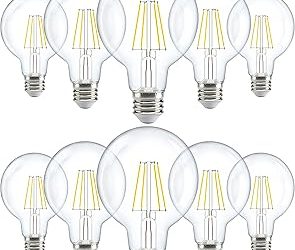
Exposed-socket fans need a bulb that looks intentional, and this frosted globe diffuses evenly enough to cut the glare you get from bare candle tips. At 550 lumens and fully dimmable, it scales from ambient evening light to full brightness without the flicker cheaper globes exhibit at low output.
Cotanic E26 A15 Ceiling Fan Bulbs, 4000K
Purpose-built for medium-base fan kits, the compact A15 body fits bowl shades that a standard A19 would crowd. Natural 4000K light with CRI 85+ keeps kitchens and dens crisp without tipping into clinical blue.
A15 LED E26 Ceiling Fan Bulbs, 5000K Daylight
The high-visibility option for garages, workshops, laundry rooms, and any fan doing double duty as task lighting. Its low 6W draw runs cool inside enclosed housings, and the same small-envelope shape works in appliance and refrigerator sockets if you have spares left over.
Frequently Asked Questions
Do I still need a special vibration-resistant bulb?
Not in the way incandescents required. Filament bulbs sold “rough service” ratings because the coil snapped under vibration; LEDs have no filament. Focus instead on base construction and heat management, which are what actually fail in a fan socket now.
Why do my fan bulbs burn out so quickly?
Usually heat or dimmer mismatch. An enclosed shade with high-wattage bulbs cooks the driver electronics, and non-dimmable bulbs on a dimmed circuit degrade fast. Dropping to 5W to 6W bulbs rated for enclosed fixtures fixes most premature failures.
Can I mix color temperatures in one fan?
You can, but it looks off. Sockets sit inches apart, so any difference in warmth or brightness is immediately visible. Replace the full set at once from a single multipack.
What about BR30 flood bulbs?
Those belong in recessed cans, not fan shades. A wide reflector like the DAYBETTER BR30 is a strong daylight option for ceiling cans elsewhere in the room, but it won’t seat properly in a fan light kit.
Final Thoughts
For most fans, the comzler E12 candelabra set is the dependable default: correct base, slim body, warm and easy on the eyes. Choose the GvvooHome E12 dimmable if a wall dimmer is in play and you want 90+ CRI accuracy, or the Cotanic E26 A15 if your kit takes medium-base bulbs and you’d rather have neutral 4000K light overhead.