Key takeaways
- Independent leg adjustment: This is the non-negotiable feature. Legs that extend separately in fixed increments let you match riser height precisely, keeping the top cap level and your hips square. Improvised shimming with timber offcuts is how stair falls begin.
- Rung depth and edge geometry: Anything under roughly 25 mm of contact depth concentrates pressure on your metatarsals and makes standing at height genuinely painful. Look for deep, ribbed, slightly flattened rungs and a proper standing platform if you’ll be static for long stretches.
- Hinge quality over stated capacity: Multi-position ladders live and die by their pivot hardware. Cast, spring-loaded locks with positive detents survive years of reconfiguration; thin stamped brackets develop play, and play in a stairwell means lateral wander under load.
- Material chosen for context: Fiberglass is non-conductive, dimensionally stable, and forgiving of overload, which is why it belongs anywhere near wiring. Aluminium wins on carry weight, and if you’re hauling a ladder up two flights repeatedly, that difference shows up in your lower back long before it shows up in the spec sheet.
- Duty rating with real headroom: Rate for your body weight plus tools plus the awkward dynamic loads of stair work. Type IA (300 lb) is a sensible floor; Type IAA (375 lb), as on the DeWalt DXL3410-04, gives you margin that translates directly into less rail flex and a steadier feel underfoot.
What's inside
Stairwells punish ladders. The moment you set one foot on a tread and the other on a stringer, you’ve introduced a compound problem: two legs land at different heights, the ladder’s centre of mass drifts toward the open drop, and your body starts compensating with the exact spinal twist that ergonomists spend careers trying to eliminate. Most buyers only discover this after wrestling a standard stepladder into a landing, propping one foot on a stack of books, and deciding the light fixture can stay dusty. The failure isn’t user error. It’s a tool mismatch.
This guide looks at ladders through two lenses that matter more than headline reach numbers: how the ladder loads your body over a forty-minute job, and how its joints, rails, and feet hold up after two hundred cycles of folding, dragging, and stair-edge contact. I’ve weighted adjustable-leg geometry, rung depth and edge profile, hinge tolerance, and material fatigue behaviour. Below are the models that earn their place in a stairwell, plus the compact fiberglass options worth owning alongside them.
As an Amazon Associate we earn from qualifying purchases.


How to Choose a Ladder For Stairs (2026)
- Independent leg adjustment: This is the non-negotiable feature. Legs that extend separately in fixed increments let you match riser height precisely, keeping the top cap level and your hips square. Improvised shimming with timber offcuts is how stair falls begin.
- Rung depth and edge geometry: Anything under roughly 25 mm of contact depth concentrates pressure on your metatarsals and makes standing at height genuinely painful. Look for deep, ribbed, slightly flattened rungs and a proper standing platform if you’ll be static for long stretches.
- Hinge quality over stated capacity: Multi-position ladders live and die by their pivot hardware. Cast, spring-loaded locks with positive detents survive years of reconfiguration; thin stamped brackets develop play, and play in a stairwell means lateral wander under load.
- Material chosen for context: Fiberglass is non-conductive, dimensionally stable, and forgiving of overload, which is why it belongs anywhere near wiring. Aluminium wins on carry weight, and if you’re hauling a ladder up two flights repeatedly, that difference shows up in your lower back long before it shows up in the spec sheet.
- Duty rating with real headroom: Rate for your body weight plus tools plus the awkward dynamic loads of stair work. Type IA (300 lb) is a sensible floor; Type IAA (375 lb), as on the DeWalt DXL3410-04, gives you margin that translates directly into less rail flex and a steadier feel underfoot.
The Best Ladder For Stairs (2026)s Reviewed
Little Giant Velocity, 18 ft Reach Aluminium
The Velocity pairs wide-flared rails with rock-locks that hold their tolerance impressively well, and the tip-and-glide wheels mean you reposition it without lifting the full mass. Aluminium keeps carry weight manageable for multi-floor work, and the deep rungs stay comfortable well past the point where cheaper ladders start biting into your arches.
Little Giant Dark Horse 2.0 M17 Fiberglass
Non-conductive fiberglass with the same multi-position architecture makes this the ladder I’d choose for stairwell lighting and any job with cabling overhead. It’s heavier than the aluminium equivalents, but the rails resist twist under offset loading noticeably better, which is precisely what you want when one pair of feet sits a tread lower than the other.
LANBITOU 14 FT Multi-Position Folding Ladder
A genuinely capable value option with a 330 lb rating and telescoping legs that let you dial in stair geometry without improvising. The locking collars need a firm, deliberate seat before you commit weight, so build the habit of a visual check on every leg after adjustment.
17 FT Telescoping A-Frame with Stabilizer Bar and Wheels
The stabilizer bar is the differentiator here, widening the effective base and cutting the lateral sway that makes stair work feel precarious. Combined with the wheels for repositioning, it reduces the lift-and-shuffle cycles that account for most ladder-related strain injuries.
Little Giant MightyLite 4 ft Fiberglass Stepladder
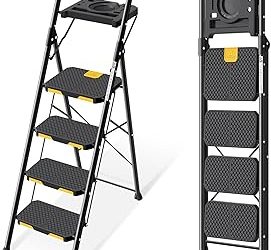
For landings, hallways, and the countless short tasks that don’t justify a seventeen-foot rig, the MightyLite’s slim profile, full standing platform, and Ground Cue feedback make it the one you’ll actually reach for. The 375 lb rating gives it a stiffness you feel immediately underfoot.
Frequently Asked Questions
Can I safely stand a ladder on a staircase?
Only with a ladder designed for uneven ground and legs adjusted so all four feet bear load on solid, level contact points. Never bridge a ladder across treads, stack material under a leg, or work from a stepladder with one foot unsupported.
Is aluminium or fiberglass better for stair work?
Fiberglass for anything electrical and for maximum torsional rigidity; aluminium when repeated carrying between floors is the dominant burden. Many households end up owning one of each.
How high a reach do I actually need?
Measure from the lowest tread you’ll stand a ladder on to the target, then add clearance for comfortable arm position. Working at full extension with arms overhead is both fatiguing and unstable, so buy above your minimum.
When should a ladder be retired?
Inspect locks, rivets, and feet before each use. Retire it on any sign of hinge play, rail cracking, deformed rungs, worn-through foot pads, or after any significant fall or overload event.
Final Thoughts
For most homes, the Little Giant Velocity is the best all-round stairwell ladder, balancing reach, adjustability, and a carry weight you won’t resent. Choose the Dark Horse 2.0 M17 instead if electrical work is on the agenda and you want the rigidity of fiberglass, and add the MightyLite 4 ft for everyday landing and hallway jobs where a full multi-position ladder is simply more machine than the task requires.