Key takeaways
- Independent leg adjustment: This is the non-negotiable feature. On stairs, your two feet land on different treads, so you need per-leg length adjustment or built-in levelers. Anything that only extends as a matched pair forces you into shimming, which is how accidents begin.
- Duty rating over stated capacity: Look for ANSI Type IA (300 lbs) or better. Your body weight is only part of the equation; tools, a paint can, and the dynamic load of shifting your stance all stack on top of it. Buy at least 100 lbs of headroom.
- Lateral stiffness at extension: Telescoping ladders feel different at 8 feet than at their maximum. Push sideways on the stiles before trusting one over a stairwell. Wide-profile rails, a stabilizer bar, and tight rung tolerances all reduce the sway that makes users freeze up.
- Rung geometry and foot comfort: Flat, deep rungs distribute pressure across the arch instead of concentrating it under the ball of the foot. If you plan to stand for more than a few minutes, prioritise a wide pedal or a work platform over raw reach.
- Locking mechanism durability: The latches take the abuse. Look for stainless or reinforced polymer thumb locks with visible engagement indicators, and check whether replacement parts are available. A ladder is only as durable as the part you actuate a hundred times a year.
What's inside
Stairwells are the one place in a house where a ladder’s weakest habits get exposed. The treads fall away beneath you, the run is rarely wide enough for a standard base, and the wall you need to reach sits at an angle no flat-floor ladder was designed to meet. Most people improvise: a plank across the steps, one leg propped on a riser, a chair borrowed from the dining room. That improvisation is why stairwell falls tend to be worse than garage falls, and it is also why a ladder that flexes, twists, or rattles under load is a poor investment no matter how affordable it looks.
This guide approaches the problem from an ergonomics-and-durability standpoint: how a ladder distributes your weight when its feet sit at different heights, how much lateral sway the frame allows at full extension, and which components fail first after a few seasons of use. Below you will find the ladders that handle uneven footing honestly, along with the specifications that matter when you are working above a stairwell drop.
As an Amazon Associate we earn from qualifying purchases.


How to Choose a/an Ladder For Staircase (2026)
- Independent leg adjustment: This is the non-negotiable feature. On stairs, your two feet land on different treads, so you need per-leg length adjustment or built-in levelers. Anything that only extends as a matched pair forces you into shimming, which is how accidents begin.
- Duty rating over stated capacity: Look for ANSI Type IA (300 lbs) or better. Your body weight is only part of the equation; tools, a paint can, and the dynamic load of shifting your stance all stack on top of it. Buy at least 100 lbs of headroom.
- Lateral stiffness at extension: Telescoping ladders feel different at 8 feet than at their maximum. Push sideways on the stiles before trusting one over a stairwell. Wide-profile rails, a stabilizer bar, and tight rung tolerances all reduce the sway that makes users freeze up.
- Rung geometry and foot comfort: Flat, deep rungs distribute pressure across the arch instead of concentrating it under the ball of the foot. If you plan to stand for more than a few minutes, prioritise a wide pedal or a work platform over raw reach.
- Locking mechanism durability: The latches take the abuse. Look for stainless or reinforced polymer thumb locks with visible engagement indicators, and check whether replacement parts are available. A ladder is only as durable as the part you actuate a hundred times a year.
The Best Ladder For Staircase (2026)s Reviewed
Little Giant Velocity 22 ft with Leg Levelers
The Velocity remains the benchmark for stairwell work because its integrated leg levelers let you correct for tread height without dismantling anything, and the Type IA frame barely moves under load. It is heavy and priced accordingly, but the rung stiffness and slip-resistant feet justify it for anyone working at height regularly.
Telescoping A-Frame 22 FT with Stabilizer Bar & Wheels
The stabilizer bar is what earns this one a place here, widening the effective base and cutting the side-to-side flex that longer telescoping ladders tend to develop. The transport wheels are a real ergonomic win when you are moving 40-plus pounds through hallways and around newel posts.
Prime 13.5 FT Telescopic Extension Ladder
An ANSI Type 1A extension ladder with stabilizers included, the Prime 13.5 hits the sweet spot for two-storey stairwells and high landing lights. Its per-rung extension lets you dial the exact height needed, which matters when the ceiling above a staircase is the only thing limiting your setup.
LANBITOU 14 FT A-Frame Multi-Position Ladder
A versatile pick that folds from an A-frame into a straight extension, handling both landing work and wall reach. The anti-slip feet and 330 lb rating are solid for the price, though it collapses to a bulky package, so measure your storage before committing.
Combi 9.5 FT Telescopic Combination Ladder
For most interior stairwells, 9.5 feet is genuinely enough, and this combination ladder compresses to a size that fits a closet shelf. The Type 1A certification means you are not trading strength for compactness, which is the usual compromise in this size class.
Frequently Asked Questions
Can I safely set a ladder up on a staircase?
Only with a ladder designed for uneven footing, and only with both feet fully supported on stable treads. Never bridge a plank between steps, never rest one leg on a riser edge, and keep your belt buckle between the rails at all times.
Do I need a full 22-foot ladder for a stairwell?
Usually not. Measure from the lowest tread you would stand on to the highest point you need to reach, then add four feet. Most two-storey stairwells are served by a 13 to 14 foot ladder.
Are step ladders with handrails worth it?
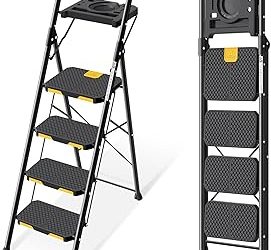
For landing-level work, yes. Something like the LANBITOU 5 Step with handrails and a tool platform reduces fatigue considerably, because you are not gripping a rung to stay balanced. It is not a substitute for a stair-capable ladder, though.
How long should a quality aluminium ladder last?
Fifteen years or more with indoor storage. Inspect the locking latches and foot pads annually, and retire any ladder that has taken a hard fall, since aluminium can hold hidden deformation.
Final Thoughts
If you work at height often, the Little Giant Velocity with leg levelers is the durable, ergonomically sound choice and the one least likely to unsettle you over a stairwell drop. The Prime 13.5 FT covers most household needs at a fairer price, while the Combi 9.5 FT is the sensible pick for anyone short on storage who still wants Type 1A strength underfoot.