Key takeaways
- Shank and adapter fit: A 1/2″ round shank in a keyless chuck can creep under load and start spinning in place; a 3/8″ hex drive locks positively and spares both the chuck jaws and your grip. If you own a hex-capable impact-rated drill, favor hex.
- Torque budget, not just voltage: An 8″ bore in thick ice demands sustained low-RPM torque. A two-speed 18V/20V drill with a side handle is the practical minimum; single-speed compact drivers will stall and transmit that stall straight into your wrist.
- Blade metallurgy: Look for hardened high-carbon steel such as SK-5, or carbide edges on the garden-style bits. Soft stamped blades dull after a handful of holes and then require far more downforce, which is where shoulder and lumbar strain creeps in.
- Buoyancy and retrieval: Foam collars or floating nylon bodies are a durability feature disguised as a convenience one. An auger that floats when the adapter lets go is an auger you still own.
- Flighting material and geometry: Nylon flighting is lighter, quieter, and won’t rust, which matters for a tool stored damp all season. Steel spirals cut aggressively but add mass at full arm extension, the worst possible place for weight.
What's inside
Anyone who has spent a February morning hunched over a hand auger knows the real cost is not measured in minutes. It shows up the next day, in the lower back, the forearm flexors, and the shoulder that has to keep a spinning shaft plumb while your boots slide on wet ice. Cordless drill augers solve that problem elegantly, but they also introduce a new one: the drill becomes the weakest link in a torque chain, and a poorly matched auger will punish your wrists, chew through batteries, and shear an adapter at exactly the wrong moment.
This guide looks at the current crop of drill-mounted ice augers through two lenses I care about most: how the load transfers into your body, and how long the components survive repeated freeze-thaw cycles. Below you’ll find the picks worth your attention, a checklist for matching an auger to the drill you already own, and answers to the questions that come up once the auger is actually in your hands.
As an Amazon Associate we earn from qualifying purchases.


How to Choose a/an Ice Auger For Cordless Drill (2026)
- Shank and adapter fit: A 1/2″ round shank in a keyless chuck can creep under load and start spinning in place; a 3/8″ hex drive locks positively and spares both the chuck jaws and your grip. If you own a hex-capable impact-rated drill, favor hex.
- Torque budget, not just voltage: An 8″ bore in thick ice demands sustained low-RPM torque. A two-speed 18V/20V drill with a side handle is the practical minimum; single-speed compact drivers will stall and transmit that stall straight into your wrist.
- Blade metallurgy: Look for hardened high-carbon steel such as SK-5, or carbide edges on the garden-style bits. Soft stamped blades dull after a handful of holes and then require far more downforce, which is where shoulder and lumbar strain creeps in.
- Buoyancy and retrieval: Foam collars or floating nylon bodies are a durability feature disguised as a convenience one. An auger that floats when the adapter lets go is an auger you still own.
- Flighting material and geometry: Nylon flighting is lighter, quieter, and won’t rust, which matters for a tool stored damp all season. Steel spirals cut aggressively but add mass at full arm extension, the worst possible place for weight.
The Best Ice Auger For Cordless Drill (2026)s Reviewed
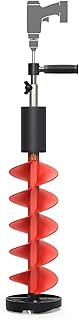
Eyoyo 6–8″ Nylon Ice Auger Bit
The nylon body keeps swing weight low, so holding the shaft vertical for the last few inches of a hole doesn’t turn into an isometric endurance test. Shipping a spare blade set and a blade guard is genuinely thoughtful, since edge protection during transport is the single biggest predictor of how long a cutting head stays sharp.
FUJIWARA 8″ Ice Auger with Buoyant Foam
SK-5 high-carbon steel holds an edge well through repeated wet-ice contact, and the buoyant foam collar is honest insurance rather than a marketing bullet. At 8″ this is the most demanding pick on your drill, so pair it with a high-capacity battery and use the auxiliary handle.
Lounsweer 6″ Floating Ice Auger
A 6″ bore is the sweet spot for wrist comfort: enough hole for most panfish and walleye rigs without the torque spike a larger diameter creates. The floating nylon construction makes it the easiest of the group to carry any distance on foot.
16″ x 4″ Carbide-Tipped Auger Bit
Tungsten carbide cemented edges are the durability standout here, shrugging off grit and frozen soil that would roll a plain steel blade. The 3/8″ hex drive is the right call, and the narrow 4″ bore keeps reaction torque manageable for one-handed starts.
Upgraded 4″ x 16″ Double-Blade Garden and Ice Auger
A genuine dual-purpose tool: the double-blade geometry clears spoil efficiently in both bulb beds and thin ice. Treat the 16″ length as a reach advantage, not an excuse to lean on it, since long shanks amplify any off-axis load into the drill’s gearbox.
Frequently Asked Questions
Will a standard cordless drill really handle this?
A brushless 18V or 20V drill with two speed ranges and a clutch will manage 6″ augers comfortably and 8″ augers with care. Run the low-speed gear, let the blades cut, and stop if the motor bogs.
Do I need a drill with a side handle?
Strongly recommended. If the auger binds, the drill body rotates fast; a second contact point turns a wrist-wrenching jolt into something your whole arm absorbs.
How thick an ice sheet is reasonable?
Most of these reach roughly 12 to 18 inches in a single pass. Beyond that you need an extension rod, and you should reassess whether battery capacity is limiting you before diameter is.
How should I store the auger between trips?
Dry the blades, apply a light oil film, and fit the blade guard. Corrosion pitting on a cutting edge is irreversible and doubles the effort every hole thereafter.
Final Thoughts
For most anglers the Lounsweer 6″ floating auger offers the best balance of comfortable torque and easy carrying, while the FUJIWARA 8″ earns its place if you need bigger holes and want SK-5 steel doing the work. If you want one tool for the garden and the lake, the carbide-tipped 16″ x 4″ hex-drive bit is the most durable of the bunch.