Key takeaways
- Match your compressed seat height, not the showroom spec: Sit down, let the cushion settle, and measure from floor to cushion top. Aim for a table within roughly two inches of that number — level or slightly below keeps your forearm travelling on a horizontal plane instead of dropping.
- Treat 24 inches as the laptop threshold: If you work from the couch, you need a surface near elbow height, which for most seated adults lands between 23 and 26 inches. A lift top spanning 19 to 24 inches covers lounging and typing without a second piece of furniture.
- Audit the lift mechanism before the finish: Paired gas struts or a steel scissor frame with sealed pivots outlast single-arm plastic hinges. Look for a stated dynamic load rating on the raised top; anything under 30 pounds will sag with a monitor or a full dinner plate.
- Check depth and shin clearance together: An 18 to 20 inch depth keeps the far edge reachable without leaning past your hip crease, and 16 to 18 inches of walking gap between sofa and table prevents shin strikes.
- Read the panel construction: Thicker engineered board with full edge banding, cam-lock and dowel joinery, and levelling feet resists the racking that eventually makes a lift top bind. Loose particleboard with stapled backers is where these tables die.
What's inside
Coffee table height is the one dimension most shoppers measure last, and it’s the one their body notices first. Sofa seat cushions in North America typically compress to somewhere between 16 and 19 inches off the floor, yet coffee tables ship anywhere from 14 to 20 inches tall. Get the relationship wrong and every reach for a mug becomes a small shoulder shrug or a forward slump — repeated dozens of times an evening. Buyers also underestimate the second problem: a table sized correctly for lounging is far too low for a laptop, so the sofa becomes a workstation with a 15-degree neck flexion habit attached to it.
This guide approaches height as a load-and-posture question rather than a styling one. Below you’ll find the measurement logic that actually matters, a durability checklist for lift mechanisms (the component that fails long before the panel does), and reviews of six tables whose stated heights and adjustable ranges hold up under scrutiny. Every model here either sits inside the ergonomic sweet spot or lifts into a second, work-capable height.
As an Amazon Associate we earn from qualifying purchases.


How to Choose a/an Height For A Coffee Table (2026)
- Match your compressed seat height, not the showroom spec: Sit down, let the cushion settle, and measure from floor to cushion top. Aim for a table within roughly two inches of that number — level or slightly below keeps your forearm travelling on a horizontal plane instead of dropping.
- Treat 24 inches as the laptop threshold: If you work from the couch, you need a surface near elbow height, which for most seated adults lands between 23 and 26 inches. A lift top spanning 19 to 24 inches covers lounging and typing without a second piece of furniture.
- Audit the lift mechanism before the finish: Paired gas struts or a steel scissor frame with sealed pivots outlast single-arm plastic hinges. Look for a stated dynamic load rating on the raised top; anything under 30 pounds will sag with a monitor or a full dinner plate.
- Check depth and shin clearance together: An 18 to 20 inch depth keeps the far edge reachable without leaning past your hip crease, and 16 to 18 inches of walking gap between sofa and table prevents shin strikes.
- Read the panel construction: Thicker engineered board with full edge banding, cam-lock and dowel joinery, and levelling feet resists the racking that eventually makes a lift top bind. Loose particleboard with stapled backers is where these tables die.
The Best Height For A Coffee Table (2026)s Reviewed
WLIVE Lift Top Coffee Table, Brown
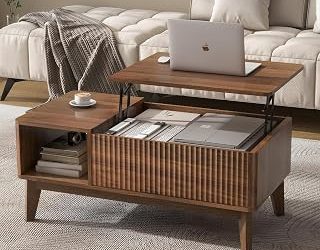
At 16.9 inches closed, this sits squarely in the neutral-reach band for most standard sofas, and the 39.4 by 19.7 inch footprint keeps the far edge within a comfortable arm sweep. The adjustable interior shelf is the practical touch — it lets you tune storage depth so the lift top isn’t fighting stacked contents on the way up.
Oval Lift Top Coffee Table, 47.2″ Walnut
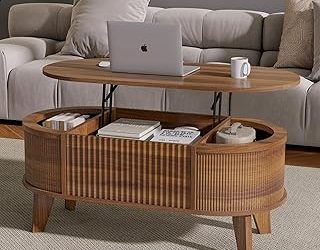
The oval profile removes the corner that shins usually find, which matters in tighter rooms where you can’t buy your way to full clearance. Its 180-degree sliding tambour door is also gentler on the frame than a swing door, since nothing loads the hinge line every time you open it.
SEDETA 31.5″ Lift Top Coffee Table, Grey
A genuinely compact square for apartments and loveseat pairings, with a lift top that brings a work surface close enough to keep your elbows tucked rather than splayed. The deep compartment and adjustable shelves earn their space, though the smaller top means one laptop and one mug, not both plus paperwork.
VASAGLE Lift Top Coffee Table ULCT202B01
The 19.3 to 24.4 inch travel is the most useful range in this group: closed, it suits taller sofa cushions; open, it reaches the elbow-height zone that stops laptop use from becoming a neck problem. The metal-accented rustic build also gives the frame more lateral stiffness than an all-panel carcass.
Itaar 39.4″ Lift Top Coffee Table
Storage is the standout here — a large hidden compartment plus two drawers and adjustable shelves — which keeps weight distributed low and off the lifting panel. Two-tone vintage white and walnut hides scuffs better than uniform dark finishes, a small but real durability advantage in high-traffic rooms.
Frequently Asked Questions
What is the ideal coffee table height?
Between 16 and 18 inches suits the majority of sofas, because it lands level with or just under a compressed seat cushion. Measure your own cushion first; deep-seated modern sofas sometimes call for the upper end of that range.
Should a coffee table be lower than the sofa?
Slightly lower is the safer error. A table an inch or two below cushion height keeps your reach downward and relaxed, while a table above cushion height forces the shoulder to abduct on every grab.
Are lift-top tables sturdy enough for daily work?
Good ones are, provided the mechanism uses dual struts or a steel scissor frame and the manufacturer publishes a load rating for the raised position. Avoid resting your forearms heavily on the extended edge, which is where leverage is highest.
How much space do I need between the sofa and table?
Plan on 16 to 18 inches. That’s enough to pass through without turning sideways and enough to stand up without your calves meeting an edge.
Final Thoughts
If you want one table to serve both lounging and laptop work, the VASAGLE ULCT202B01 has the most usable height range and a frame stiff enough to justify it. For a classic seated height with clean geometry, the WLIVE Brown lift top hits 16.9 inches and stays there reliably, while the 47.2″ Oval Walnut is the pick for tight floor plans where a rounded edge and sliding tambour door do more for daily comfort than extra square inches ever will.