Key takeaways
- Webbing material and stretch: Polyester webbing holds its length under sustained load; nylon can elongate 5 to 10 percent, which quietly ruins your hang angle over an afternoon. If a listing says “no-stretch,” it almost always means polyester.
- Loop count and spacing: More loops means finer adjustment. Sets with 30 to 40 loops let you tune sag in roughly 3-inch increments; a 7-loop strap forces you to compromise or move the anchor point.
- Width at the tree: At least 3/4 inch of webbing distributes pressure across the cambium instead of cutting into it. Wider is better for bark health and reduces the strap’s own edge-fraying.
- Verified load capacity: Look for a per-strap static rating with a clear margin over your body weight — 500 lb per strap is a sensible floor, and 1,000 lb or more covers two-person lounging and dynamic bounce.
- Length versus pack size: Ten feet per strap handles most trees. Twenty-foot straps solve wide gaps and thick trunks but add bulk, so match length to where you actually hang.
What's inside
Most hammock discomfort gets blamed on the hammock. In practice, the suspension is usually the culprit. Nylon webbing that creeps a few inches under load drops your seated hip below the ideal line, tightens the fabric across your shoulders, and turns a 30-degree hang into a taco. Add loops spaced too far apart to fine-tune the angle, and you end up re-rigging three times before you settle — which is how straps develop abrasion damage at the tree contact point long before their rated life is up.
This guide looks at hammock straps the way a durability tester would: webbing material and stretch behavior, loop spacing resolution, stitch construction at the load-bearing bar tacks, hardware gate strength, and how gently the strap treats bark over repeated seasons. Six popular 2026 kits are compared below, spanning compact 6.5-foot travel sets to 20-foot spans for awkward tree spacing.
As an Amazon Associate we earn from qualifying purchases.


How to Choose a Hammock Strap (2026)
- Webbing material and stretch: Polyester webbing holds its length under sustained load; nylon can elongate 5 to 10 percent, which quietly ruins your hang angle over an afternoon. If a listing says “no-stretch,” it almost always means polyester.
- Loop count and spacing: More loops means finer adjustment. Sets with 30 to 40 loops let you tune sag in roughly 3-inch increments; a 7-loop strap forces you to compromise or move the anchor point.
- Width at the tree: At least 3/4 inch of webbing distributes pressure across the cambium instead of cutting into it. Wider is better for bark health and reduces the strap’s own edge-fraying.
- Verified load capacity: Look for a per-strap static rating with a clear margin over your body weight — 500 lb per strap is a sensible floor, and 1,000 lb or more covers two-person lounging and dynamic bounce.
- Length versus pack size: Ten feet per strap handles most trees. Twenty-foot straps solve wide gaps and thick trunks but add bulk, so match length to where you actually hang.
The Best Hammock Straps (2026) Reviewed
Foxelli XL Hammock Straps
The 20-foot length and 40-plus loops give you the widest tuning range here, which matters when trees are 18 feet apart or the trunks are wide enough to eat several feet of webbing. Low-stretch construction and a 2,000 lb stated capacity mean the hang angle you set at noon is still there at dusk — the closest thing to a set-and-forget suspension on this list.
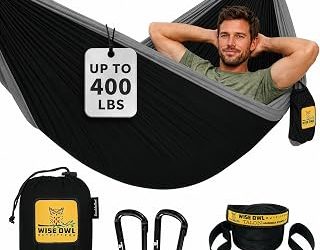
Wise Owl Outfitters Hammock Straps
A well-balanced 10-foot kit with 38 loops, carabiners, and hooks, built with the tidy bar-tack stitching that holds up to repeated cycling. The spacing resolution is good enough to dial in a proper 30-degree sag without fiddling, and the packed bulk stays reasonable for camping.
MalloMe Hammock Straps for Trees
The most versatile option if your straps do double duty on swings, punching bags, or porch chairs — the multi-purpose hanging kit accounts for anchoring to a single branch as well as spanning two trunks. Adjustment is straightforward, and the webbing width keeps bark pressure sensible on smaller ornamental trees.
SZHLUX Hammock Straps
Two 10-foot straps, 38 loops, and two carabiners at a value-first price point. It covers the fundamentals competently, and the dense loop spacing is genuinely useful; just inspect the stitching periodically if you hang daily rather than seasonally.
Heavy Duty Long Extender Hammock Webbing Kit
With 32 loops per 10-foot strap and 1,000 lb per side, this kit leans toward extender duty — pairing with an existing suspension to bridge a wider gap. Fewer loops than the leaders, but the increments are still fine enough for practical adjustment.
Frequently Asked Questions
What hang angle should I aim for?
Roughly 30 degrees from horizontal at each end. Steeper straps feel like a hard cocoon and squeeze your shoulders; shallower ones raise anchor stress and leave you sagging into a banana shape.
Do hammock straps damage trees?
Webbing at least 3/4 inch wide, wrapped directly around a healthy trunk at least 8 inches in diameter, spreads pressure enough to avoid harm. Rope and thin cord are what girdle bark, which is why most parks require flat straps.
How often should I replace them?
Inspect at the tree contact zone and the sewn loops each season. Retire the set when you see fuzzed edges, cut fibers, broken stitching, or noticeable stiffness and fading from UV exposure — typically three to five seasons of regular use.
Are the included carabiners strong enough?
Included aluminum carabiners are usually adequate for single-person hanging, but they are the least durable part of any kit. If you hang two people or load the system frequently, upgrade to a rated wiregate or steel carabiner.
Final Thoughts
For the best combination of stretch resistance, adjustment range, and headroom on capacity, the Foxelli XL straps are the pick for anyone who wants a suspension they never have to re-rig. Wise Owl Outfitters is the balanced everyday choice at a more portable 10 feet, while MalloMe earns its spot for households that want one kit to serve hammocks, swings, and everything else on the porch.