Key takeaways
- Interior volume, not just length: A net that matches your hammock’s length can still collapse onto your face. Look for a ridgeline or spreader system that holds mesh 8–12 inches clear of your chest, and treat listed width as usable only if the net tapers gently rather than sharply at the ends.
- Mesh count and thread gauge: Anything under roughly 1,000 holes per square inch will let no-see-ums through. Fine mesh also snags more easily, so check whether the fabric is polyester (better abrasion resistance, holds shape) or the lighter nylon variants that pack smaller but fray faster at contact points.
- Zipper placement and travel: The single most common ergonomic complaint. Dual-sided or diagonal zippers let you exit toward whichever side your feet are pointing, which matters at 3 a.m. Verify the pull sits within arm’s reach when you’re lying down, not stretched behind your head.
- Failure points under load: Inspect reinforcement at the gathered ends and along any suspension sleeve. Bar-tacked corners and bound seams outlast simple overlocked edges by a wide margin, especially where wind flutter causes repeated flexing.
- Integrated versus retrofit: All-in-one systems eliminate gaps and reduce setup time but tie you to that hammock’s weight rating and fabric. A separate net keeps your existing hammock in play and is cheaper to replace when the mesh eventually gives out.
What's inside
A hammock stops being restful the moment you have to choose between breathing air and being bitten. Most shoppers discover this the hard way: they buy netting sized for a catalog photo, string it up, and then spend the night with mesh pressed against their nose, one arm pinned, and a zipper that only opens from the side they aren’t lying on. The failure is rarely the mesh itself. It’s the geometry — how much headroom the net holds above your face, whether the entry seam lands near your hip or somewhere behind your shoulder, and how the whole assembly behaves once your body weight pulls the hammock into a curve.
This guide evaluates hammock bug nets the way a durability tester would: mesh density and hole count, zipper hardware and its stress points, stitch quality at load-bearing corners, and the ergonomics of getting in and out without contorting your spine. I’ve separated standalone nets that retrofit gear you already own from integrated hammock-and-net systems, since the two solve different problems and wear out in different places. Below are the models worth your money in 2026, followed by the criteria I’d apply to anything not on this list.
As an Amazon Associate we earn from qualifying purchases.


How to Choose a/an Hammock Bug Nets (2026)
- Interior volume, not just length: A net that matches your hammock’s length can still collapse onto your face. Look for a ridgeline or spreader system that holds mesh 8–12 inches clear of your chest, and treat listed width as usable only if the net tapers gently rather than sharply at the ends.
- Mesh count and thread gauge: Anything under roughly 1,000 holes per square inch will let no-see-ums through. Fine mesh also snags more easily, so check whether the fabric is polyester (better abrasion resistance, holds shape) or the lighter nylon variants that pack smaller but fray faster at contact points.
- Zipper placement and travel: The single most common ergonomic complaint. Dual-sided or diagonal zippers let you exit toward whichever side your feet are pointing, which matters at 3 a.m. Verify the pull sits within arm’s reach when you’re lying down, not stretched behind your head.
- Failure points under load: Inspect reinforcement at the gathered ends and along any suspension sleeve. Bar-tacked corners and bound seams outlast simple overlocked edges by a wide margin, especially where wind flutter causes repeated flexing.
- Integrated versus retrofit: All-in-one systems eliminate gaps and reduce setup time but tie you to that hammock’s weight rating and fabric. A separate net keeps your existing hammock in play and is cheaper to replace when the mesh eventually gives out.
The Best Hammock Bug Nets (2026)s Reviewed
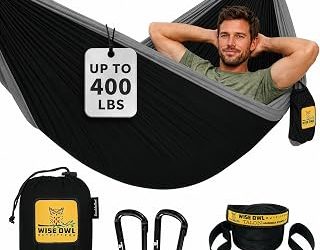
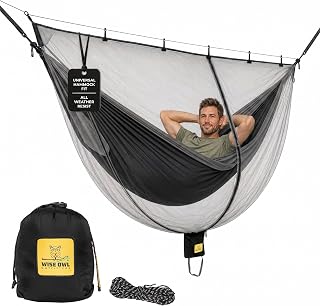
Wise Owl Outfitters Hammock Bug Net
A well-executed retrofit option with tightly woven netting and a suspension setup that keeps the canopy usefully lofted rather than draped. The polyester construction resists abrasion better than ultralight competitors, making it the sensible pick if you pack and unpack frequently.
XL No-See-Ums Net with Dual Diagonal Zipper
At 11 by 4.6 feet, this one buys you genuine shoulder and elbow room, and the dual diagonal zippers are the standout ergonomic feature — you can exit from either side without rolling across the seam. The fine polyester mesh handles the smallest biting insects, which many cheaper nets don’t.
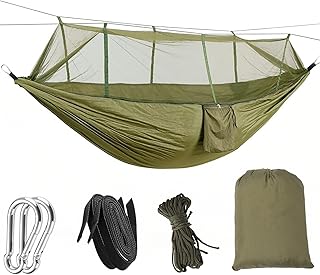
Camping Hammock with Mosquito Net and Rain Fly
A complete shelter package for buyers who’d rather not assemble a system from parts. Coverage is reliable and setup is quick, though the fly adds bulk and the fixed net geometry gives you less latitude to tune headroom than a standalone canopy would.
Onewind 11ft Ultralight Hammock with Bug Net
The most refined build here: 40D hexagon ripstop nylon, an integrated no-see-um panel, and a factory ridgeline that produces a genuinely flat lay. The 64-inch single-wide panel is where the ergonomics pay off, easing the shoulder squeeze that plagues narrower backpacking hammocks.
500 lb Camping Hammock with Net and Tree Straps
Built for load rather than gram-counting, with a 500-pound rating and a double/single configuration that suits larger sleepers or occasional two-person lounging. Included tree straps make it turnkey, and the heavier fabric shrugs off rough bark and gritty campsites.
Frequently Asked Questions
Do I need a separate net if my hammock has one built in?
No, provided the integrated net has sufficient mesh density and adequate loft. Add a standalone net only if the built-in version sags onto your face or the mesh is too coarse for no-see-ums.
How do I stop the mesh from touching my face?
Run a structural ridgeline above the hammock and clip the net to it. A tensioned ridgeline also stabilizes your hammock’s sag, which improves both comfort and net geometry.
Will a bug net make the hammock hotter?
Fine mesh reduces airflow slightly, though the effect is minor compared to a rain fly. Keeping the canopy lofted rather than collapsed preserves most of the ventilation.
What usually fails first?
Zippers and the seams at gathered ends. Keep grit off the zipper track, stuff the net rather than tightly folding it along the same creases, and store it dry to slow UV and mildew damage.
Final Thoughts
For an integrated system with the best flat lay and shoulder room, the Onewind 11ft ultralight hammock is the one I’d trust over multiple seasons. If you already own a hammock you like, the XL dual-diagonal-zipper net delivers the strongest ergonomics for entry and exit, while the Wise Owl Outfitters net is the more durable everyday choice for frequent packers.