Key takeaways
- Covers five seasons in a single volume, reducing long-term cost and shelf clutter.
- Owner feedback highlights the logical layout for tracking year-over-year planting decisions.
- Fixed format means you cannot rearrange or add pages as your garden grows more complex.
A garden journal solves a deceptively simple problem: remembering what you planted, when you watered, what worked, and what did not. Every season brings small decisions that compound — whether a bed produced enough to justify its space, whether a fertilizer helped or hurt, whether your budget for seedlings left room for a second round of planting in late summer. Without a reliable system for capturing those details, gardeners repeat the same mistakes year after year and lose the specific, hard-won knowledge that separates a seasoned plot from an average one.
The best garden journal balances structure with flexibility. Too rigid and you abandon it by week three; too open and it becomes a blank notebook that never gets filled. Page count, binding type, whether sections exist for planting dates, harvest weights, or expense tracking, and how portable the format is during actual garden work all determine whether a journal survives a full season or ends up in a drawer. Owner feedback across these eight models reveals consistent patterns about which design choices translate into daily use and which create friction.
Our top picks



As an Amazon Associate we earn from qualifying purchases at no extra cost to you.
Quick Picks
| Product | Best for | Price |
|---|---|---|
| Legend Garden Journal, Forest Green | Multi-season tracking in one book | $13.99 |
| Garden Planner & Log Book | Structured weekly routines and budgeting | $12.99 |
| The Gardener’s Logbook | Minimalist entry-level use | $10.19 |
| Garden Journal Planner & Log Book | Harvest and plant data logging | $9.99 |
| Legend Garden Journal, Cypress | Same 5-year format, different colorway | $13.99 |
| The Garden Journal: A 5-Year Record | Long-term bed-by-bed memory | $15.95 |
| Garden Journal 3-Ring Binder | Seed packet storage and custom layouts | $29.99 |
| My Gardening Journal | Weekly planning cadence | $15.3 |
How We Picked
We evaluated these eight models against four criteria that owner reviews consistently flag as decisive: whether the journal can be carried into the garden without damaging pages or losing entries to weather, whether its internal structure matches how a gardener actually thinks during the season (weekly task cycles versus annual planting maps versus harvest tallies), how many seasons a single volume realistically covers before it fills up, and whether the price reflects genuine long-term value or a premium for aesthetics alone. Binding type and page layout matter more than cover design, so we weighted structural features over color options.
The 8 Best Garden Journal in 2026
Legend Garden Journal, 5-Year Gardening Planner & Log Book, Forest Green
This model targets gardeners who want one book to span multiple growing seasons without re-buying annually. The five-year structure lets you log each planting cycle in the same physical volume, making it easy to compare yields and timing across years. The Forest Green cover is a colorway choice rather than a functional difference from the Cypress version.
- Covers five seasons in a single volume, reducing long-term cost and shelf clutter.
- Owner feedback highlights the logical layout for tracking year-over-year planting decisions.
- Fixed format means you cannot rearrange or add pages as your garden grows more complex.
Skip this if you prefer a modular system or if your garden changes layout dramatically each year, making rigid page assignments counterproductive.
Garden Planner – Garden Journal Planner and Log Book with Monthly & Weekly Checklists
Built for gardeners who operate on a task-cycle mindset rather than a planting-calendar mindset. Monthly and weekly checklists support routine maintenance, budget tracking, and harvest recording in the same volume. The structured prompts help people who struggle with blank-page journaling.
- Checklist format reduces decision fatigue during busy spring weeks.
- Integrated budget section supports realistic expense tracking alongside plant care.
- The weekly cadence can feel constraining for gardeners who prefer seasonal or monthly entry rhythms.
Skip this if your garden is large or complex enough that weekly checklists become repetitive rather than helpful.
The Gardener’s Logbook
A stripped-down option at the lowest mid-range price. It serves gardeners who want a dedicated logbook without the overhead of elaborate layouts, checklists, or multi-year structures. Simplicity is the main selling point here.
- Lowest entry price among dedicated garden journals, making it easy to try journaling without commitment.
- Minimal structure suits gardeners who already have their own recording habits and only need a place to write them down.
- Lacks dedicated sections for harvest weights, expense tracking, or planting maps that more structured competitors provide.
Skip this if you want guided prompts or organized sections to keep your data consistent across seasons.
Garden Journal Planner and Log Book, Plant & Harvest Tracker for Gardeners
The most affordable option on this list at $9.99, focused specifically on plant and harvest data. It suits growers who care most about recording what they planted and what they collected, with less emphasis on routine maintenance logs or budgeting.
- Lowest price point makes it accessible for casual or experimental gardeners testing whether journaling helps.
- Harvest-focused layout supports yield tracking, useful for gardeners evaluating which crops justify bed space.
- Owners note the simpler construction and thinner pages compared to higher-priced alternatives.
Skip this if you need a durable field journal or want multi-year tracking built into a single volume.
Legend Garden Journal, 5-Year Gardening Planner & Log Book, Cypress
Functionally identical to the Forest Green version, differentiated only by the Cypress colorway. If the multi-year format and internal structure suit your needs, this is the same product in a different aesthetic finish. Both are priced at $13.99.
- Same proven five-year structure and year-over-year comparison layout as the Forest Green edition.
- Offers a distinct visual choice for gardeners who prefer earthier, muted tones over darker greens.
- Color variation does not add functional value; the choice is purely cosmetic.
Skip this if you are deciding between the two Legend colors and do not care about cover appearance; they are the same journal.
The Garden Journal: A 5-year record of your home garden
Positioned at the higher end of single-book journals at $15.95, this five-year record emphasizes long-term bed-by-bed memory. It is designed for gardeners who think spatially and want to track how each bed evolves over half a decade.
- Five-year structure supports detailed spatial tracking that shorter-term formats miss.
- Owner reviews praise the thoroughness of prompts for soil amendments, crop rotation, and bed history.
- Higher price than comparable five-year journals without a clear structural advantage over the Legend options.
Skip this if budget is your primary concern or if you prefer task-based organization over bed-based organization.
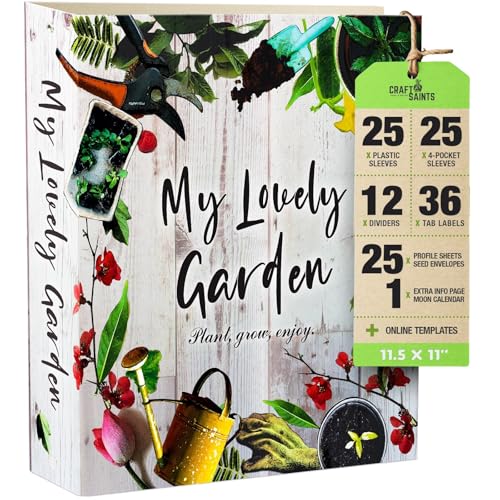
Garden Journal, 3 Ring Full Page 8.5×11″ Binder, Seed Packet Organizer Kit
The premium pick and the most versatile format here. The three-ring binder design lets you insert, remove, and rearrange pages freely, while the full 8.5×11 size accommodates seed packets, printouts, and detailed sketches. At $29.99 it costs roughly double the next-highest option but offers customization no bound journal can match.
- Fully modular: add or remove pages as your garden plan evolves mid-season.
- Integrated seed packet storage keeps catalogs and labels alongside your notes in one system.
- Large format is impractical to carry into the garden; it works best as a stationary planning tool.
Skip this if you need something portable for logging observations at the bed side rather than planning at a desk.
My Gardening Journal: A Weekly Garden Planner, Tracker, and Logbook
At $15.3, this model commits fully to a weekly cadence. Each spread is designed around a single week, making it ideal for gardeners whose attention naturally resets on a seven-day rhythm. The tracker and logbook elements complement the planner sections without duplicating them.
- Weekly structure aligns with real garden maintenance cycles like watering rotations and pest inspections.
- Combines planning, tracking, and logging in one format, reducing the need for a separate notebook.
- Owners with short growing seasons report unused weekly pages and a sense of forced structure in shoulder seasons.
Skip this if you live in a mild climate where the growing season runs year-round and weekly granularity feels excessive.
Buying Guide
Format: Bound vs. Binder vs. Field Size
Decide where the journal will live. A bound book you can stuff into a basket and carry to the shed serves daily logging. A three-ring binder works as a central planning hub at a kitchen table. Large-format journals demand desk space but allow sketches and inserts. Owners of the 3-ring model consistently note that it is not a garden-side tool; it is a command center. If you want to record observations while kneeling in soil, a smaller bound journal beats any binder.
Time Span: Weekly, Seasonal, or Multi-Year
A journal organized by weeks suits active task management but creates pressure to fill pages during slow months. Multi-year formats reward patience and help you spot patterns across three to five seasons, which is where the most valuable garden insights live. Seasonal journals hit a middle ground. Match the time horizon to your actual attention span; an empty weekly spread in November feels like failure even when it is simply the correct time to rest.
Content Sections: What You Actually Need to Record
Not every gardener needs harvest weights alongside budget lines alongside pest logs. Identify the three or four data points that would actually change your decisions next season, then select the journal whose built-in sections cover them without forcing you into columns you ignore. Over-structured journals with prompts you skip create a guilt loop that drives abandonment. The best garden journal is the one whose structure matches your curiosity, not the one with the most features on paper.
Our Verdict
The top pick is the Legend Garden Journal, 5-Year Gardening Planner & Log Book at $13.99. It delivers multi-year tracking in a portable bound format at a price that makes each season cost under $3, and the structured prompts support year-over-year comparison without the over-engineering of a binder. The budget pick is the Garden Journal Planner and Log Book, Plant & Harvest Tracker at $9.99, which covers the essential recording needs for gardeners who care most about plant and harvest data. The 3-Ring Binder wins outright if your primary need is a centralized planning hub with seed packet storage and the flexibility to redesign your system mid-season.
FAQ
How many years should a garden journal cover?
Three to five years is the practical sweet spot for spotting patterns in crop rotation, soil amendments, and seasonal timing. Journals shorter than that force you to maintain multiple books and makes long-term comparison harder; journals claiming to cover more than five years often run out of usable pages before the stated timeframe.
Is a physical journal better than a digital app?
Physical journals win in the garden because soil, moisture, and gloves make phone screens impractical. Digital tools handle data aggregation and photos better but rarely get filled in during actual work. Many gardeners use a hybrid: a cheap physical logbook for in-the-moment notes and a digital sheet for end-of-season analysis.
What should I record if I only have time for one entry type?
Record what you planted and what you harvested, with dates and locations. That single pairing — input and output per bed per season — drives the most useful decisions about crop selection, spacing, and rotation. Expense and maintenance logs are valuable but secondary to this core data.
How do I keep a journal going past the first busy month?
Anchor journaling to an existing habit rather than creating a new one. Write entries at the end of a task you already do: after watering, after a harvest walk, or while checking the weather each morning. Journals with built-in prompts and checklists support this better than blank pages, which is why structured formats see more consistent use across owner reviews.