Key takeaways
- Feather material and memory: Rigid polycarbonate feathers deliver crisp pressure but can crack or take a permanent bend after heavy use. Elastomer blends such as EVA and reinforced nylon flex thousands of cycles and spring back, which keeps pressure consistent in year three, not just week one.
- Clamp ergonomics: You will lock and release this thing dozens of times per session. A single large knob or cam lever beats two small hex-driven set screws every time, particularly if you have arthritis, cold hands, or gloves on.
- Mounting versatility: Check that the bar fits your saw’s miter slot without slop, and confirm whether the same board mounts to a router fence or band saw T-track. One accessory serving three machines saves both money and bench clutter.
- Anti-kickback bite: Look for feather geometry or a friction surface engineered to resist rearward travel. A board that grips in reverse is a safety device; one that merely applies side pressure is only an alignment aid.
- Marring and vibration: Soft, non-marring contact surfaces protect prefinished plywood and hardwood faces, and they dampen the chatter that leaves faint scallop marks on the cut edge.
What's inside
Ask anyone who feeds sheet goods or narrow rips across a table saw all afternoon: the fatigue rarely shows up in your arms first. It shows up in your wrists, your lower back, and the small stabilizing muscles that keep a workpiece pinned to the fence while your dominant hand pushes. A featherboard takes over that holding job, and the moment it does, your posture changes. You stand squarer to the machine, your hands stay clear of the blade path, and the cut quality improves because the stock stops drifting. The problem is that most shoppers buy on price, discover the plastic feathers take a set after a season, and end up back where they started.
This guide looks at featherboards through two lenses that matter over years rather than weekends: how the clamping mechanism behaves under a gloved or tired hand, and how the feathers themselves hold up to repeated deflection, heat, and dust. I have weighted models that adjust without tools, resist compression fatigue, and mount securely in both miter slots and T-track fences. Below you will find current picks, followed by a buying framework and answers to the questions that come up most often in the shop.
As an Amazon Associate we earn from qualifying purchases.



How to Choose a/an Featherboard For Table Saw (2026)
- Feather material and memory: Rigid polycarbonate feathers deliver crisp pressure but can crack or take a permanent bend after heavy use. Elastomer blends such as EVA and reinforced nylon flex thousands of cycles and spring back, which keeps pressure consistent in year three, not just week one.
- Clamp ergonomics: You will lock and release this thing dozens of times per session. A single large knob or cam lever beats two small hex-driven set screws every time, particularly if you have arthritis, cold hands, or gloves on.
- Mounting versatility: Check that the bar fits your saw’s miter slot without slop, and confirm whether the same board mounts to a router fence or band saw T-track. One accessory serving three machines saves both money and bench clutter.
- Anti-kickback bite: Look for feather geometry or a friction surface engineered to resist rearward travel. A board that grips in reverse is a safety device; one that merely applies side pressure is only an alignment aid.
- Marring and vibration: Soft, non-marring contact surfaces protect prefinished plywood and hardwood faces, and they dampen the chatter that leaves faint scallop marks on the cut edge.
The Best Featherboard For Table Saw (2026)s Reviewed
BOW Products EVA Featherboard
The EVA feathers are the standout here: they compress and rebound without fatiguing, and the claimed fivefold kickback resistance comes from real grip rather than sheer stiffness. The AnchorPRO miter bar tightens with a thumb turn and stays put, which is exactly what you want when your hands are already busy.
Hedgehog Spiral Safety Featherboard
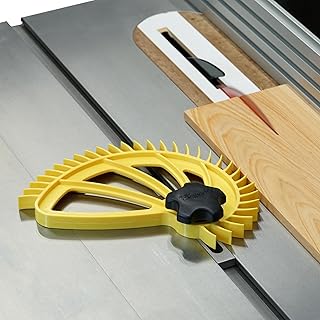
The spiral fingers apply pressure at a slight forward angle, so the workpiece is nudged toward the fence and resisted on any rearward slip. DuPont nylon holds its shape well over time, and the one-knob setup is the friendliest adjustment in this group for anyone with limited hand strength.
POWERTEC Universal Tandem Featherboards
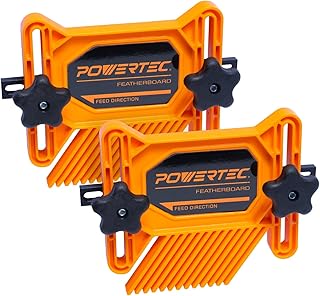
A two-pack with T-track hardware included, these give you paired pressure points above and beside the cut for narrow rips where a single board tends to let stock wander. Build quality is solid for the money, though the rigid feathers demand a slightly gentler hand than elastomer designs.
BOW Products FencePRO FP4
Designed for T-track fences and sold in pairs, the FP4 stacks so you can build vertical hold-down and lateral pressure at the same station. The vibration dampening is genuinely noticeable on thin stock, and tool-free mounting means repositioning between cuts costs seconds, not minutes.
Magswitch Table Featherboard
Switchable magnets let you place this anywhere on a cast-iron top, including spots no miter slot can reach, which is a real advantage for odd-shaped or oversized panels. Setup is fast and repeatable, though it does require a ferrous table surface to work at all.
Frequently Asked Questions
Should a featherboard sit before or after the blade?
Always ahead of the blade, contacting the stock before it reaches the teeth. Pressure applied beside or after the cut pinches the offcut against the blade and invites kickback.
How much pressure is correct?
Enough that the feathers deflect visibly and the workpiece cannot be pulled backward by hand, but not so much that feeding requires effort. Overloading the feathers accelerates material fatigue and can burn the cut.
Do I still need a push stick?
Yes. A featherboard controls the workpiece; a push stick or push block controls your hands. They solve different problems and belong on the saw together.
Will magnetic models work on my saw?
Only if the tabletop is cast iron or steel. Aluminum tops and phenolic router tables need a slot-mounted or T-track model instead.
Final Thoughts
For most shops, the BOW Products EVA Featherboard is the best long-term buy thanks to feathers that resist compression fatigue and a miter bar you can set without reaching for a wrench. The Hedgehog Spiral is the pick if effortless one-knob adjustment matters most to your hands, while the Magswitch Table Featherboard earns its place for the awkward setups where no slot is within reach.