Key takeaways
- Measure the throat, not just the mouth: Record width, height, and depth at both the front opening and roughly eight inches back. Angled firebox walls narrow fast, and a unit that clears the front lip can still bind at the rear. Leave at least an inch of tolerance on each side for cord routing and airflow.
- Put the controls where your hands actually go: Panels mounted low behind glass force a full kneel every time you change settings. Look for top-edge or front-lip controls as the primary interface, with the remote as backup rather than the only realistic option. Larger, tactile buttons age better than flush membrane pads.
- Judge the blower, not the wattage: Nearly every insert on the market delivers 750W and 1500W stages, so the differentiator is how quietly and evenly the fan moves that heat. A sleeved or ball-bearing motor with a broad outlet grille stays civil for years; cheap sleeve bearings develop a whine by the second season.
- Prefer serviceable flame assemblies: LED strips, rotisserie motors, and log sets that can be reached without cutting sealant will outlast sealed units. Ask whether the log set lifts out and whether replacement parts are catalogued.
- Check the surround before you check the price: Trim kits, mesh screens, and integrated frames determine whether the finished install reads intentional or improvised. Powder-coated steel resists hearth abrasion far better than painted MDF or thin plastic trim.
What's inside
A masonry firebox that no longer burns wood is one of the more frustrating pieces of real estate in a house. It draws cold air, collects soot dust, and resists every attempt to make it useful again. Dropping in an electric insert solves the problem on paper, but the practical details are what trip buyers up: the opening tapers toward the back, the hearth sits low enough that adjusting anything means kneeling on brick, and the nearest outlet is often on the wrong wall entirely. Plenty of shoppers order by width alone, then discover the unit sits proud of the surround or that the control panel is buried behind a fixed glass front.
This guide looks at inserts through the lens I use professionally: how the thing behaves after two winters of daily handling, not just how it photographs on day one. That means honest talk about reach distance and control placement, blower noise at head height, whether the flame assembly uses serviceable components, and how the housing holds up when it lives in a slightly gritty, slightly damp masonry cavity. The picks below span 23 to 36 inches, cover both trim-out and freestanding log-set formats, and all run on standard 120V household current.
As an Amazon Associate we earn from qualifying purchases.


🛒 Best Price Today on Amazon
Prime members get fast, free shipping on everything above, plus member-only deals. New members get a 30-day free trial — cancel anytime.
How to Choose a/an Electric Fireplace Insert For Existing Fireplace (2026)
- Measure the throat, not just the mouth: Record width, height, and depth at both the front opening and roughly eight inches back. Angled firebox walls narrow fast, and a unit that clears the front lip can still bind at the rear. Leave at least an inch of tolerance on each side for cord routing and airflow.
- Put the controls where your hands actually go: Panels mounted low behind glass force a full kneel every time you change settings. Look for top-edge or front-lip controls as the primary interface, with the remote as backup rather than the only realistic option. Larger, tactile buttons age better than flush membrane pads.
- Judge the blower, not the wattage: Nearly every insert on the market delivers 750W and 1500W stages, so the differentiator is how quietly and evenly the fan moves that heat. A sleeved or ball-bearing motor with a broad outlet grille stays civil for years; cheap sleeve bearings develop a whine by the second season.
- Prefer serviceable flame assemblies: LED strips, rotisserie motors, and log sets that can be reached without cutting sealant will outlast sealed units. Ask whether the log set lifts out and whether replacement parts are catalogued.
- Check the surround before you check the price: Trim kits, mesh screens, and integrated frames determine whether the finished install reads intentional or improvised. Powder-coated steel resists hearth abrasion far better than painted MDF or thin plastic trim.
The Best Electric Fireplace Insert For Existing Fireplace (2026)s Reviewed
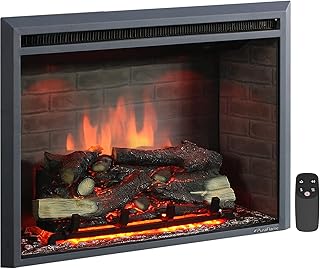
PuraFlame Western 33″ Insert
The Western is the one I recommend most often for standard 33-inch masonry openings, largely because the recessed control strip sits at the top of the frame where a standing adult can reach it without stooping. Build quality is genuinely solid — heavy-gauge steel housing, a firebrick-look interior panel that resists scuffing, and a crackling sound module you can mute independently of the flame.
PuraFlame Klaus 33″ Insert
Mechanically close to the Western but finished with a hinged glass door and removable mesh screen, which makes it the better choice when you want the insert to read as a traditional firebox. The door adds one more moving part to maintain, though the hinges are substantial and the screen lifts out cleanly for dusting.
23″ Insert with Four Flame Brightness Levels
A sensible pick for narrow or bungalow-era fireboxes where a 33-inch unit simply won’t fit. The four-stage brightness control and 8-hour timer give it more day-to-day flexibility than its footprint suggests, and the low-noise fan keeps it comfortable in a small room where the hearth sits close to seating.
Valuxhome 36″ Insert
The widest option here and the right answer for oversized or double-wide openings where a smaller unit would look lost. Overheating protection is built in, the flame field spreads convincingly across the extra width, and the frame edges are cleanly finished — worth noting, since 36-inch units often show their seams.
LegendFlame EF290 23″ Log Set
A freestanding log set rather than a framed insert, so it slides into an existing firebox with no trim work and no permanent commitment. It’s the most forgiving install of the group and the easiest to pull out for cleaning, which matters more than most buyers expect in a working masonry cavity.
Frequently Asked Questions
Do I need to seal or cap the chimney first?
Yes, and it’s worth doing properly. An open flue pulls conditioned air out of the room continuously, which will undercut the heater’s performance. A top-sealing damper or an insulated chimney balloon takes an afternoon and pays for itself.
Can I plug one into an existing outlet?
Only if that outlet is on a circuit with headroom. At 1500W an insert draws roughly 12.5 amps, so it should not share a 15-amp circuit with other significant loads, and it should never run through an extension cord or power strip.
How much heat will it actually produce?
Plan on supplemental warmth for 350 to 400 square feet, not primary heating. These units are resistance heaters capped by household voltage, so any brand claiming dramatically more from 1500W is measuring optimistically.
What tends to fail first?
The blower motor and the flame-effect rotisserie motor, usually in that order, typically after several seasons of heavy use. Both are inexpensive parts, which is exactly why serviceability should factor into the purchase.
Final Thoughts
For most standard fireboxes the PuraFlame Western 33″ is the durable, ergonomically sensible default, with the Klaus 33″ earning the nod if a glass door and mesh screen better suit your surround. If your opening runs wide, the Valuxhome 36″ fills it cleanly without looking like a compromise.