Key takeaways
- Match depth to your leg length, not your ambition: Usable seat depth of 22–26 inches suits torsos over about 5’8″. If you’re shorter, a 26-inch seat will leave your lower back unsupported and your feet dangling, so plan on a firm lumbar bolster from day one rather than assuming you’ll adapt.
- Interrogate the fill, layer by layer: High-resilience foam at 1.8 lb density or better is the load-bearing core; feather-down or fiber wrap is comfort only. A cushion that’s soft fill top to bottom feels superb for three months and bottoms out by month twelve.
- Frame and suspension over surface finish: Kiln-dried hardwood with corner blocking and either sinuous steel springs or webbing straps resists the racking forces that deep seats amplify. Metal legs should bolt into a wood rail, not into engineered board.
- Know which leather you’re buying: Full-grain and top-grain develop patina and tolerate conditioning. Faux leather and polyurethane coatings resist scratches and clean easily but eventually craze at flex points, so favor models with removable, replaceable covers if you’re going synthetic.
- Check seat height and exit ergonomics: A 17–19 inch seat height keeps sit-to-stand transitions comfortable for most adults. Pair that with a back pitch of roughly 100–110 degrees; deeper seats need more recline or you’ll slouch to reach the backrest.
What's inside
Deep seat sofas sell a promise that most of them break within eighteen months. The showroom sit feels generous, the cushions swallow you, and then the foam collapses into a hammock, the leather at the front rail creases into hard ridges, and you find yourself perching on the edge because nothing back there supports your spine anymore. The failure is rarely the leather itself. It’s the geometry underneath: seat depth chosen without regard to back angle, low-density fill asked to span 24 inches unsupported, and frames that flex just enough to let seams work themselves loose.
I evaluate seating the way an ergonomist reads a chair spec sheet, then the way a service technician reads a warranty claim. This guide looks at six deep seat leather sofas through both lenses: usable seat depth versus your actual leg length, fill construction and how it ages, frame and suspension quality, and how the hide or coating holds up against pets, sunlight, and daily entry-exit cycles. Below are the models worth your money in 2026, followed by the specifications that actually predict longevity.
As an Amazon Associate we earn from qualifying purchases.


How to Choose a Deep Seat Leather Sofa (2026)
- Match depth to your leg length, not your ambition: Usable seat depth of 22–26 inches suits torsos over about 5’8″. If you’re shorter, a 26-inch seat will leave your lower back unsupported and your feet dangling, so plan on a firm lumbar bolster from day one rather than assuming you’ll adapt.
- Interrogate the fill, layer by layer: High-resilience foam at 1.8 lb density or better is the load-bearing core; feather-down or fiber wrap is comfort only. A cushion that’s soft fill top to bottom feels superb for three months and bottoms out by month twelve.
- Frame and suspension over surface finish: Kiln-dried hardwood with corner blocking and either sinuous steel springs or webbing straps resists the racking forces that deep seats amplify. Metal legs should bolt into a wood rail, not into engineered board.
- Know which leather you’re buying: Full-grain and top-grain develop patina and tolerate conditioning. Faux leather and polyurethane coatings resist scratches and clean easily but eventually craze at flex points, so favor models with removable, replaceable covers if you’re going synthetic.
- Check seat height and exit ergonomics: A 17–19 inch seat height keeps sit-to-stand transitions comfortable for most adults. Pair that with a back pitch of roughly 100–110 degrees; deeper seats need more recline or you’ll slouch to reach the backrest.
The Best Deep Seat Leather Sofa (2026)s Reviewed
80″ Full-Grain Leather Chesterfield, Caramel
This is the one I’d buy if I planned to keep a sofa for fifteen years: full-grain hide over a tufted back with feather-down comfort layers, which means the surface softens and burnishes instead of degrading. The caramel finish will shift tone unevenly near windows, so position it out of direct afternoon sun and condition it twice a year.
Garvee 81″ Mid Century Leather Sofa, Brown
Hand-tufted buttons anchor the back cushioning, which is exactly what keeps a deep seat from sagging into an unsupported void at the lumbar curve. At 81 inches it seats three without crowding, and the cognac tan version of the same frame is a smart pick if you want the identical geometry in a warmer colorway.
EASE MOOSE Oversized Modular Sectional, Brown
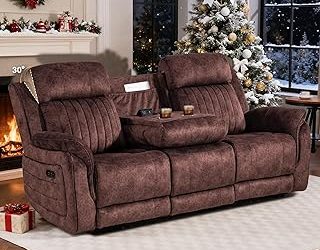
The scratch-resistant faux leather is the pragmatic choice for households with cats or large dogs, and modularity lets you redistribute wear by rotating sections annually, which is the single most effective longevity tactic on any oversized seat. Wide, deep cushions here genuinely require tall users or accent bolsters.
EASE MOOSE 100″ L-Shaped Deep Seat Sectional, Black
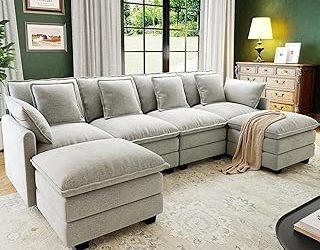
Removable covers plus a waterproof, scratch-resistant surface make this the most serviceable sofa in the group, since the component most likely to fail is also the component you can replace. The movable ottoman doubles as a leg extension that corrects the depth-to-support ratio for shorter sitters.
111.81″ 4-Seater Faux Leather Sofa, Brown
A wood frame on metal legs gives this four-seater the rigidity that long spans demand, and at nearly 112 inches it absorbs a family without anyone claiming the armrest. Measure your doorways and stair turns carefully before ordering; the footprint that makes it comfortable also makes it awkward to deliver.
Frequently Asked Questions
How deep is too deep for a deep seat sofa?
Beyond about 26 inches of usable depth, most adults can’t reach the backrest without sliding forward, which flattens the lumbar curve and loads the tailbone. If you love the look of an extra-deep seat, budget for structured back cushions rather than accepting the slouch.
Will faux leather hold up as well as genuine hide?
Not over the same time horizon. Quality faux leather resists scratches and spills better in years one through five, then tends to craze where it flexes, while top-grain and full-grain leather scuff more readily but can be conditioned and repaired almost indefinitely.
How do I stop deep cushions from sagging?
Rotate and flip cushions every month or two so compression sets evenly, and avoid always sitting in the same spot. If a cushion has already lost loft, a replacement high-resilience foam core is far cheaper than a new sofa.
Are deep seat sofas practical in small apartments?
Yes, provided you trade width for depth rather than adding both. An 80- to 81-inch three-seater with a 23-inch seat delivers the lounging depth without eating the walkway that a 110-inch sectional would consume.
Final Thoughts
For long-term ownership, the 80″ full-grain Chesterfield in caramel is the durability benchmark here, since real hide is the only surface that improves with age and can be restored rather than replaced. The Garvee 81″ mid century sofa is the best-balanced pick for typical living rooms, and if pets, kids, or spills are part of daily life, the EASE MOOSE 100″ L-shaped sectional with its removable, waterproof covers is the sofa most likely to still look right in five years.