Key takeaways
- Beam height above eye level: A light that sits at 24 inches puts glare straight into your field of view and casts long shadows across horizontal surfaces. Tripods that extend past 60 inches let you angle light downward, which is what you want for reading grain, spotting sanding scratches, and seeing into dovetail sockets.
- Diffusion over raw lumens: A 2,500-lumen panel with a frosted lens is easier on the eyes over a four-hour session than a 1,500-lumen bare-emitter spot. Look for wide LED arrays rather than single high-output chips if you’ll be working near the light for extended periods.
- Adjustable color temperature: Around 4000K reads finishes and stain color honestly; 6500K sharpens contrast for detail work and mechanical tasks. Models offering both give you a genuine functional range instead of a marketing bullet, and warmer 3000K settings are useful when the same light doubles as porch or patio lighting.
- Housing and hinge quality: Aluminum bodies shed heat better than plastic, which directly extends LED lifespan. The failure point on most work lights is the pivot joint — check whether it holds position under its own weight and whether the detent has real resistance or just friction that wears smooth.
- Battery strategy: Integrated packs (8Ah, 12000mAh) mean grab-and-go simplicity but eventual replacement of the whole unit. Platform tools like DEWALT’s 20V MAX share batteries across your drill and driver, which is the more economical path if you already own the system.
What's inside
Assembling a walnut sideboard in a basement corner, refinishing a chair on a covered porch, chasing a squeak in a bed frame at 9 p.m. — furniture work happens in exactly the places where fixed lighting fails you. A single overhead bulb throws your own shadow across the joint you’re trying to see, phone flashlights die mid-task, and clamp lamps have a habit of sliding off whatever they were gripping. The result is squinting, hunching, and glue-ups you second-guess in the morning.
This guide looks at cordless work lights through two lenses that get skipped in most comparisons: ergonomics and durability. Ergonomics covers how the light positions light relative to your eyes and hands — beam height, glare control, color temperature, how quickly you can reaim it without setting down a chisel. Durability covers what happens over three years of being knocked off a bench, stored in a cold garage, and recharged a few hundred times. Below are six options worth your attention, from tall tripod towers for whole-room fill to compact battery-platform lights for tight cabinet interiors.
As an Amazon Associate we earn from qualifying purchases.


🛒 Best Price Today on Amazon
Prime members get fast, free shipping on everything above, plus member-only deals. New members get a 30-day free trial — cancel anytime.
How to Choose a/an Cordless Work Light (2026)
- Beam height above eye level: A light that sits at 24 inches puts glare straight into your field of view and casts long shadows across horizontal surfaces. Tripods that extend past 60 inches let you angle light downward, which is what you want for reading grain, spotting sanding scratches, and seeing into dovetail sockets.
- Diffusion over raw lumens: A 2,500-lumen panel with a frosted lens is easier on the eyes over a four-hour session than a 1,500-lumen bare-emitter spot. Look for wide LED arrays rather than single high-output chips if you’ll be working near the light for extended periods.
- Adjustable color temperature: Around 4000K reads finishes and stain color honestly; 6500K sharpens contrast for detail work and mechanical tasks. Models offering both give you a genuine functional range instead of a marketing bullet, and warmer 3000K settings are useful when the same light doubles as porch or patio lighting.
- Housing and hinge quality: Aluminum bodies shed heat better than plastic, which directly extends LED lifespan. The failure point on most work lights is the pivot joint — check whether it holds position under its own weight and whether the detent has real resistance or just friction that wears smooth.
- Battery strategy: Integrated packs (8Ah, 12000mAh) mean grab-and-go simplicity but eventual replacement of the whole unit. Platform tools like DEWALT’s 20V MAX share batteries across your drill and driver, which is the more economical path if you already own the system.
The Best Cordless Work Light (2026)s Reviewed
Aluminum 67″ Rechargeable LED Work Light with Tripod
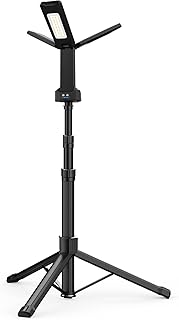
The extruded aluminum column and 67-inch extension make this the most ergonomically sound pick here for room-scale furniture work — light comes from above, shadows fall away from you, and the 500/1500/2500-lumen steps let you dial down to something comfortable for close inspection. The aluminum construction also handles thermal load better than the plastic-shelled competition, which matters if you run it at full output for hours.
GoGonova Cordless Work Light with Triple LED Lamps
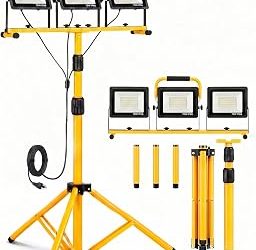
Three independently aimable lamp heads solve a problem single-panel lights can’t: lighting the top, front, and inside of a cabinet carcass at once without repositioning. The 8Ah cell and 700-lumen low setting give you genuinely long runtime for detail work, and dual color temperatures cover both finish evaluation and hardware installation.
DEWALT DCL050 20V MAX LED Work Light
A bare-tool purchase that earns its place through sheer robustness — the housing takes drops that would crack lesser lights, and the pivoting head holds its angle reliably over years. Best treated as a supplementary light for drawer boxes and undersides rather than a primary workspace source.
DEWALT DCL043 20V MAX Handheld Spotlight
At 1,500 lumens with 508 yards of throw, this is a targeting tool, not an area light. Where it shines for furniture work is raking light across a surface at a low angle to reveal high spots, tearout, and sanding marks that flat frontal lighting hides completely.
12000mAh Camping Light with 3 LED Heads
The magnetic base is the standout feature, letting you park it on any steel surface and free both hands, while the 12000mAh cell delivers real endurance at the 2,200-lumen ceiling. The tripod detaches for tabletop use, which makes it the most versatile single unit in this lineup.
Frequently Asked Questions
How many lumens do I need for furniture assembly and finishing?
For assembly, 1,500 to 2,500 lumens from an elevated position is ample. Finish inspection benefits from more, but positioning and diffusion matter more than raw output — a well-placed 2,000-lumen panel beats a poorly aimed 3,000-lumen one every time.
Are integrated batteries or platform batteries better long-term?
Platform lights like the DEWALT models outlast integrated units because you replace only the cell. Integrated-battery towers are more convenient day to day, but plan on a five-to-seven-year service life before capacity loss becomes noticeable.
Will a work light distort how I judge stain and finish color?
Yes, significantly. Cool 6500K light exaggerates blue tones and makes warm finishes look flat, so evaluate color at the 4000K setting or, ideally, confirm in daylight before committing to a topcoat.
Do these lights hold up in an unheated garage?
The LEDs are fine; lithium cells are the weak point. Cold storage reduces available capacity and repeated deep discharge in freezing conditions accelerates aging, so bring the battery indoors between projects if your shop drops below freezing.
Final Thoughts
For most furniture projects, the Aluminum 67″ tripod light is the strongest all-around choice — the height and aluminum housing address ergonomics and durability together. Choose the GoGonova triple-head model if your work involves lighting multiple surfaces of a carcass simultaneously, and add the DEWALT DCL050 as a compact companion if you already own 20V MAX batteries.